 Add to Chrome
 Add to Firefox
 Add to Edge
Structural-Semantic Reciprocal Learning for Unsupervised Visible-Infrared Person Re-Identification
Jul 16, 2026
Unsupervised visible-infrared person re-identification (USVI-ReID) is challenging due to the large modality gap and the lack of cross-modal identity annotations. Progressive association paradigms have been proposed to gradually bridge the gap, but they suffer from two critical bottlenecks: reliance on ambiguous global representations and unchecked propagation of pseudo-label noise in an open-loop manner. To address these issues, we propose Structural-Semantic Reciprocal Learning (SSRL), a framework that transforms open-loop association into a self-correcting closed-loop system. Structurally, we introduce Fine-grained Structural Decoupling (FSD) to extract discriminative body-part primitives as reliable spatial anchors, complementing ambiguous holistic silhouettes with spatially consistent structural details. Semantically, we design a Closed-loop Semantic Calibration (CSC) mechanism that reconstructs shared semantic prototypes at each epoch and feeds them back into the training loop, effectively filtering pseudo-label noise before the next clustering cycle. Through the reciprocal interaction between structural and semantic learning, SSRL achieves robust cross-modal representation. Extensive experiments demonstrate the competitive performance of SSRL against state-of-the-art USVI-ReID methods on both SYSU-MM01 and RegDB, notably surpassing several supervised counterparts on RegDB.

Adapting Transformer Language Models for Predictive Typing in Brain-Computer Interfaces
May 05, 2023
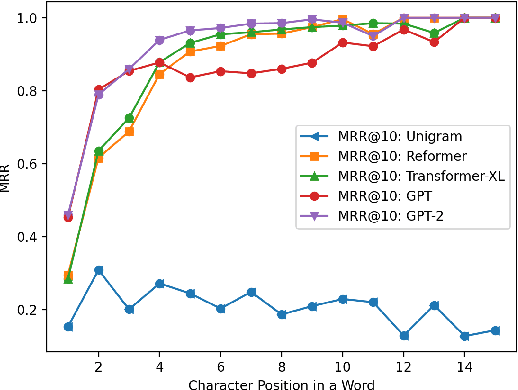

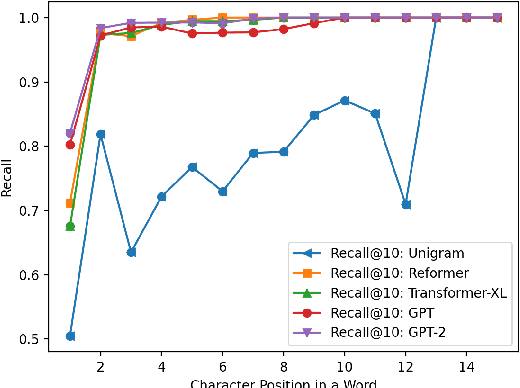
Brain-computer interfaces (BCI) are an important mode of alternative and augmentative communication for many people. Unlike keyboards, many BCI systems do not display even the 26 letters of English at one time, let alone all the symbols in more complex systems. Using language models to make character-level predictions, therefore, can greatly speed up BCI typing (Ghosh and Kristensson, 2017). While most existing BCI systems employ character n-gram models or no LM at all, this paper adapts several wordpiece-level Transformer LMs to make character predictions and evaluates them on typing tasks. GPT-2 fares best on clean text, but different LMs react differently to noisy histories. We further analyze the effect of character positions in a word and context lengths.
On the Idiosyncrasies of the Mandarin Chinese Classifier System
Apr 05, 2019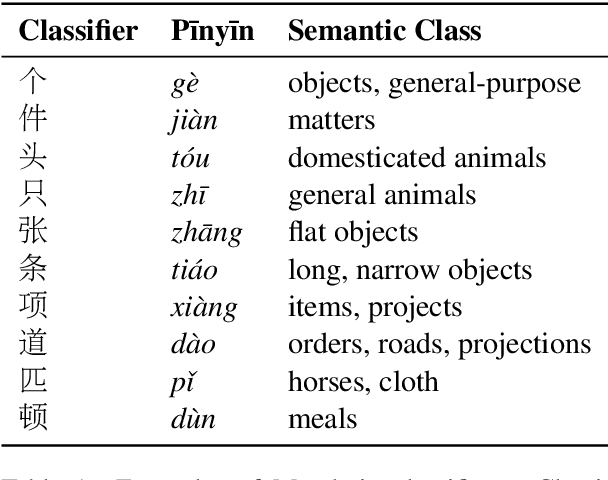
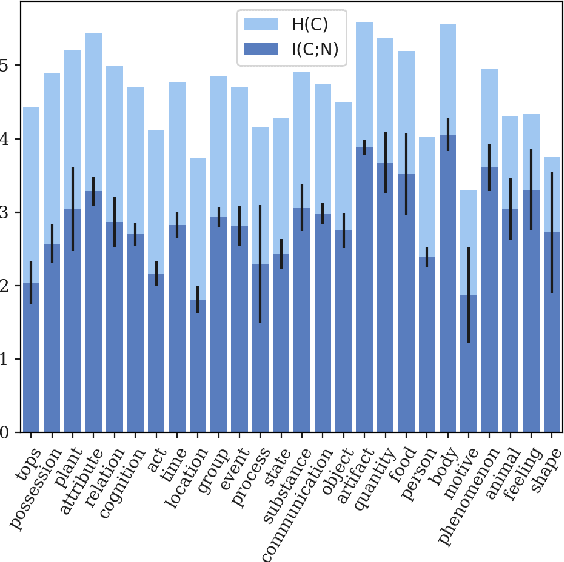
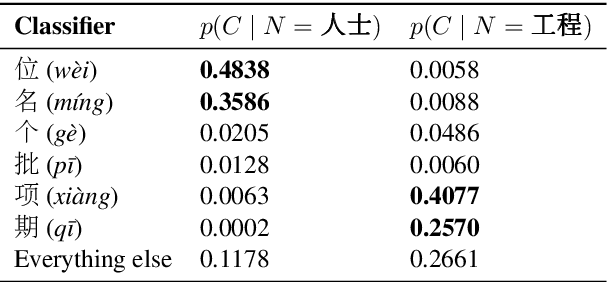
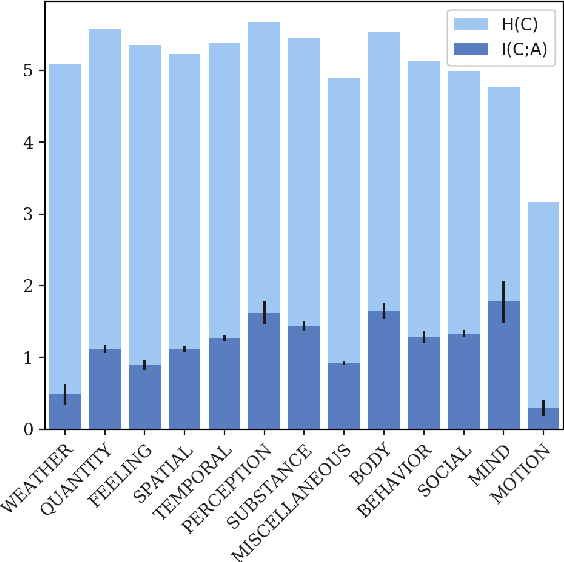
While idiosyncrasies of the Chinese classifier system have been a richly studied topic among linguists (Adams and Conklin, 1973; Erbaugh, 1986; Lakoff, 1986), not much work has been done to quantify them with statistical methods. In this paper, we introduce an information-theoretic approach to measuring idiosyncrasy; we examine how much the uncertainty in Mandarin Chinese classifiers can be reduced by knowing semantic information about the nouns that the classifiers modify. Using the empirical distribution of classifiers from the parsed Chinese Gigaword corpus (Graff et al., 2005), we compute the mutual information (in bits) between the distribution over classifiers and distributions over other linguistic quantities. We investigate whether semantic classes of nouns and adjectives differ in how much they reduce uncertainty in classifier choice, and find that it is not fully idiosyncratic; while there are no obvious trends for the majority of semantic classes, shape nouns reduce uncertainty in classifier choice the most.