 Add to Chrome
 Add to Firefox
 Add to Edge
fMRI2Face: A Full-HD fMRI-Video Dataset and Geometry-Guided Neural Decoding Framework for Dynamic Human Face Reconstruction
Jul 24, 2026
Reconstructing dynamic human faces from brain activity provides a powerful way to study how the mind perceives identity, expression, and facial motion. However, progress in fMRI-based face decoding has been limited by scarce controlled, high-resolution neural datasets and by methods that struggle to recover both identity-specific appearance and time-varying facial dynamics. We present fMRI-Face, the first fMRI dataset paired with controllable full-HD digital human facial videos rendered at 1920$\times$1080 resolution. During scanning, participants watched photorealistic, background-free facial videos with controlled identity, expression, and head pose, while fMRI activity was recorded. The resulting dataset contains 62,856 paired fMRI-video samples, providing a structured resource for studying dynamic face perception and reconstruction. Building on this dataset, we propose fMRI2Face, a geometry-guided neural video decoding framework for reconstructing facial videos from fMRI signals. fMRI2Face derives two complementary neural controls from brain activity: Brain-derived Appearance Context, which captures global identity-related visual attributes, and Morphable 3D Facial Control, which provides explicit geometry-aware guidance for pose, expression, and non-rigid facial dynamics. These controls are integrated through Neural-Controlled Video Diffusion with auxiliary latent completion, enabling high-fidelity facial video reconstruction directly from brain activity. Experiments show that fMRI2Face consistently improves reconstruction fidelity, identity preservation, facial geometry, and motion consistency over representative neural decoding baselines. Together, fMRI-Face and fMRI2Face establish a controlled platform for studying dynamic face perception and provide a new benchmark for fMRI-based digital human reconstruction.

Joint analysis of clinical risk factors and 4D cardiac motion for survival prediction using a hybrid deep learning network
Oct 07, 2019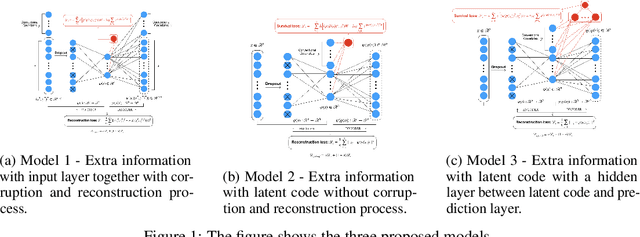
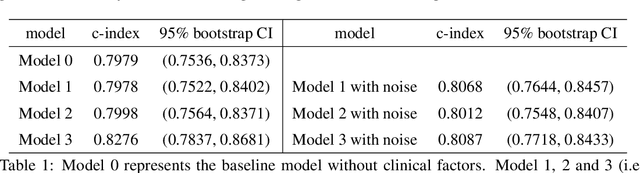
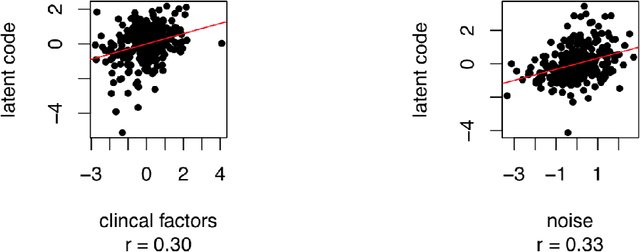

In this work, a novel approach is proposed for joint analysis of high dimensional time-resolved cardiac motion features obtained from segmented cardiac MRI and low dimensional clinical risk factors to improve survival prediction in heart failure. Different methods are evaluated to find the optimal way to insert conventional covariates into deep prediction networks. Correlation analysis between autoencoder latent codes and covariate features is used to examine how these predictors interact. We believe that similar approaches could also be used to introduce knowledge of genetic variants to such survival networks to improve outcome prediction by jointly analysing cardiac motion traits with inheritable risk factors.
* 4 pages, 2 figures