 Add to Chrome
 Add to Firefox
 Add to Edge
Non-Square UPA-Enabled XL-MIMO Systems: Anisotropic Near-Field Characterization, Fundamental Limits, and Channel Estimation
Jul 21, 2026
Extremely large-scale multiple-input multiple-output (XL-MIMO) is crucial for next-generation communication systems. In practice, the deployment of non-square uniform planar arrays (UPAs) fundamentally alters wavefront characteristics and induces anisotropic beamfocusing capability along different axes due to the aperture disparity originating from the non-square array geometry. To fully uncover the performance impact of such non-square geometry and thus unleash the potential of the non-square UPAs, we investigate the anisotropic near-field characteristics, fundamental limits, and channel estimation for non-square UPA-enabled XL-MIMO systems. First, we derive the effective beamfocusing distances for the long and short axes of the array. Interestingly, the radiation space of a non-square UPA can be partitioned into three regions, i.e., the fully near-field, the anisotropic near-field, and the far-field regions, and the anisotropic region asymptotically dominates the overall near-field space as the array aspect ratio increases. Then, the asymptotic effective degree of freedom for non-square UPA-enabled XL-MIMO systems is provided, which reveals that distance-domain multiplexing is governed by the long-axis aperture in the large array aspect ratio regime. Furthermore, the closed-form Cramer-Rao bound for distance estimation and the three-dimensional (3D) position error bound (PEB) are derived to reveal the geometry-induced performance trade-offs among distance, azimuth, and elevation estimation, based on which the optimal array aspect ratio that minimizes the 3D PEB is determined. Finally, by exploiting the anisotropic wavefront properties, we design a 3D anisotropic near-field codebook to facilitate low-complexity channel estimation for non-square UPAs. Numerical results validate that the proposed codebook achieves comparable accuracy to the 3D polar-domain codebook at reduced complexity.

Environment-Aware and Training-Free Beam Alignment for mmWave Massive MIMO via Channel Knowledge Map
Feb 19, 2021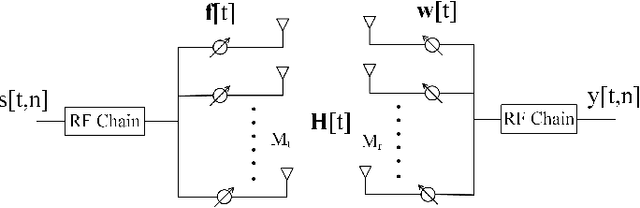
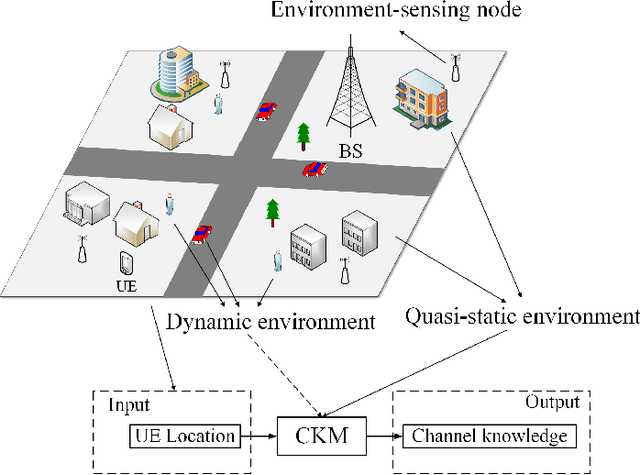
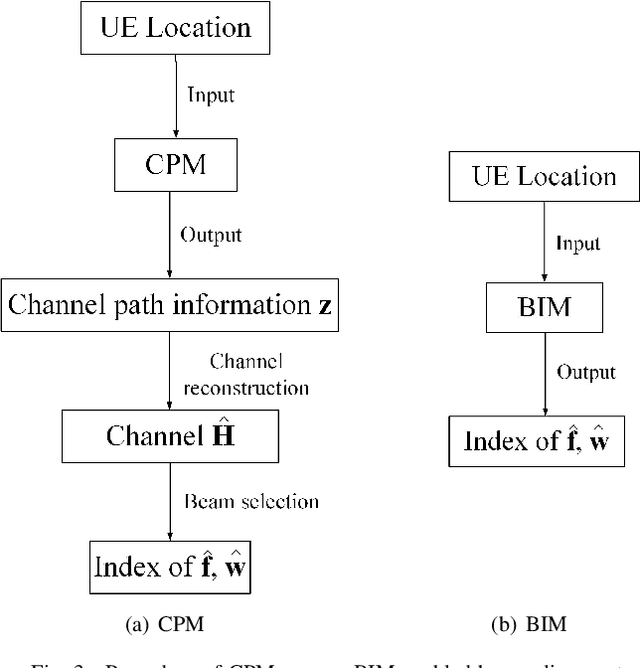
Millimeter wave (mmWave) massive multiple-input multiple-output (MIMO) communication system is expected to achieve enormous transmission rate, provided that the transmit and receive beams are properly aligned with the MIMO channel. However, existing beam alignment techniques rely on either channel estimation or beam sweeping, which incur prohibitively high training overhead, especially for future wireless systems with further increased antenna dimensions and more stringent requirement on cost-effective hardware architectures. In this paper, we propose a new beam alignment technique, which is environment-aware and training-free, by utilizing the emerging concept of channel knowledge map (CKM), together with the user location information that is readily available in contemporary wireless systems. CKM is a site-specific database, tagged with the transmitter/receiver locations, which contains useful channel information to facilitate or even obviate real-time channel state information (CSI) acquistion. Two instances of CKM are proposed for beam alignment in mmWave massive MIMO systems, namely channel path map (CPM) and beam index map (BIM). It is shown that compared with existing training-based beam alignment schemes, the proposed CKM-enabled environment-aware beam alignment is able to drastically improve the effective communication rate, even with moderate user location errors, thanks to its significant saving of the prohibitive training overhead.