 Add to Chrome
 Add to Firefox
 Add to Edge
GeoFlow: Efficient Driving Video Generation via Geometry-Aligned Priors
Aug 12, 2026
Generative models like Diffusion Models and Flow Matching have demonstrated remarkable capabilities in synthesizing high-fidelity driving videos, but are severely constrained by high inference latency due to the requirement of extensive sampling steps. We argue that this inefficiency stems from the prevailing reliance on a standard Gaussian source distribution, where consecutive frames are initialized as independent Gaussian noise. This paradigm disregards the rich spatiotemporal correlations inherent in driving videos, compelling the model to regenerate deterministic scene structures existing in previous frames from noise, which is both computationally redundant and prone to geometric inconsistency. To address this problem, we propose GeoFlow, a novel framework designed to achieve efficient driving video generation by harnessing explicit geometric priors. Instead of sampling from standard Gaussian noise, we leverage multi-view geometry and spatially-adaptive noise injection to construct a Geometry-Aligned Prior (GAP) distribution as starting point. This initialization bridges the gap between source distribution and data distribution, yielding a significantly straighter and shorter sampling trajectory. Extensive experiments demonstrate that GeoFlow can achieve remarkable efficiency of both training and inference: merely several hours of fine-tuning on baseline models can significantly boost few-step generation quality, while fully converged training drastically reduces number of inference steps required for state-of-the-art video generation.

Object Scan Context: Object-centric Spatial Descriptor for Place Recognition within 3D Point Cloud Map
Jun 07, 2022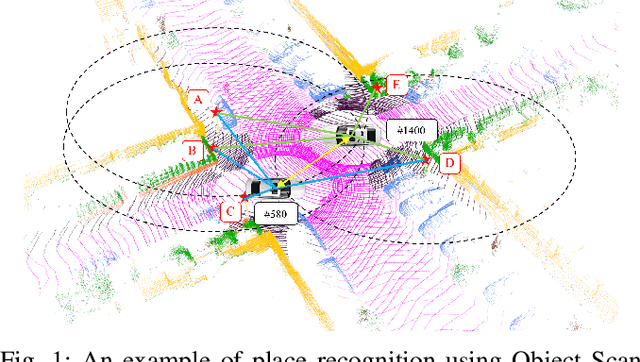
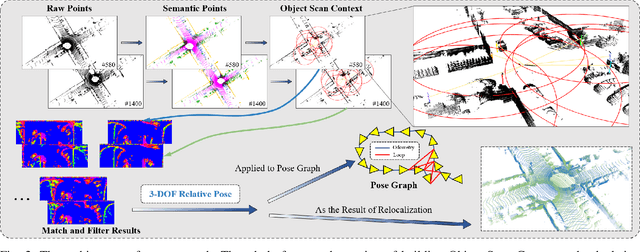
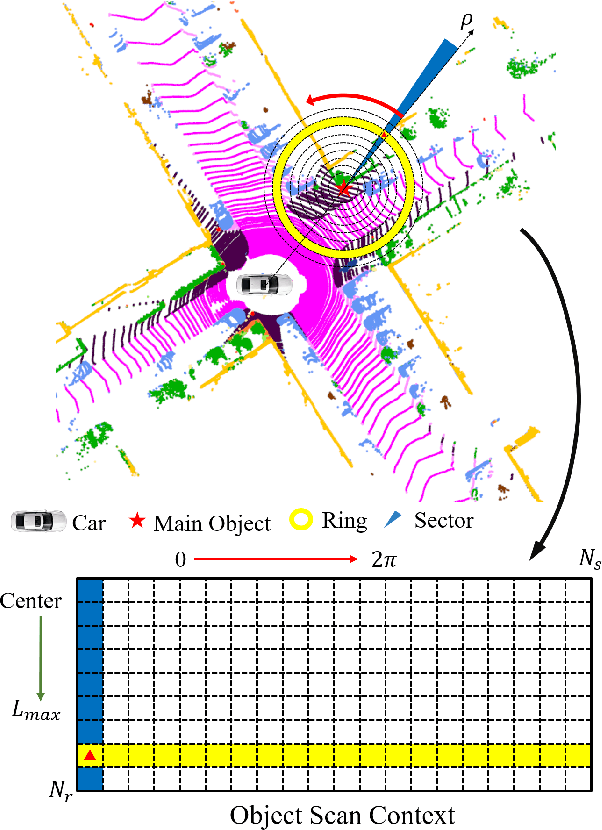
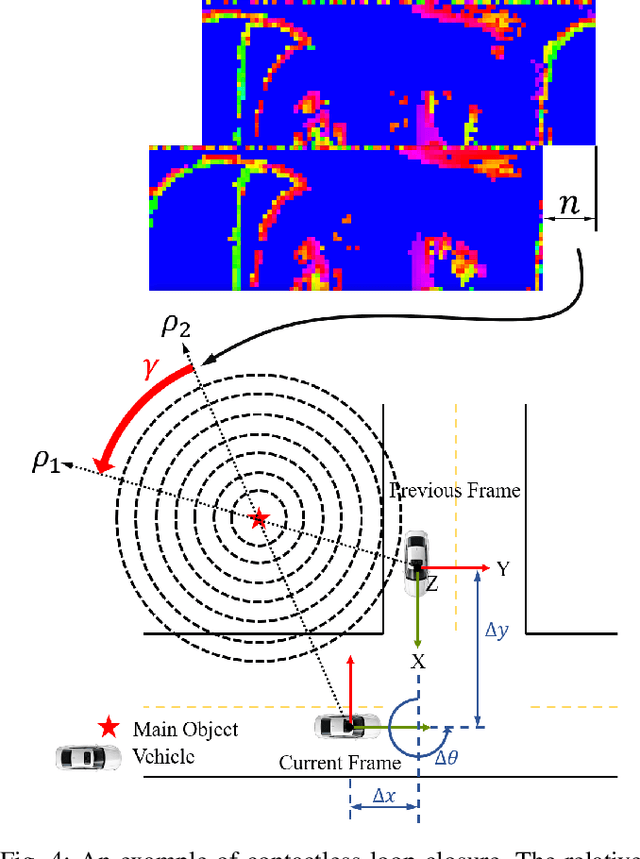
Place recognition technology endows a SLAM algorithm with the ability to eliminate accumulated errors and to relocalize itself. Existing methods on point cloud-based place recognition often leverage the matching of global descriptors which are lidar-centric. These methods have the following two major defects: place recognition cannot be performed when the distance between the two point clouds is far, and only the rotation angle can be calculated without the offset in the X and Y direction. To solve these two problems, we propose a novel global descriptor, which is built around the Main Object, in this way, descriptors are no longer dependent on the observation position. We analyze the theory that this method can perfectly solve the above two problems, and conduct a lot of experiments in KITTI and some extreme scenarios, which show that our method has obvious advantages over traditional methods.