 Add to Chrome
 Add to Firefox
 Add to Edge
Photonic Quantum-Enhanced Knowledge Distillation
Mar 16, 2026
Photonic quantum processors naturally produce intrinsically stochastic measurement outcomes, offering a hardware-native source of structured randomness that can be exploited during machine-learning training. Here we introduce Photonic Quantum-Enhanced Knowledge Distillation (PQKD), a hybrid quantum photonic--classical framework in which a programmable photonic circuit generates a compact conditioning signal that constrains and guides a parameter-efficient student network during distillation from a high-capacity teacher. PQKD replaces fully trainable convolutional kernels with dictionary convolutions: each layer learns only a small set of shared spatial basis filters, while sample-dependent channel-mixing weights are derived from shot-limited photonic features and mapped through a fixed linear transform. Training alternates between standard gradient-based optimisation of the student and sampling-robust, gradient-free updates of photonic parameters, avoiding differentiation through photonic hardware. Across MNIST, Fashion-MNIST and CIFAR-10, PQKD traces a controllable compression--accuracy frontier, remaining close to teacher performance on simpler benchmarks under aggressive convolutional compression. Performance degrades predictably with finite sampling, consistent with shot-noise scaling, and exponential moving-average feature smoothing suppresses high-frequency shot-noise fluctuations, extending the practical operating regime at moderate shot budgets.

Quantum Computing for Climate Resilience and Sustainability Challenges
Jul 23, 2024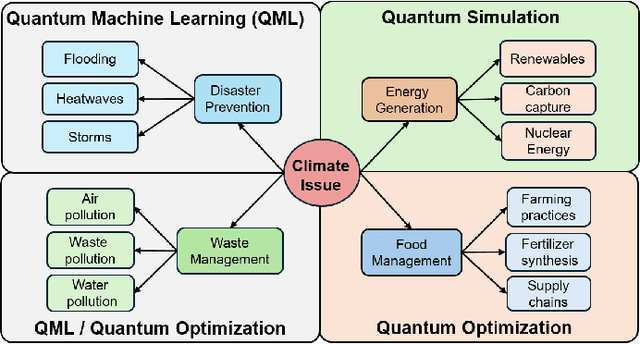
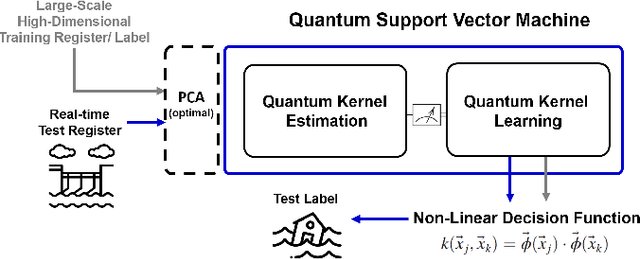
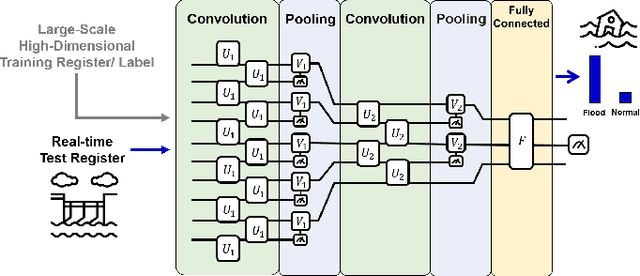
The escalating impacts of climate change and the increasing demand for sustainable development and natural resource management necessitate innovative technological solutions. Quantum computing (QC) has emerged as a promising tool with the potential to revolutionize these critical areas. This review explores the application of quantum machine learning and optimization techniques for climate change prediction and enhancing sustainable development. Traditional computational methods often fall short in handling the scale and complexity of climate models and natural resource management. Quantum advancements, however, offer significant improvements in computational efficiency and problem-solving capabilities. By synthesizing the latest research and developments, this paper highlights how QC and quantum machine learning can optimize multi-infrastructure systems towards climate neutrality. The paper also evaluates the performance of current quantum algorithms and hardware in practical applications and presents realistic cases, i.e., waste-to-energy in anaerobic digestion, disaster prevention in flooding prediction, and new material development for carbon capture. The integration of these quantum technologies promises to drive significant advancements in achieving climate resilience and sustainable development.
Experimentally detecting a quantum change point via Bayesian inference
Jan 23, 2018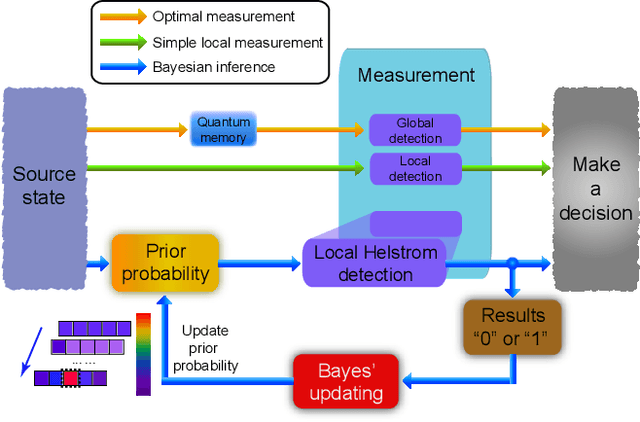
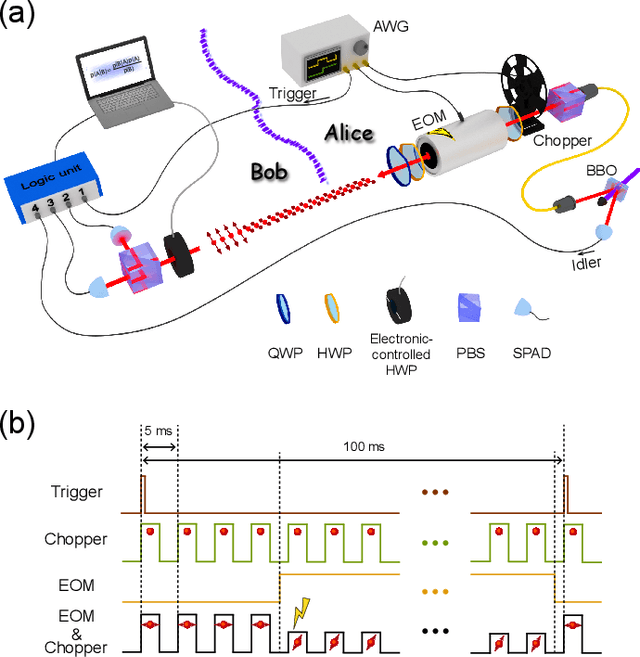
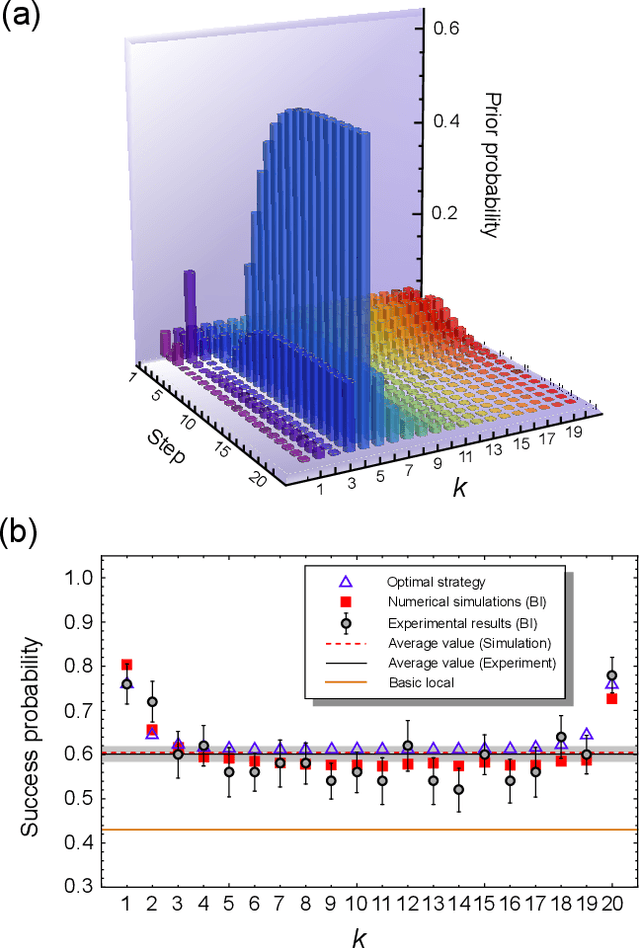
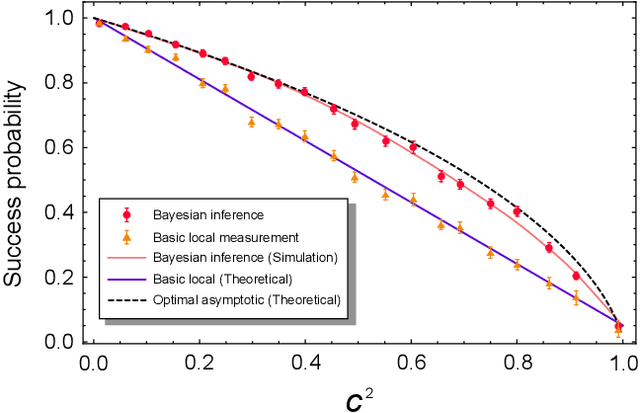
Detecting a change point is a crucial task in statistics that has been recently extended to the quantum realm. A source state generator that emits a series of single photons in a default state suffers an alteration at some point and starts to emit photons in a mutated state. The problem consists in identifying the point where the change took place. In this work, we consider a learning agent that applies Bayesian inference on experimental data to solve this problem. This learning machine adjusts the measurement over each photon according to the past experimental results finds the change position in an online fashion. Our results show that the local-detection success probability can be largely improved by using such a machine learning technique. This protocol provides a tool for improvement in many applications where a sequence of identical quantum states is required.