 Add to Chrome
 Add to Firefox
 Add to Edge
Mixture-of-Translators: Translating KV Caches Across Heterogeneous Large Language Models
Jul 31, 2026
Heterogeneous Large Language Model (LLM) systems increasingly rely on shared contexts, retrieved evidence, and multi-agent dialogue histories, yet their internal key-value (KV) caches remain model-specific and cannot be reused across architectures. Consequently, each model must repeatedly prefill or store caches for the same context, limiting the scalability of multi-model reasoning and long-context generation. We propose Mixture-of-Translators(MoT), a cache translation framework that maps context KV caches from a source LLM into the cache space of a target LLM. Unlike prior approaches that depend on a single projection path or global shared latent space, MoT uses multiple translator modules to capture diverse source--target mappings. To further reduce residual translation error, we introduce a Context Correction Loss that aligns the replayed target trajectory with the native target trajectory. We reveal two competing failure modes in cache translation: propagated translation shift from early injection and last-state shift from late injection. MoT addresses them through translator mixtures and target-side correction. Across homogeneous and heterogeneous translations among Qwen2.5, GPT-2, and OPT models, MoT preserves downstream QA performance, including Qwen2.5-7B-scale translation with 51.0% average closed-set QA accuracy and 0.43 average extractive QA F1. In practical case studies, MoT enables quality-preserving memory reuse for multi-agent reasoning and retains 96.3% of direct-context quality in long-context cache-augmented generation, demonstrating scalable KV cache reuse across heterogeneous LLMs.

MPR-CiteG: Enhancing RAG with Multi-Portfolio Retrieval and Citation-Grounded Generation
Jul 20, 2026This paper presents the MPR-CiteG framework, which achieved second place in the ScienceON AI Challenge by addressing two fundamental challenges in generative AI: inefficient retrieval and the absence of source verification. We propose a dual-component system, termed MPR-CiteG, in which the Multi-Portfolio Retriever (MPR) efficiently retrieves diverse and relevant information, while the Citation-Grounded Generation (CiteG) module ensures that every generated output remains factually consistent and explicitly attributed to its source. MPR-CiteG represents a significant step toward building more trustworthy and accurate LLMs that are not only capable of generating information but also of grounding their responses in reliable evidence, thereby mitigating common issues like model hallucination. Extensive experiments on the challenge dataset validate the effectiveness and reliability of our approach. Our code is available at https://github.com/2noweyh/MPR-citeG.
Hyperbolic Heterogeneous Graph Transformer
Jan 13, 2026In heterogeneous graphs, we can observe complex structures such as tree-like or hierarchical structures. Recently, the hyperbolic space has been widely adopted in many studies to effectively learn these complex structures. Although these methods have demonstrated the advantages of the hyperbolic space in learning heterogeneous graphs, most existing methods still have several challenges. They rely heavily on tangent-space operations, which often lead to mapping distortions during frequent transitions. Moreover, their message-passing architectures mainly focus on local neighborhood information, making it difficult to capture global hierarchical structures and long-range dependencies between different types of nodes. To address these limitations, we propose Hyperbolic Heterogeneous Graph Transformer (HypHGT), which effectively and efficiently learns heterogeneous graph representations entirely within the hyperbolic space. Unlike previous message-passing based hyperbolic heterogeneous GNNs, HypHGT naturally captures both local and global dependencies through transformer-based architecture. Furthermore, the proposed relation-specific hyperbolic attention mechanism in HypHGT, which operates with linear time complexity, enables efficient computation while preserving the heterogeneous information across different relation types. This design allows HypHGT to effectively capture the complex structural properties and semantic information inherent in heterogeneous graphs. We conduct comprehensive experiments to evaluate the effectiveness and efficiency of HypHGT, and the results demonstrate that it consistently outperforms state-of-the-art methods in node classification task, with significantly reduced training time and memory usage.
Zero-Shot Industrial Anomaly Segmentation with Image-Aware Prompt Generation
Apr 18, 2025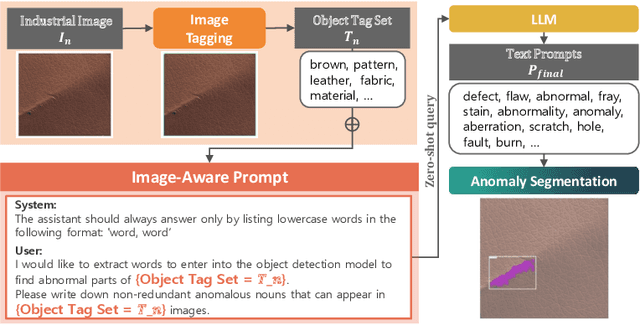
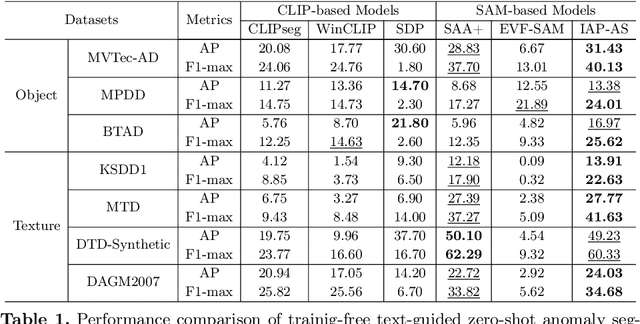
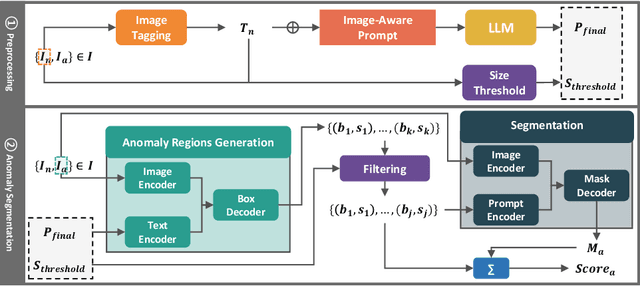
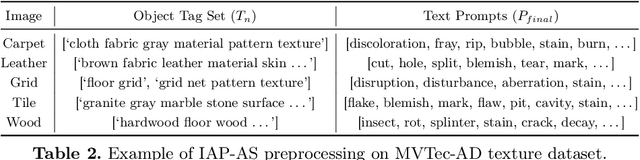
Anomaly segmentation is essential for industrial quality, maintenance, and stability. Existing text-guided zero-shot anomaly segmentation models are effective but rely on fixed prompts, limiting adaptability in diverse industrial scenarios. This highlights the need for flexible, context-aware prompting strategies. We propose Image-Aware Prompt Anomaly Segmentation (IAP-AS), which enhances anomaly segmentation by generating dynamic, context-aware prompts using an image tagging model and a large language model (LLM). IAP-AS extracts object attributes from images to generate context-aware prompts, improving adaptability and generalization in dynamic and unstructured industrial environments. In our experiments, IAP-AS improves the F1-max metric by up to 10%, demonstrating superior adaptability and generalization. It provides a scalable solution for anomaly segmentation across industries
CLAIMCHECK: How Grounded are LLM Critiques of Scientific Papers?
Mar 27, 2025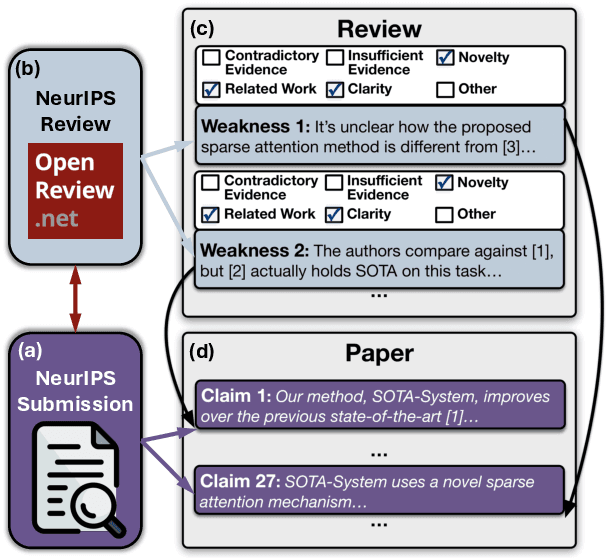
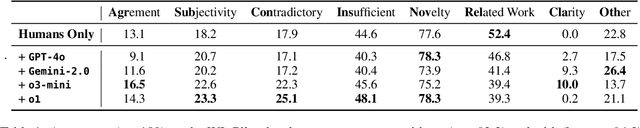
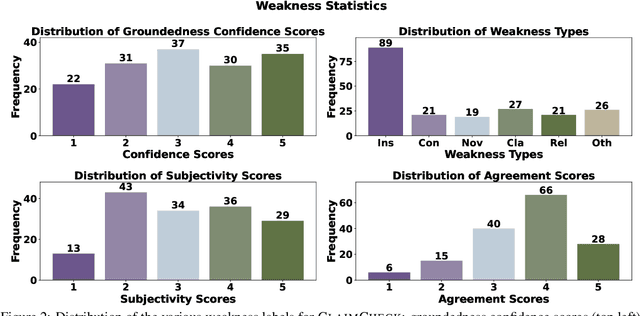
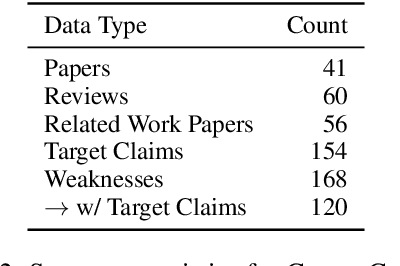
A core part of scientific peer review involves providing expert critiques that directly assess the scientific claims a paper makes. While it is now possible to automatically generate plausible (if generic) reviews, ensuring that these reviews are sound and grounded in the papers' claims remains challenging. To facilitate LLM benchmarking on these challenges, we introduce CLAIMCHECK, an annotated dataset of NeurIPS 2023 and 2024 submissions and reviews mined from OpenReview. CLAIMCHECK is richly annotated by ML experts for weakness statements in the reviews and the paper claims that they dispute, as well as fine-grained labels of the validity, objectivity, and type of the identified weaknesses. We benchmark several LLMs on three claim-centric tasks supported by CLAIMCHECK, requiring models to (1) associate weaknesses with the claims they dispute, (2) predict fine-grained labels for weaknesses and rewrite the weaknesses to enhance their specificity, and (3) verify a paper's claims with grounded reasoning. Our experiments reveal that cutting-edge LLMs, while capable of predicting weakness labels in (2), continue to underperform relative to human experts on all other tasks.
Multi-Hyperbolic Space-based Heterogeneous Graph Attention Network
Nov 18, 2024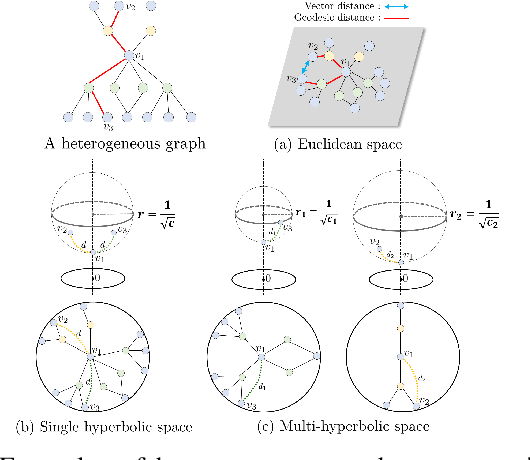
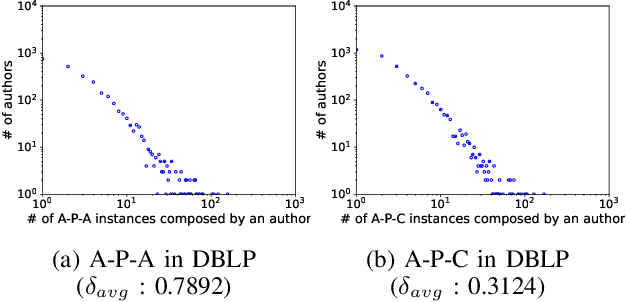
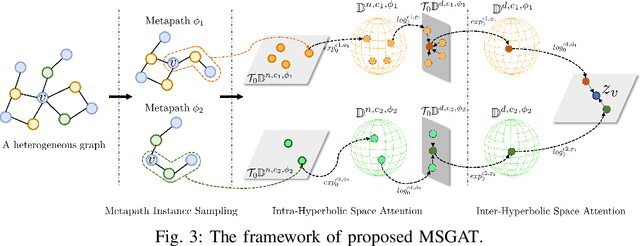
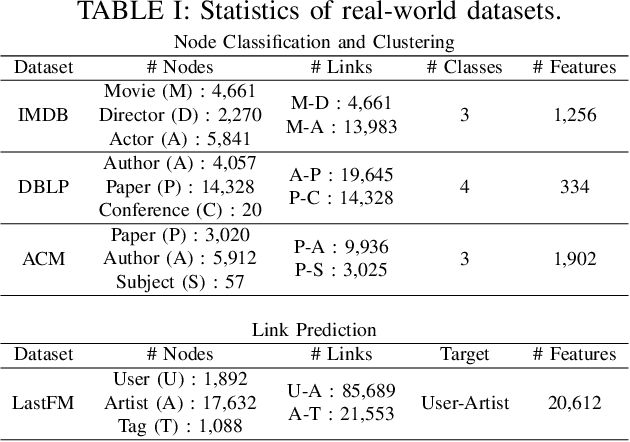
To leverage the complex structures within heterogeneous graphs, recent studies on heterogeneous graph embedding use a hyperbolic space, characterized by a constant negative curvature and exponentially increasing space, which aligns with the structural properties of heterogeneous graphs. However, despite heterogeneous graphs inherently possessing diverse power-law structures, most hyperbolic heterogeneous graph embedding models use a single hyperbolic space for the entire heterogeneous graph, which may not effectively capture the diverse power-law structures within the heterogeneous graph. To address this limitation, we propose Multi-hyperbolic Space-based heterogeneous Graph Attention Network (MSGAT), which uses multiple hyperbolic spaces to effectively capture diverse power-law structures within heterogeneous graphs. We conduct comprehensive experiments to evaluate the effectiveness of MSGAT. The experimental results demonstrate that MSGAT outperforms state-of-the-art baselines in various graph machine learning tasks, effectively capturing the complex structures of heterogeneous graphs.
Hyperbolic Heterogeneous Graph Attention Networks
Apr 15, 2024
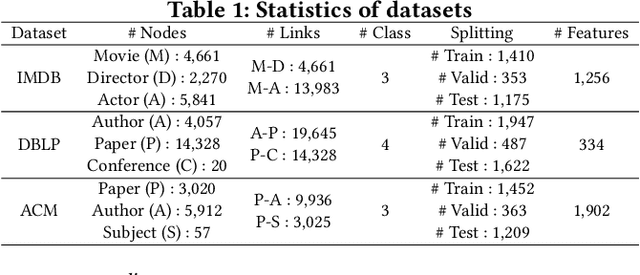
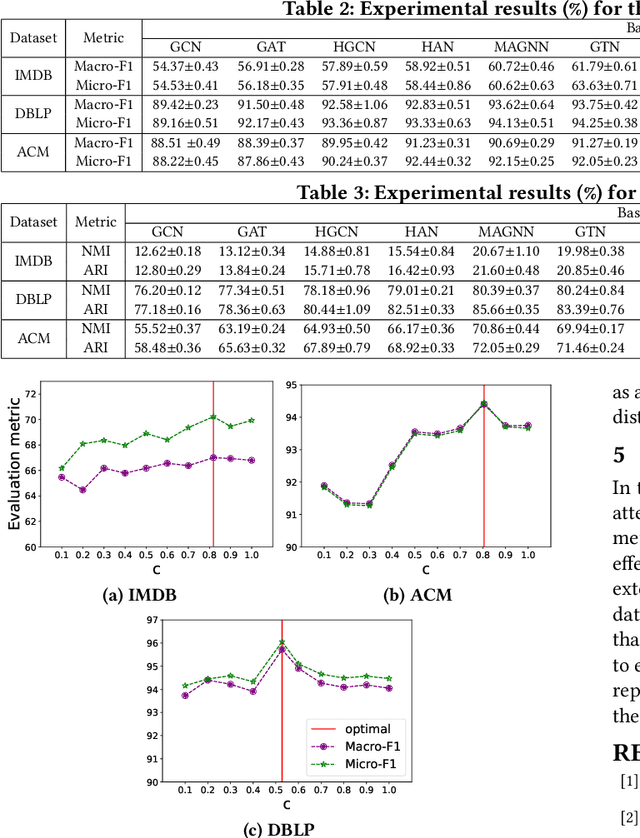
Most previous heterogeneous graph embedding models represent elements in a heterogeneous graph as vector representations in a low-dimensional Euclidean space. However, because heterogeneous graphs inherently possess complex structures, such as hierarchical or power-law structures, distortions can occur when representing them in Euclidean space. To overcome this limitation, we propose Hyperbolic Heterogeneous Graph Attention Networks (HHGAT) that learn vector representations in hyperbolic spaces with meta-path instances. We conducted experiments on three real-world heterogeneous graph datasets, demonstrating that HHGAT outperforms state-of-the-art heterogeneous graph embedding models in node classification and clustering tasks.