 Add to Chrome
 Add to Firefox
 Add to Edge
Mixture-of-Translators: Translating KV Caches Across Heterogeneous Large Language Models
Jul 31, 2026
Heterogeneous Large Language Model (LLM) systems increasingly rely on shared contexts, retrieved evidence, and multi-agent dialogue histories, yet their internal key-value (KV) caches remain model-specific and cannot be reused across architectures. Consequently, each model must repeatedly prefill or store caches for the same context, limiting the scalability of multi-model reasoning and long-context generation. We propose Mixture-of-Translators(MoT), a cache translation framework that maps context KV caches from a source LLM into the cache space of a target LLM. Unlike prior approaches that depend on a single projection path or global shared latent space, MoT uses multiple translator modules to capture diverse source--target mappings. To further reduce residual translation error, we introduce a Context Correction Loss that aligns the replayed target trajectory with the native target trajectory. We reveal two competing failure modes in cache translation: propagated translation shift from early injection and last-state shift from late injection. MoT addresses them through translator mixtures and target-side correction. Across homogeneous and heterogeneous translations among Qwen2.5, GPT-2, and OPT models, MoT preserves downstream QA performance, including Qwen2.5-7B-scale translation with 51.0% average closed-set QA accuracy and 0.43 average extractive QA F1. In practical case studies, MoT enables quality-preserving memory reuse for multi-agent reasoning and retains 96.3% of direct-context quality in long-context cache-augmented generation, demonstrating scalable KV cache reuse across heterogeneous LLMs.

MPR-CiteG: Enhancing RAG with Multi-Portfolio Retrieval and Citation-Grounded Generation
Jul 20, 2026This paper presents the MPR-CiteG framework, which achieved second place in the ScienceON AI Challenge by addressing two fundamental challenges in generative AI: inefficient retrieval and the absence of source verification. We propose a dual-component system, termed MPR-CiteG, in which the Multi-Portfolio Retriever (MPR) efficiently retrieves diverse and relevant information, while the Citation-Grounded Generation (CiteG) module ensures that every generated output remains factually consistent and explicitly attributed to its source. MPR-CiteG represents a significant step toward building more trustworthy and accurate LLMs that are not only capable of generating information but also of grounding their responses in reliable evidence, thereby mitigating common issues like model hallucination. Extensive experiments on the challenge dataset validate the effectiveness and reliability of our approach. Our code is available at https://github.com/2noweyh/MPR-citeG.
LFI-CAM: Learning Feature Importance for Better Visual Explanation
May 03, 2021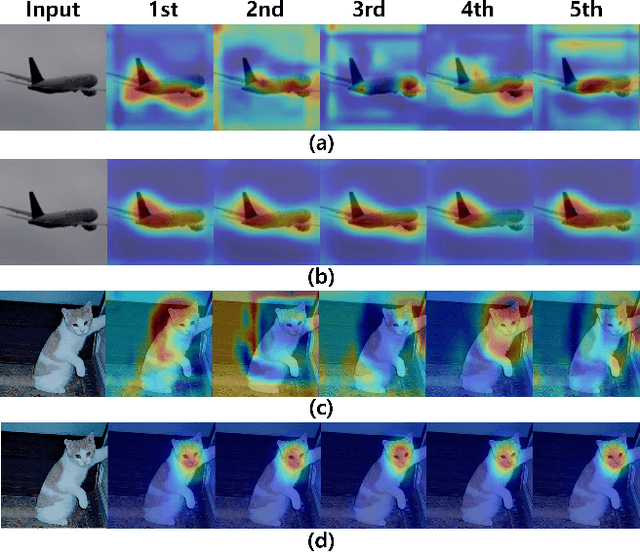
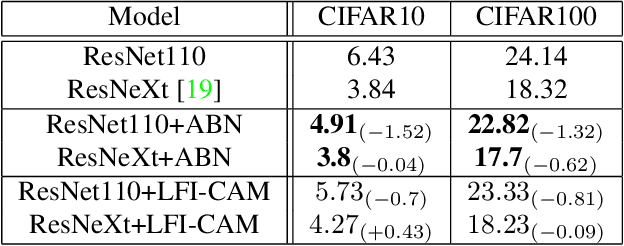
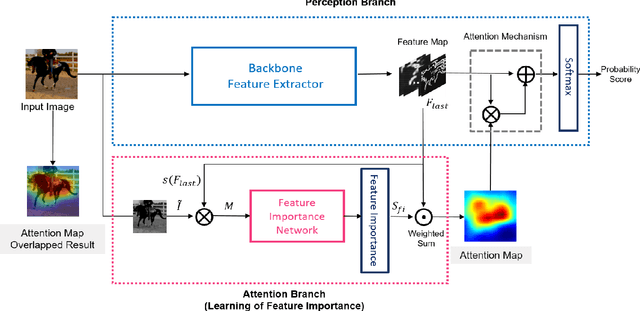
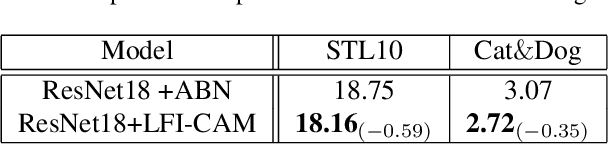
Class Activation Mapping (CAM) is a powerful technique used to understand the decision making of Convolutional Neural Network (CNN) in computer vision. Recently, there have been attempts not only to generate better visual explanations, but also to improve classification performance using visual explanations. However, the previous works still have their own drawbacks. In this paper, we propose a novel architecture, LFI-CAM, which is trainable for image classification and visual explanation in an end-to-end manner. LFI-CAM generates an attention map for visual explanation during forward propagation, at the same time, leverages the attention map to improve the classification performance through the attention mechanism. Our Feature Importance Network (FIN) focuses on learning the feature importance instead of directly learning the attention map to obtain a more reliable and consistent attention map. We confirmed that LFI-CAM model is optimized not only by learning the feature importance but also by enhancing the backbone feature representation to focus more on important features of the input image. Experimental results show that LFI-CAM outperforms the baseline models's accuracy on the classification tasks as well as significantly improves on the previous works in terms of attention map quality and stability over different hyper-parameters.