 Add to Chrome
 Add to Firefox
 Add to Edge
Linear Recurrent Unit with Semantic Modulation for Image Super-Resolution
Jun 18, 2026
Linear recurrent unit (LRU), designed with a principled formulation for stable linear recurrence, has demonstrated promising accuracy and robustness on long-range dependency tasks. However, its static parameterization and single-scan method limits its applicability to 2D vision tasks. In this study, we propose a LRU-based restoration network with a semantic modulating unit (SMU) to achieve a harmonious balance between performance and efficiency in single-image super-resolution. The SMU plays three key roles: LRU modulation, spatial categorization, and feature enhancement through learned prototype. Extensive experiments demonstrate that our method quantitatively and qualitatively surpasses recent state-of-the-art methods. Notably, our approach achieves superior performance with computational complexity on par with existing methods. The source code and models are available at https://github.com/MingyuChoi-run/LSM

Zero-Shot Industrial Anomaly Segmentation with Image-Aware Prompt Generation
Apr 18, 2025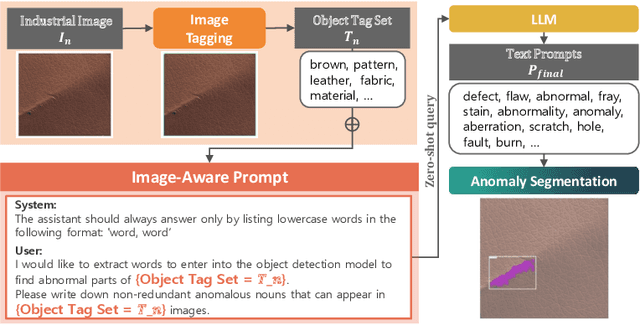
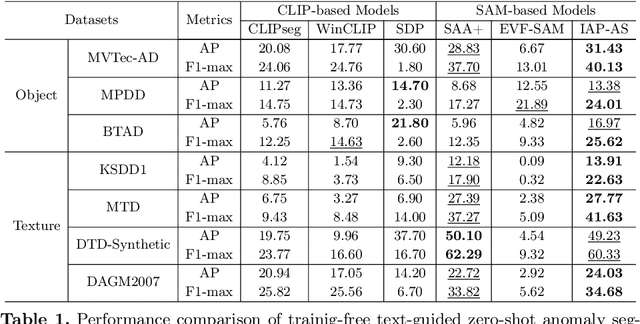
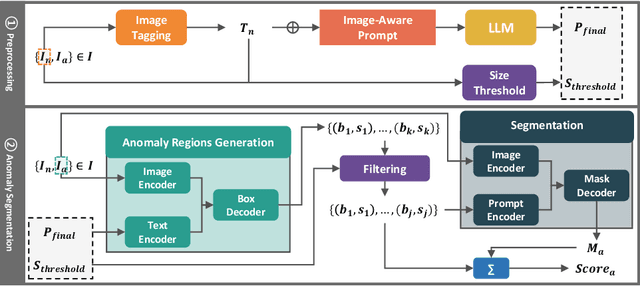
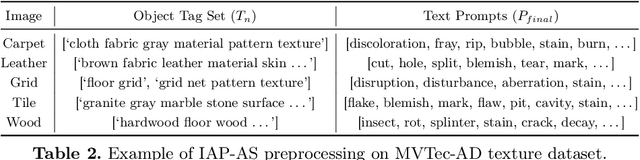
Anomaly segmentation is essential for industrial quality, maintenance, and stability. Existing text-guided zero-shot anomaly segmentation models are effective but rely on fixed prompts, limiting adaptability in diverse industrial scenarios. This highlights the need for flexible, context-aware prompting strategies. We propose Image-Aware Prompt Anomaly Segmentation (IAP-AS), which enhances anomaly segmentation by generating dynamic, context-aware prompts using an image tagging model and a large language model (LLM). IAP-AS extracts object attributes from images to generate context-aware prompts, improving adaptability and generalization in dynamic and unstructured industrial environments. In our experiments, IAP-AS improves the F1-max metric by up to 10%, demonstrating superior adaptability and generalization. It provides a scalable solution for anomaly segmentation across industries