 Add to Chrome
 Add to Firefox
 Add to Edge
MPR-CiteG: Enhancing RAG with Multi-Portfolio Retrieval and Citation-Grounded Generation
Jul 20, 2026
This paper presents the MPR-CiteG framework, which achieved second place in the ScienceON AI Challenge by addressing two fundamental challenges in generative AI: inefficient retrieval and the absence of source verification. We propose a dual-component system, termed MPR-CiteG, in which the Multi-Portfolio Retriever (MPR) efficiently retrieves diverse and relevant information, while the Citation-Grounded Generation (CiteG) module ensures that every generated output remains factually consistent and explicitly attributed to its source. MPR-CiteG represents a significant step toward building more trustworthy and accurate LLMs that are not only capable of generating information but also of grounding their responses in reliable evidence, thereby mitigating common issues like model hallucination. Extensive experiments on the challenge dataset validate the effectiveness and reliability of our approach. Our code is available at https://github.com/2noweyh/MPR-citeG.

"When to Hand Off, When to Work Together": Expanding Human-Agent Co-Creative Collaboration through Concurrent Interaction
Mar 02, 2026Human collaborators coordinate dynamically through process visibility and workspace awareness, yet AI agents typically either provide only final outputs or expose read-only execution processes (e.g., planning, reasoning) without interpreting concurrent user actions on shared artifacts. Building on mixed-initiative interaction principles, we explore whether agents can achieve collaborative context awareness -- interpreting concurrent user actions on shared artifacts and adapting in real-time. Study 1 (N=10 professional designers) revealed that process visibility enabled reasoning about agent actions but exposed conflicts when agents could not distinguish feedback from independent work. We developed CLEO, which interprets collaborative intent and adapts in real-time. Study 2 (N=10, two-day with stimulated recall interviews) analyzed 214 turns, identifying five action patterns, six triggers, and four enabling factors explaining when designers choose delegation (70.1%), direction (28.5%), or concurrent work (31.8%). We present a decision model with six interaction loops, design implications, and an annotated dataset.
Hyperbolic Heterogeneous Graph Transformer
Jan 13, 2026In heterogeneous graphs, we can observe complex structures such as tree-like or hierarchical structures. Recently, the hyperbolic space has been widely adopted in many studies to effectively learn these complex structures. Although these methods have demonstrated the advantages of the hyperbolic space in learning heterogeneous graphs, most existing methods still have several challenges. They rely heavily on tangent-space operations, which often lead to mapping distortions during frequent transitions. Moreover, their message-passing architectures mainly focus on local neighborhood information, making it difficult to capture global hierarchical structures and long-range dependencies between different types of nodes. To address these limitations, we propose Hyperbolic Heterogeneous Graph Transformer (HypHGT), which effectively and efficiently learns heterogeneous graph representations entirely within the hyperbolic space. Unlike previous message-passing based hyperbolic heterogeneous GNNs, HypHGT naturally captures both local and global dependencies through transformer-based architecture. Furthermore, the proposed relation-specific hyperbolic attention mechanism in HypHGT, which operates with linear time complexity, enables efficient computation while preserving the heterogeneous information across different relation types. This design allows HypHGT to effectively capture the complex structural properties and semantic information inherent in heterogeneous graphs. We conduct comprehensive experiments to evaluate the effectiveness and efficiency of HypHGT, and the results demonstrate that it consistently outperforms state-of-the-art methods in node classification task, with significantly reduced training time and memory usage.
Zero-Shot Industrial Anomaly Segmentation with Image-Aware Prompt Generation
Apr 18, 2025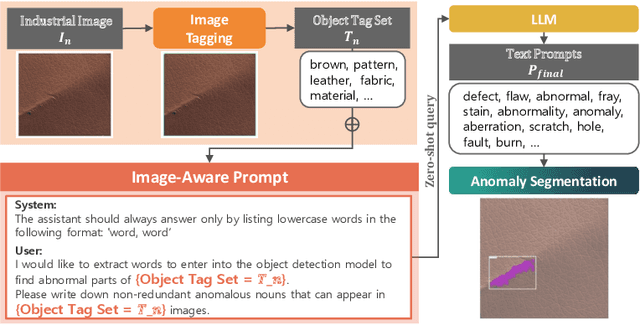
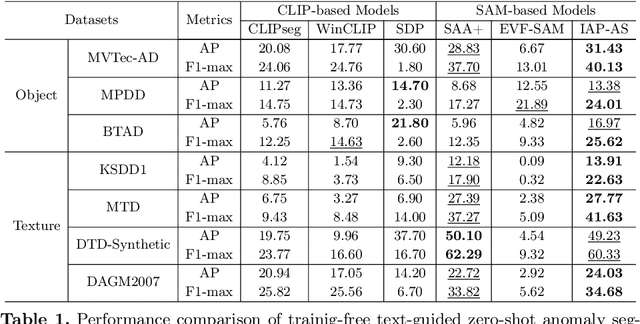
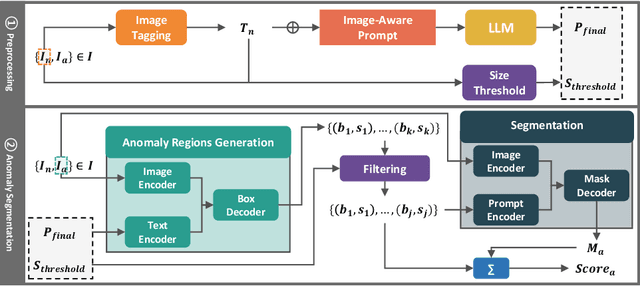
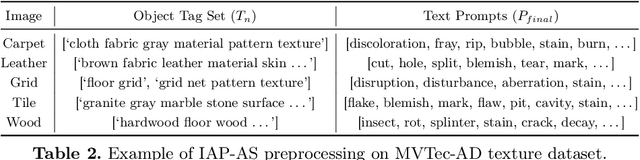
Anomaly segmentation is essential for industrial quality, maintenance, and stability. Existing text-guided zero-shot anomaly segmentation models are effective but rely on fixed prompts, limiting adaptability in diverse industrial scenarios. This highlights the need for flexible, context-aware prompting strategies. We propose Image-Aware Prompt Anomaly Segmentation (IAP-AS), which enhances anomaly segmentation by generating dynamic, context-aware prompts using an image tagging model and a large language model (LLM). IAP-AS extracts object attributes from images to generate context-aware prompts, improving adaptability and generalization in dynamic and unstructured industrial environments. In our experiments, IAP-AS improves the F1-max metric by up to 10%, demonstrating superior adaptability and generalization. It provides a scalable solution for anomaly segmentation across industries