 Add to Chrome
 Add to Firefox
 Add to Edge
LLM within MCP Matters: Measuring Inefficient Resource Utilization Driven by LLMs
Aug 09, 2026
The Model Context Protocol (MCP) standardizes how servers expose data and tools to Large Language Models (LLMs). A common server design embeds frequently used reference data, such as identifier lookup tables, directly in the server instructions: the system-prompt text a server hands to the host application. When a query concerns an entry of the embedded table, the model can act on it immediately instead of re-discovering the same information through a search tool. We test whether client LLMs actually consume such instruction-embedded data, reporting a 54,000-trial study across 24 LLMs (9 Claude, 6 Gemini, 9 GPT) on a production legal-information MCP server. A diagnostic condition that removes the competing search tool shows that failures are dominated by behavioral preference rather than missing capability. With search unavailable, 23 of 24 models read the embedded data reliably (hit ratio at least 98%); with a search tool merely present, 9 models drop below 15%. A 2^3 factorial analysis of three instruction-level interventions reveals strong interaction effects: combining all three restores at least 86% for 20 of 24 models, but individual interventions can backfire for specific model families. Per-server prompt engineering is therefore a workaround rather than a fix; we argue that MCP host applications should provide an explicit mechanism that places server instructions ahead of tool selection in the client LLM's deliberation.

Mixture-of-Translators: Translating KV Caches Across Heterogeneous Large Language Models
Jul 31, 2026Heterogeneous Large Language Model (LLM) systems increasingly rely on shared contexts, retrieved evidence, and multi-agent dialogue histories, yet their internal key-value (KV) caches remain model-specific and cannot be reused across architectures. Consequently, each model must repeatedly prefill or store caches for the same context, limiting the scalability of multi-model reasoning and long-context generation. We propose Mixture-of-Translators(MoT), a cache translation framework that maps context KV caches from a source LLM into the cache space of a target LLM. Unlike prior approaches that depend on a single projection path or global shared latent space, MoT uses multiple translator modules to capture diverse source--target mappings. To further reduce residual translation error, we introduce a Context Correction Loss that aligns the replayed target trajectory with the native target trajectory. We reveal two competing failure modes in cache translation: propagated translation shift from early injection and last-state shift from late injection. MoT addresses them through translator mixtures and target-side correction. Across homogeneous and heterogeneous translations among Qwen2.5, GPT-2, and OPT models, MoT preserves downstream QA performance, including Qwen2.5-7B-scale translation with 51.0% average closed-set QA accuracy and 0.43 average extractive QA F1. In practical case studies, MoT enables quality-preserving memory reuse for multi-agent reasoning and retains 96.3% of direct-context quality in long-context cache-augmented generation, demonstrating scalable KV cache reuse across heterogeneous LLMs.
FnRGNN: Distribution-aware Fairness in Graph Neural Network
Oct 22, 2025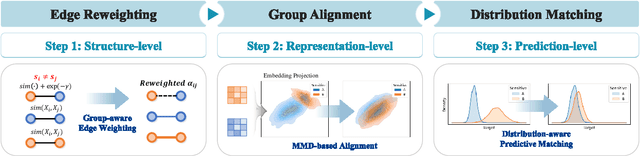
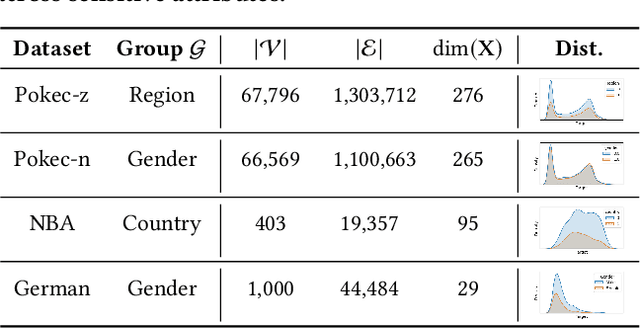
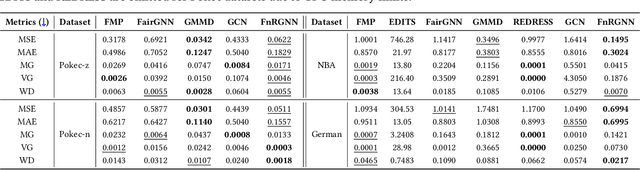
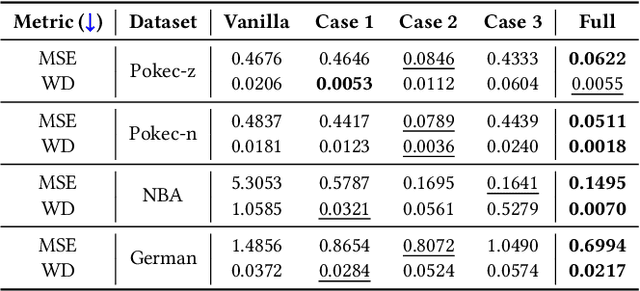
Graph Neural Networks (GNNs) excel at learning from structured data, yet fairness in regression tasks remains underexplored. Existing approaches mainly target classification and representation-level debiasing, which cannot fully address the continuous nature of node-level regression. We propose FnRGNN, a fairness-aware in-processing framework for GNN-based node regression that applies interventions at three levels: (i) structure-level edge reweighting, (ii) representation-level alignment via MMD, and (iii) prediction-level normalization through Sinkhorn-based distribution matching. This multi-level strategy ensures robust fairness under complex graph topologies. Experiments on four real-world datasets demonstrate that FnRGNN reduces group disparities without sacrificing performance. Code is available at https://github.com/sybeam27/FnRGNN.
HyperCLOVA X Technical Report
Apr 13, 2024We introduce HyperCLOVA X, a family of large language models (LLMs) tailored to the Korean language and culture, along with competitive capabilities in English, math, and coding. HyperCLOVA X was trained on a balanced mix of Korean, English, and code data, followed by instruction-tuning with high-quality human-annotated datasets while abiding by strict safety guidelines reflecting our commitment to responsible AI. The model is evaluated across various benchmarks, including comprehensive reasoning, knowledge, commonsense, factuality, coding, math, chatting, instruction-following, and harmlessness, in both Korean and English. HyperCLOVA X exhibits strong reasoning capabilities in Korean backed by a deep understanding of the language and cultural nuances. Further analysis of the inherent bilingual nature and its extension to multilingualism highlights the model's cross-lingual proficiency and strong generalization ability to untargeted languages, including machine translation between several language pairs and cross-lingual inference tasks. We believe that HyperCLOVA X can provide helpful guidance for regions or countries in developing their sovereign LLMs.
Automated Precision Localization of Peripherally Inserted Central Catheter Tip through Model-Agnostic Multi-Stage Networks
Jun 14, 2022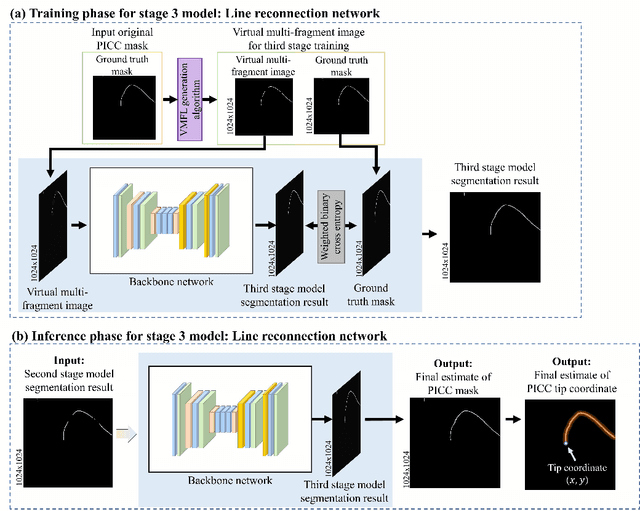

Peripherally inserted central catheters (PICCs) have been widely used as one of the representative central venous lines (CVCs) due to their long-term intravascular access with low infectivity. However, PICCs have a fatal drawback of a high frequency of tip mispositions, increasing the risk of puncture, embolism, and complications such as cardiac arrhythmias. To automatically and precisely detect it, various attempts have been made by using the latest deep learning (DL) technologies. However, even with these approaches, it is still practically difficult to determine the tip location because the multiple fragments phenomenon (MFP) occurs in the process of predicting and extracting the PICC line required before predicting the tip. This study aimed to develop a system generally applied to existing models and to restore the PICC line more exactly by removing the MFs of the model output, thereby precisely localizing the actual tip position for detecting its disposition. To achieve this, we proposed a multi-stage DL-based framework post-processing the PICC line extraction result of the existing technology. The performance was compared by each root mean squared error (RMSE) and MFP incidence rate according to whether or not MFCN is applied to five conventional models. In internal validation, when MFCN was applied to the existing single model, MFP was improved by an average of 45%. The RMSE was improved by over 63% from an average of 26.85mm (17.16 to 35.80mm) to 9.72mm (9.37 to 10.98mm). In external validation, when MFCN was applied, the MFP incidence rate decreased by an average of 32% and the RMSE decreased by an average of 65\%. Therefore, by applying the proposed MFCN, we observed the significant/consistent detection performance improvement of PICC tip location compared to the existing model.
Technologies for AI-Driven Fashion Social Networking Service with E-Commerce
Mar 11, 2022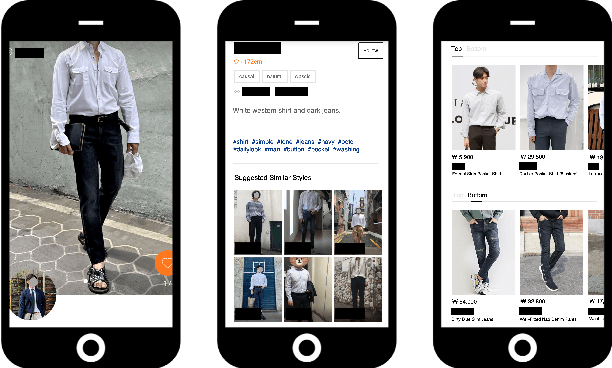
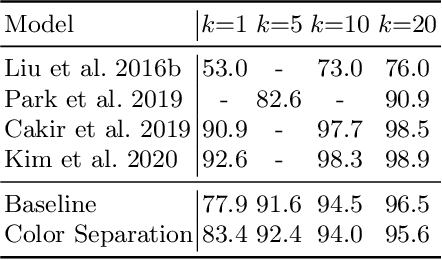
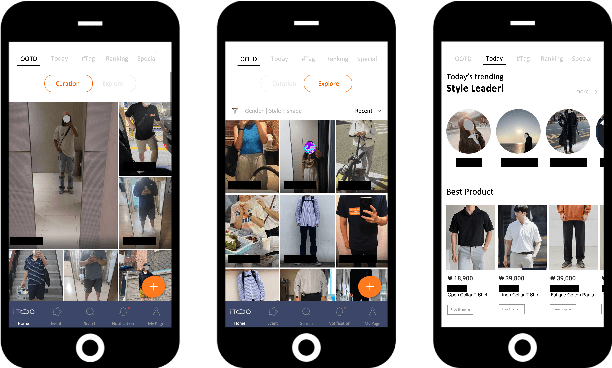
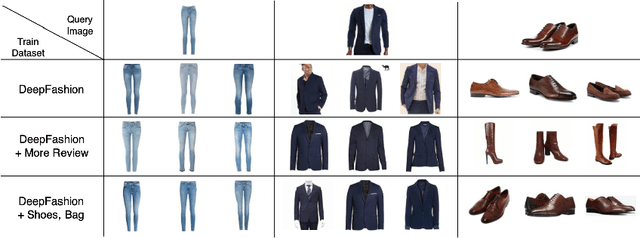
The rapid growth of the online fashion market brought demands for innovative fashion services and commerce platforms. With the recent success of deep learning, many applications employ AI technologies such as visual search and recommender systems to provide novel and beneficial services. In this paper, we describe applied technologies for AI-driven fashion social networking service that incorporate fashion e-commerce. In the application, people can share and browse their outfit-of-the-day (OOTD) photos, while AI analyzes them and suggests similar style OOTDs and related products. To this end, we trained deep learning based AI models for fashion and integrated them to build a fashion visual search system and a recommender system for OOTD. With aforementioned technologies, the AI-driven fashion SNS platform, iTOO, has been successfully launched.