 Add to Chrome
 Add to Firefox
 Add to Edge
Anti-Prompt: Image Protection against Text-Guided Image-to-Video Generation
Jul 01, 2026
Recent advances in Image-to-Video generation allow a single image to be animated into a convincing video under text guidance, raising serious copyright and privacy risks. We propose Anti-Prompt, an image protection approach that injects imperceptible perturbations into an image, inducing visible inconsistencies and structural failures in text-guided I2V generation. Our method is motivated by a simple empirical observation. When text guidance is removed from modern I2V models, generation quality degrades markedly, not only in motion realism but also in subject preservation, structural coherence, and temporal consistency. Building on this insight, Anti-Prompt exploits the model reliance on textual guidance by attenuating text-conditioned interactions during denoising while strengthening visual-only pathways. To further systematically evaluate protection effectiveness, we introduce a Video-LLM-assisted evaluation protocol that provides interpretable, frame-grounded analyses of generation artifacts and inconsistencies. Experiments on two representative I2V architectures demonstrate that our method achieves strong protection performance while improving efficiency and cross-model transferability.

RetroReasoner: A Reasoning LLM for Strategic Retrosynthesis Prediction
Mar 13, 2026Retrosynthesis prediction is a core task in organic synthesis that aims to predict reactants for a given product molecule. Traditionally, chemists select a plausible bond disconnection and derive corresponding reactants, which is time-consuming and requires substantial expertise. While recent advancements in molecular large language models (LLMs) have made progress, many methods either predict reactants without strategic reasoning or conduct only a generic product analysis, rather than reason explicitly about bond-disconnection strategies that logically lead to the choice of specific reactants. To overcome these limitations, we propose RetroReasoner, a retrosynthetic reasoning model that leverages chemists' strategic thinking. RetroReasoner is trained using both supervised fine-tuning (SFT) and reinforcement learning (RL). For SFT, we introduce SyntheticRetro, a framework that generates structured disconnection rationales alongside reactant predictions. In the case of RL, we apply a round-trip accuracy as reward, where predicted reactants are passed through a forward synthesis model, and predictions are rewarded when the forward-predicted product matches the original input product. Experimental results show that RetroReasoner not only outperforms prior baselines but also generates a broader range of feasible reactant proposals, particularly in handling more challenging reaction instances.
Universal Image Immunization against Diffusion-based Image Editing via Semantic Injection
Feb 16, 2026Recent advances in diffusion models have enabled powerful image editing capabilities guided by natural language prompts, unlocking new creative possibilities. However, they introduce significant ethical and legal risks, such as deepfakes and unauthorized use of copyrighted visual content. To address these risks, image immunization has emerged as a promising defense against AI-driven semantic manipulation. Yet, most existing approaches rely on image-specific adversarial perturbations that require individual optimization for each image, thereby limiting scalability and practicality. In this paper, we propose the first universal image immunization framework that generates a single, broadly applicable adversarial perturbation specifically designed for diffusion-based editing pipelines. Inspired by universal adversarial perturbation (UAP) techniques used in targeted attacks, our method generates a UAP that embeds a semantic target into images to be protected. Simultaneously, it suppresses original content to effectively misdirect the model's attention during editing. As a result, our approach effectively blocks malicious editing attempts by overwriting the original semantic content in the image via the UAP. Moreover, our method operates effectively even in data-free settings without requiring access to training data or domain knowledge, further enhancing its practicality and broad applicability in real-world scenarios. Extensive experiments show that our method, as the first universal immunization approach, significantly outperforms several baselines in the UAP setting. In addition, despite the inherent difficulty of universal perturbations, our method also achieves performance on par with image-specific methods under a more restricted perturbation budget, while also exhibiting strong black-box transferability across different diffusion models.
Score-informed Neural Operator for Enhancing Ordering-based Causal Discovery
Aug 18, 2025Ordering-based approaches to causal discovery identify topological orders of causal graphs, providing scalable alternatives to combinatorial search methods. Under the Additive Noise Model (ANM) assumption, recent causal ordering methods based on score matching require an accurate estimation of the Hessian diagonal of the log-densities. However, previous approaches mainly use Stein gradient estimators, which are computationally expensive and memory-intensive. Although DiffAN addresses these limitations by substituting kernel-based estimates with diffusion models, it remains numerically unstable due to the second-order derivatives of score models. To alleviate these problems, we propose Score-informed Neural Operator (SciNO), a probabilistic generative model in smooth function spaces designed to stably approximate the Hessian diagonal and to preserve structural information during the score modeling. Empirical results show that SciNO reduces order divergence by 42.7% on synthetic graphs and by 31.5% on real-world datasets on average compared to DiffAN, while maintaining memory efficiency and scalability. Furthermore, we propose a probabilistic control algorithm for causal reasoning with autoregressive models that integrates SciNO's probability estimates with autoregressive model priors, enabling reliable data-driven causal ordering informed by semantic information. Consequently, the proposed method enhances causal reasoning abilities of LLMs without additional fine-tuning or prompt engineering.
Data-free Universal Adversarial Perturbation with Pseudo-semantic Prior
Feb 28, 2025Data-free Universal Adversarial Perturbation (UAP) is an image-agnostic adversarial attack that deceives deep neural networks using a single perturbation generated solely from random noise, without any data priors. However, traditional data-free UAP methods often suffer from limited transferability due to the absence of semantic information in random noise. To address this, we propose a novel data-free universal attack approach that generates a pseudo-semantic prior recursively from the UAPs, enriching semantic contents within the data-free UAP framework. Our method is based on the observation that UAPs inherently contain latent semantic information, enabling the generated UAP to act as an alternative data prior, by capturing a diverse range of semantics through region sampling. We further introduce a sample reweighting technique to emphasize hard examples by focusing on samples that are less affected by the UAP. By leveraging the semantic information from the pseudo-semantic prior, we also incorporate input transformations, typically ineffective in data-free UAPs due to the lack of semantic content in random priors, to boost black-box transferability. Comprehensive experiments on ImageNet show that our method achieves state-of-the-art performance in average fooling rate by a substantial margin, significantly improves attack transferability across various CNN architectures compared to existing data-free UAP methods, and even surpasses data-dependent UAP methods.
Mol-LLM: Generalist Molecular LLM with Improved Graph Utilization
Feb 05, 2025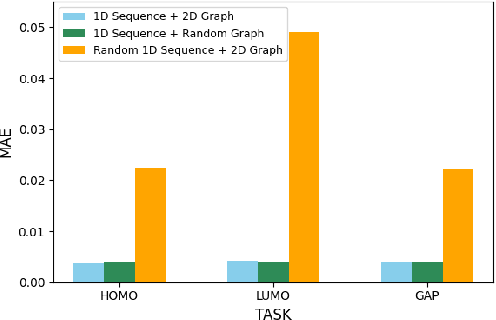
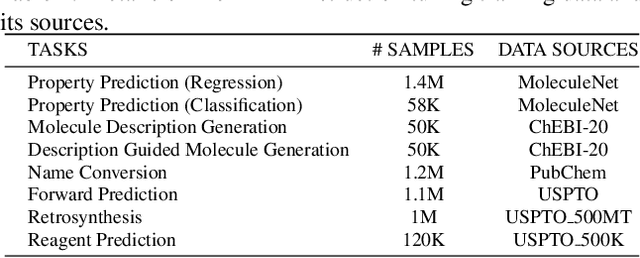

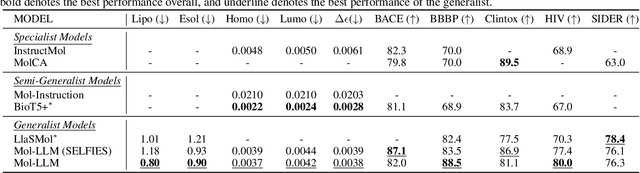
Recent advances in Large Language Models (LLMs) have motivated the development of general LLMs for molecular tasks. While several studies have demonstrated that fine-tuned LLMs can achieve impressive benchmark performances, they are far from genuine generalist molecular LLMs due to a lack of fundamental understanding of molecular structure. Specifically, when given molecular task instructions, LLMs trained with naive next-token prediction training assign similar likelihood scores to both original and negatively corrupted molecules, revealing their lack of molecular structure understanding that is crucial for reliable and general molecular LLMs. To overcome this limitation and obtain a true generalist molecular LLM, we introduce a novel multi-modal training method based on a thorough multi-modal instruction tuning as well as a molecular structure preference optimization between chosen and rejected graphs. On various molecular benchmarks, the proposed generalist molecular LLM, called Mol-LLM, achieves state-of-the-art performances among generalist LLMs on most tasks, at the same time, surpassing or comparable to state-of-the-art specialist LLMs. Moreover, Mol-LLM also shows superior generalization performances in reaction prediction tasks, demonstrating the effect of the molecular structure understanding for generalization perspective.
Scalable Multi-Task Transfer Learning for Molecular Property Prediction
Oct 01, 2024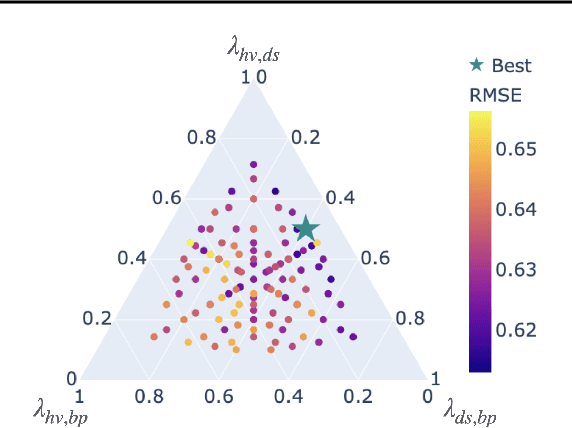

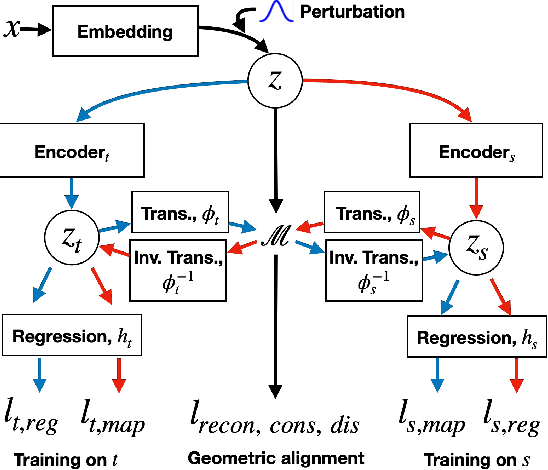
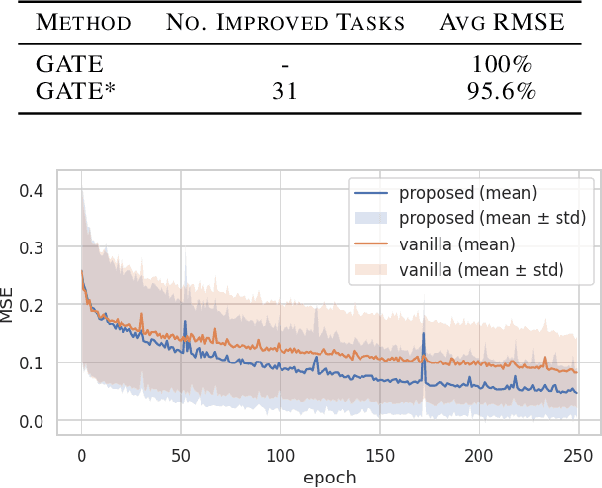
Molecules have a number of distinct properties whose importance and application vary. Often, in reality, labels for some properties are hard to achieve despite their practical importance. A common solution to such data scarcity is to use models of good generalization with transfer learning. This involves domain experts for designing source and target tasks whose features are shared. However, this approach has limitations: i). Difficulty in accurate design of source-target task pairs due to the large number of tasks, and ii). corresponding computational burden verifying many trials and errors of transfer learning design, thereby iii). constraining the potential of foundation modeling of multi-task molecular property prediction. We address the limitations of the manual design of transfer learning via data-driven bi-level optimization. The proposed method enables scalable multi-task transfer learning for molecular property prediction by automatically obtaining the optimal transfer ratios. Empirically, the proposed method improved the prediction performance of 40 molecular properties and accelerated training convergence.
Task Addition in Multi-Task Learning by Geometrical Alignment
Sep 25, 2024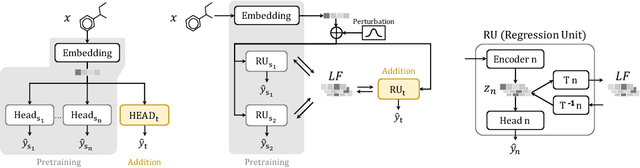

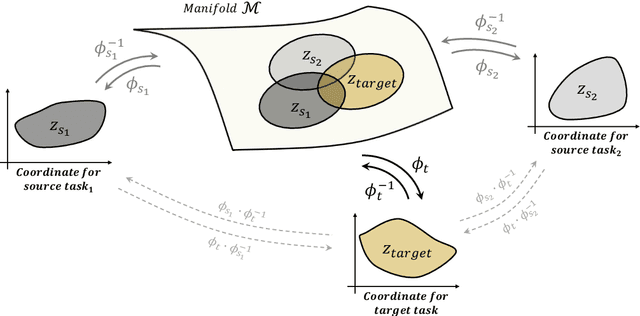

Training deep learning models on limited data while maintaining generalization is one of the fundamental challenges in molecular property prediction. One effective solution is transferring knowledge extracted from abundant datasets to those with scarce data. Recently, a novel algorithm called Geometrically Aligned Transfer Encoder (GATE) has been introduced, which uses soft parameter sharing by aligning the geometrical shapes of task-specific latent spaces. However, GATE faces limitations in scaling to multiple tasks due to computational costs. In this study, we propose a task addition approach for GATE to improve performance on target tasks with limited data while minimizing computational complexity. It is achieved through supervised multi-task pre-training on a large dataset, followed by the addition and training of task-specific modules for each target task. Our experiments demonstrate the superior performance of the task addition strategy for GATE over conventional multi-task methods, with comparable computational costs.
Multitask Extension of Geometrically Aligned Transfer Encoder
May 03, 2024
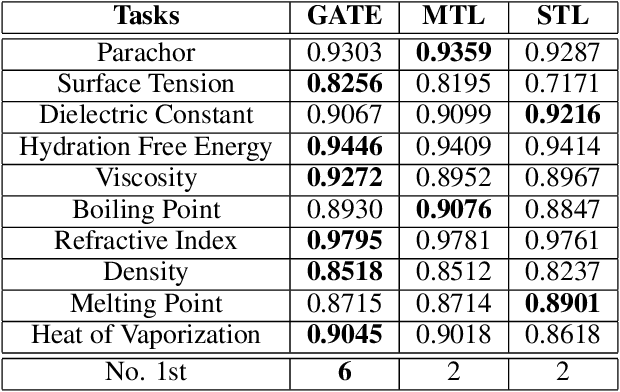


Molecular datasets often suffer from a lack of data. It is well-known that gathering data is difficult due to the complexity of experimentation or simulation involved. Here, we leverage mutual information across different tasks in molecular data to address this issue. We extend an algorithm that utilizes the geometric characteristics of the encoding space, known as the Geometrically Aligned Transfer Encoder (GATE), to a multi-task setup. Thus, we connect multiple molecular tasks by aligning the curved coordinates onto locally flat coordinates, ensuring the flow of information from source tasks to support performance on target data.
Can We Utilize Pre-trained Language Models within Causal Discovery Algorithms?
Nov 19, 2023Scaling laws have allowed Pre-trained Language Models (PLMs) into the field of causal reasoning. Causal reasoning of PLM relies solely on text-based descriptions, in contrast to causal discovery which aims to determine the causal relationships between variables utilizing data. Recently, there has been current research regarding a method that mimics causal discovery by aggregating the outcomes of repetitive causal reasoning, achieved through specifically designed prompts. It highlights the usefulness of PLMs in discovering cause and effect, which is often limited by a lack of data, especially when dealing with multiple variables. Conversely, the characteristics of PLMs which are that PLMs do not analyze data and they are highly dependent on prompt design leads to a crucial limitation for directly using PLMs in causal discovery. Accordingly, PLM-based causal reasoning deeply depends on the prompt design and carries out the risk of overconfidence and false predictions in determining causal relationships. In this paper, we empirically demonstrate the aforementioned limitations of PLM-based causal reasoning through experiments on physics-inspired synthetic data. Then, we propose a new framework that integrates prior knowledge obtained from PLM with a causal discovery algorithm. This is accomplished by initializing an adjacency matrix for causal discovery and incorporating regularization using prior knowledge. Our proposed framework not only demonstrates improved performance through the integration of PLM and causal discovery but also suggests how to leverage PLM-extracted prior knowledge with existing causal discovery algorithms.