 Add to Chrome
 Add to Firefox
 Add to Edge
Phase-Coherent D-MIMO ISAC: Multi-Target Estimation and Spectral Efficiency Trade-Offs
Paper and Code
Dec 26, 2025
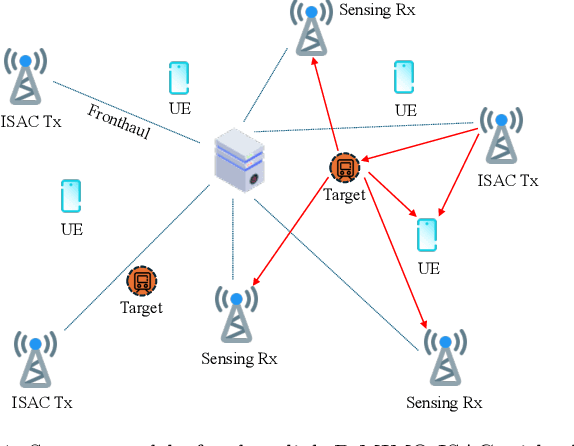
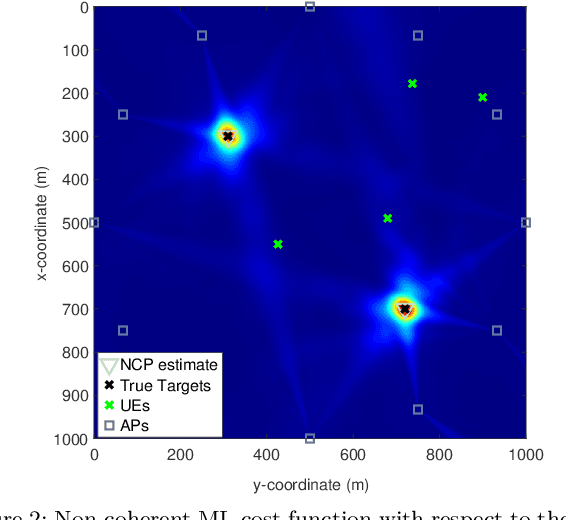
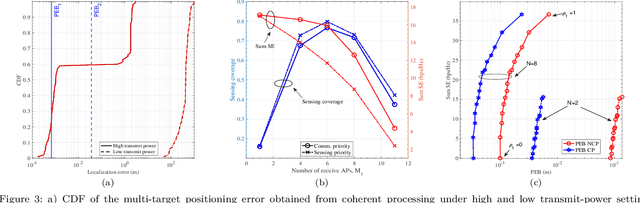
We investigate distributed multiple-input multiple-output (D-MIMO) integrated sensing and communication (ISAC) systems, in which multiple phase-synchronized access points (APs) jointly serve user equipments (UEs) while cooperatively detecting and estimating multiple static targets. To achieve high-accuracy multi-target estimation, we propose a two-stage sensing framework combining non-coherent and coherent maximum-likelihood (ML) estimation. In parallel, adaptive AP mode-selection strategies are introduced to balance communication and sensing performance: a communication-centric scheme that maximizes downlink spectral efficiency (SE) and a sensing-centric scheme that selects geometrically diverse receive APs to enhance sensing coverage. Simulation results confirm the SE-sensing trade-off, where appropriate power allocation between communication and sensing and larger array apertures alleviate performance degradation, achieving high SE with millimeter-level sensing precision. We further demonstrate that the proposed AP-selection strategy reveals an optimal number of receive APs that maximizes sensing coverage without significantly sacrificing SE.
