 Add to Chrome
 Add to Firefox
 Add to Edge
RIS-Assisted D-MIMO for Energy-Efficient 6G Indoor Networks
Mar 25, 2026
We propose an alternating optimization framework for maximizing energy efficiency (EE) in reconfigurable intelligent surface (RIS) assisted distributed MIMO (D-MIMO) systems under both coherent and non-coherent reception modes. The framework jointly optimizes access point (AP) power allocation and RIS phase configurations to improve EE under per-AP power and signal-to-interference-plus-noise ratio (SINR) constraints. Using majorization-minimization for power allocation together with per-element RIS adaptation, the framework achieves tractable optimization of this non-convex problem. Simulation results for indoor deployments with realistic power-consumption models show that the proposed scheme outperforms equal-power and random-scatterer baselines, with clear EE gains. We evaluate the performance of both reception modes and quantify the impact of RIS phase-shift optimization, RIS controller architectures (centralized vs. per-RIS control), and RIS size, providing design insights for practical RIS-assisted D-MIMO deployments in future 6G networks.

Phase-Coherent D-MIMO ISAC: Multi-Target Estimation and Spectral Efficiency Trade-Offs
Dec 26, 2025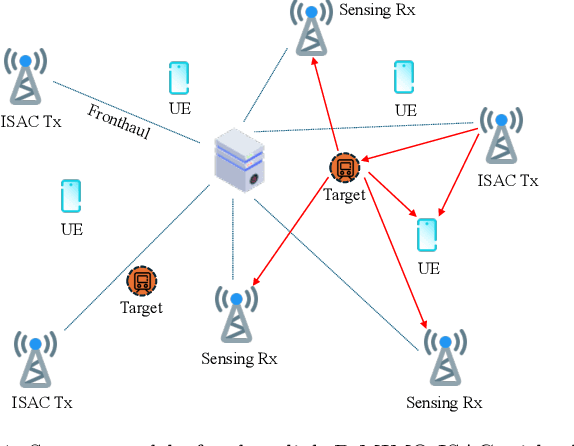
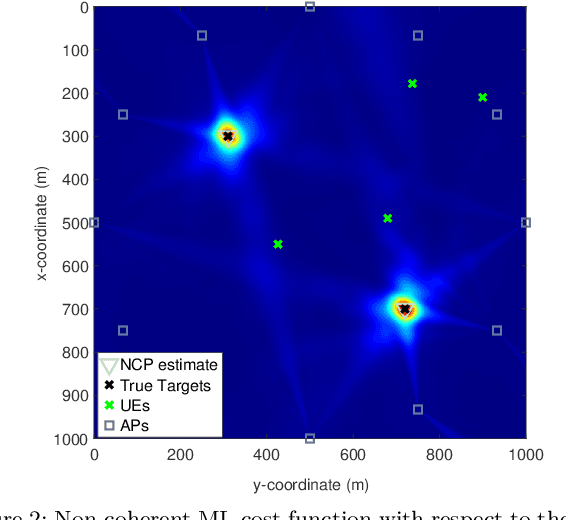
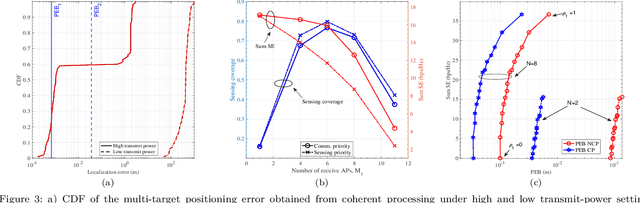
We investigate distributed multiple-input multiple-output (D-MIMO) integrated sensing and communication (ISAC) systems, in which multiple phase-synchronized access points (APs) jointly serve user equipments (UEs) while cooperatively detecting and estimating multiple static targets. To achieve high-accuracy multi-target estimation, we propose a two-stage sensing framework combining non-coherent and coherent maximum-likelihood (ML) estimation. In parallel, adaptive AP mode-selection strategies are introduced to balance communication and sensing performance: a communication-centric scheme that maximizes downlink spectral efficiency (SE) and a sensing-centric scheme that selects geometrically diverse receive APs to enhance sensing coverage. Simulation results confirm the SE-sensing trade-off, where appropriate power allocation between communication and sensing and larger array apertures alleviate performance degradation, achieving high SE with millimeter-level sensing precision. We further demonstrate that the proposed AP-selection strategy reveals an optimal number of receive APs that maximizes sensing coverage without significantly sacrificing SE.
Hardware-Impaired Rician-Faded Cell-Free Massive MIMO Systems With Channel Aging
Apr 18, 2023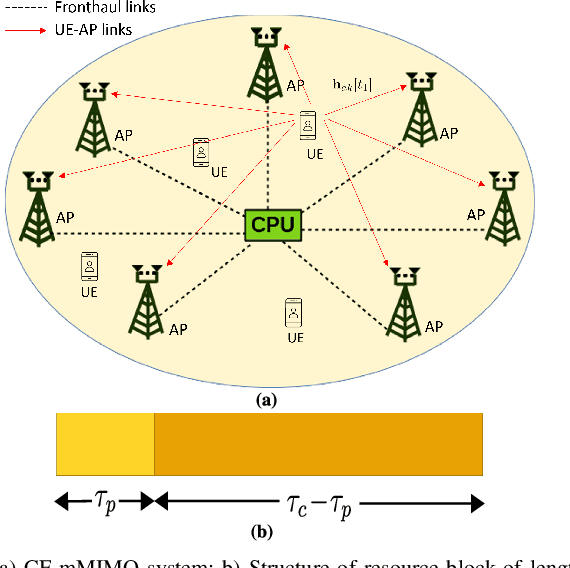
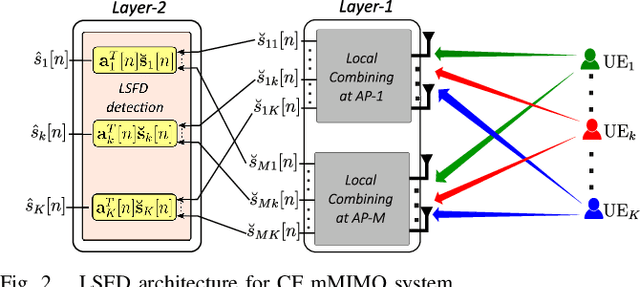
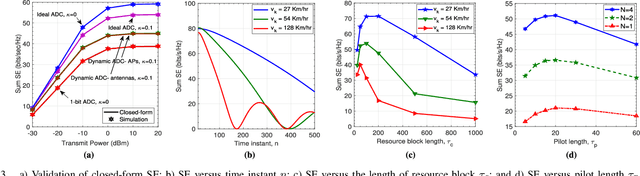
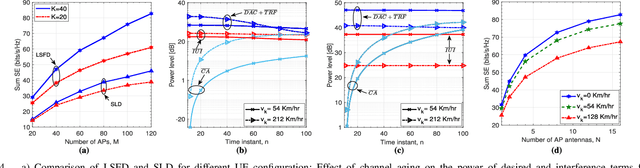
We study the impact of channel aging on the uplink of a cell-free (CF) massive multiple-input multiple-output (mMIMO) system by considering i) spatially-correlated Rician-faded channels; ii) hardware impairments at the access points and user equipments (UEs); and iii) two-layer large-scale fading decoding (LSFD). We first derive a closed-form spectral efficiency (SE) expression for this system, and later propose two novel optimization techniques to optimize the non-convex SE metric by exploiting the minorization-maximization (MM) method. The first one requires a numerical optimization solver, and has a high computation complexity. The second one with closed-form transmit power updates, has a trivial computation complexity. We numerically show that i) the two-layer LSFD scheme effectively mitigates the interference due to channel aging for both low- and high-velocity UEs; and ii) increasing the number of AP antennas does not mitigate the SE deterioration due to channel aging. We numerically characterize the optimal pilot length required to maximize the SE for various UE speeds. We also numerically show that the proposed closed-form MM optimization yields the same SE as that of the first technique, which requires numerical solver, and that too with a much reduced time-complexity.
LSFD for Rician-Faded Cell-Free mMIMO Systems With Channel Aging and Hardware Impairments
Feb 21, 2023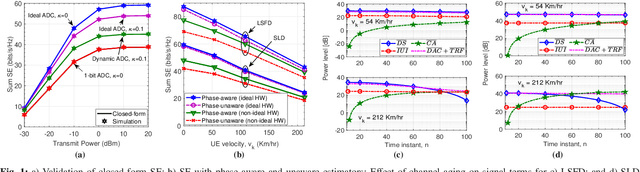
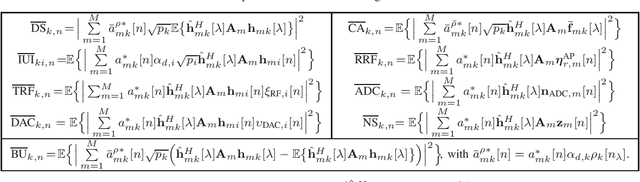
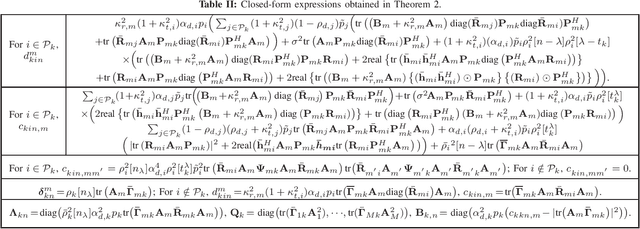
We study the impact of channel aging on the uplink of a cell-free massive multiple-input multiple-output system with hardware impairments. We consider a dynamic analog-to-digital converter architecture at the access points (APs), and low-resolution digital-to-analog converters at the user equipments (UEs). We derive a closed-form spectral efficiency expression by considering i) practical spatially-correlated Rician channels; ii) hardware impairments at the APs and the UEs; iii) channel aging; and iv) large-scale fading decoding (LSFD). We show that LSFD can effectively mitigate the detrimental effects of i) channel aging for both low and high UE velocities; and ii) inter-user interference for low-velocity UEs but not for high-velocity UEs.
Hardware-Aware Pilot Decontamination Precoding for Multi-cell mMIMO Systems With Rician Fading
Nov 29, 2022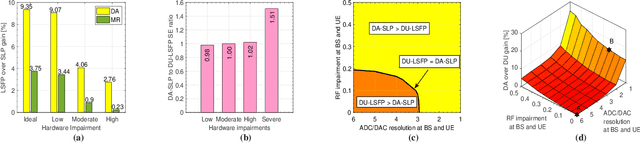
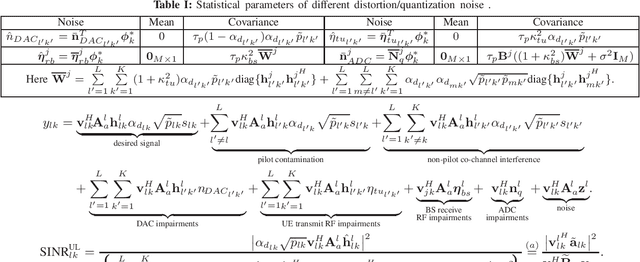
We consider a hardware-impaired multi-cell Rician faded massive multi-input multi-output (mMIMO) system with two-layer pilot decontamination precoding, also known as large-scale fading precoding (LSFP). Each BS is equipped with a flexible dynamic analog-to-digital converter (ADC)/digital-to-analog converter (DAC) architecture and the user equipments (UEs) have low-resolution ADCs. Further, both BS and UEs have hardwareimpaired radio frequency chains. The dynamic ADC/DAC architecture allows us to vary the resolution of ADC/DAC connected to each BS antenna, and suitably choose them to maximize the SE. We propose a distortion-aware minimum mean squared error (DA-MMSE) precoder and investigate its usage with two-layer LSFP and conventional single-layer precoding (SLP) for hardware-impaired mMIMO systems. We discuss the use cases of LSFP and SLP with DA-MMSE and distortion-unaware MMSE (DU-MMSE) precoders, which will provide critical insights to the system designer regarding their usage in practical systems.