 Add to Chrome
 Add to Firefox
 Add to Edge
When Agentic AI Meets Integrated Sensing and Communication
Aug 06, 2026
Agentic artificial intelligence (AI) is transforming Integrated Sensing and Communication (ISAC) from a function-oriented physical-layer technology into a goal-driven, closed-loop intelligent system, a paradigm we term AISAC. Existing work on learning-based sensing, resource allocation, reconfigurable intelligent surfaces (RIS), edge intelligence, multi-agent coordination, and resilient networking has developed largely in isolation. This survey unifies the literature within a six-stage closed-loop framework comprising observation, contextualization, reasoning and prediction, planning and orchestration, execution and collaboration, and feedback and resilience. It also introduces five levels of agentic maturity, ranging from physical-layer primitives to fully closed-loop agentic ISAC. We use this framework to review advances in multimodal intelligence, large language models, reinforcement learning, federated learning, RIS-assisted control, Unmanned Aerial Vehicle (UAV) and vehicular networks, and AI-native network management, and analyze privacy, security, resilience, and sustainability as cross-cutting requirements of the full perception-reasoning-action loop. An audit of representative studies against nine agentic-specific evaluation criteria shows that no system reports more than one or two of them, exposing a gap between claimed and demonstrated agentic maturity. We identify open challenges in physical-to-semantic grounding, predictive world models, real-time agent-PHY interaction, safe tool use, heterogeneous multi-agent collaboration, benchmarking, and resource-efficient autonomy.

Attacking Slicing Network via Side-channel Reinforcement Learning Attack
Sep 17, 2024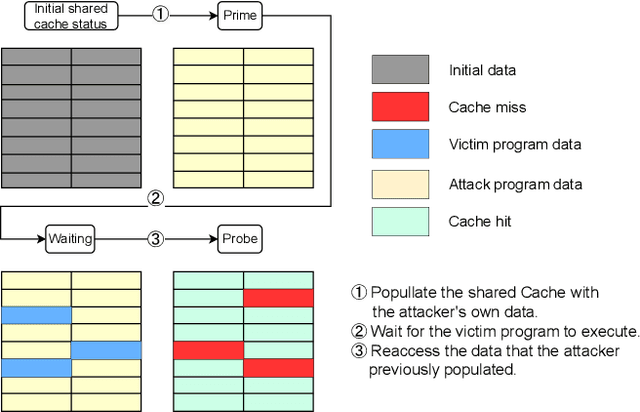


Network slicing in 5G and the future 6G networks will enable the creation of multiple virtualized networks on a shared physical infrastructure. This innovative approach enables the provision of tailored networks to accommodate specific business types or industry users, thus delivering more customized and efficient services. However, the shared memory and cache in network slicing introduce security vulnerabilities that have yet to be fully addressed. In this paper, we introduce a reinforcement learning-based side-channel cache attack framework specifically designed for network slicing environments. Unlike traditional cache attack methods, our framework leverages reinforcement learning to dynamically identify and exploit cache locations storing sensitive information, such as authentication keys and user registration data. We assume that one slice network is compromised and demonstrate how the attacker can induce another shared slice to send registration requests, thereby estimating the cache locations of critical data. By formulating the cache timing channel attack as a reinforcement learning-driven guessing game between the attack slice and the victim slice, our model efficiently explores possible actions to pinpoint memory blocks containing sensitive information. Experimental results showcase the superiority of our approach, achieving a success rate of approximately 95\% to 98\% in accurately identifying the storage locations of sensitive data. This high level of accuracy underscores the potential risks in shared network slicing environments and highlights the need for robust security measures to safeguard against such advanced side-channel attacks.
One-Shot Collaborative Data Distillation
Aug 05, 2024
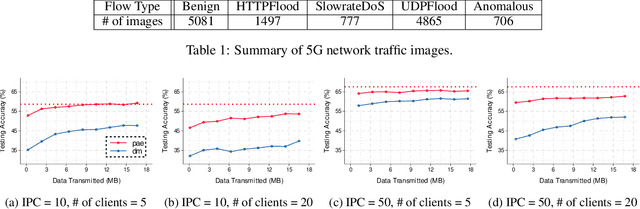

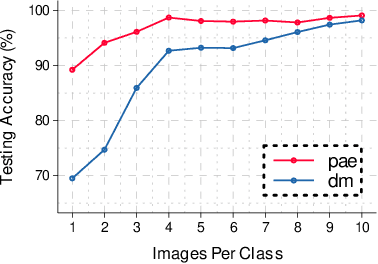
Large machine-learning training datasets can be distilled into small collections of informative synthetic data samples. These synthetic sets support efficient model learning and reduce the communication cost of data sharing. Thus, high-fidelity distilled data can support the efficient deployment of machine learning applications in distributed network environments. A naive way to construct a synthetic set in a distributed environment is to allow each client to perform local data distillation and to merge local distillations at a central server. However, the quality of the resulting set is impaired by heterogeneity in the distributions of the local data held by clients. To overcome this challenge, we introduce the first collaborative data distillation technique, called CollabDM, which captures the global distribution of the data and requires only a single round of communication between client and server. Our method outperforms the state-of-the-art one-shot learning method on skewed data in distributed learning environments. We also show the promising practical benefits of our method when applied to attack detection in 5G networks.