 Add to Chrome
 Add to Firefox
 Add to Edge
AquaGen: Scaling generative models to molecular dynamics precision on thousands of atoms
Jul 03, 2026
We present AquaGen, the first all-atom, explicit solvent, periodic-boundary-condition-aware generative model that produces molecular configurations from the Boltzmann distribution at a fraction of the cost of molecular dynamics (MD). This is in contrast with existing generative models that remove degrees of freedom by operating on coarse-grained, vacuum, or implicit solvent systems. Operating at this resolution allows for post-processing through force field energy evaluations and MD simulations, and enables the prediction of relevant properties in a gray-box manner (as ensemble averages of potential energy evaluations over generated samples). We demonstrate the utility of this paradigm on absolute hydration free energy (AHFE), producing estimates 4-10x faster and with comparable accuracy to standard GPU-based MD. By generating uncorrelated samples from alchemical Boltzmann distributions, we create more accurate, interpretable, and refinable ensemble predictions with calibrated uncertainty estimates, unlike regression methods which are entirely black-box predictors. Our approach also yields predictable benefits from increasing train- and test-time compute, realized by scaling model size and generating more samples, respectively. We believe that this approach demonstrates the utility of high-resolution ensemble generation for free energy estimation, with future potential to replace MD in tasks such as the prediction of lipophilicity, membrane permeability, or absolute binding free energy (ABFE) -- whose grounding and interpretability may be critical for the development of new drugs and materials.

PDEInvBench: A Comprehensive Dataset and Design Space Exploration of Neural Networks for PDE Inverse Problems
May 26, 2026Inverse problems in partial differential equations (PDEs) involve estimating the physical parameters of a system from observed spatiotemporal solution fields. Neural networks are well-suited for PDE parameter estimation due to their capability to model function-to-function space transformations. While existing benchmarks of machine learning methods for PDEs primarily focus on the forward problem, there are no similar comprehensive studies and benchmark datasets on PDE inverse problems, i.e., mapping solution fields to underlying physical parameters. We fill this gap by introducing PDEInvBench, a comprehensive benchmark dataset consisting of numerical simulations for both time-dependent and time-independent PDEs across a wide range of physical behaviors and parameters. Our dataset includes evaluation splits that assess performance in both in-distribution and various out-of-distribution settings. Using our benchmark dataset, we comprehensively explore the design space of neural networks for PDE inverse problems along three key dimensions: (1) optimization procedures, analyzing the role of supervised, self-supervised, and test-time training objectives on performance, (2) problem representations, where we study the value of architectural choices with different inductive biases and various conditioning strategies, and (3) scaling, which we perform with respect to both model and data size. Our experiments reveal several practical insights: 1) neural networks perform best with a two-stage training procedure: initial supervision with PDE parameters followed by test-time fine-tuning using the PDE residual, 2) incorporating PDE derivatives as input features consistently improves accuracy, and 3) increasing the diversity of initial conditions in the training data yields greater performance gains than expanding the range of PDE parameters. We make our dataset and codebase publicly available.
* 37 total pages, 13 main pages, 20 figures, 8 tables. Published in Transactions on Machine Learning Research (TMLR), 2026
Action-Minimization Meets Generative Modeling: Efficient Transition Path Sampling with the Onsager-Machlup Functional
May 01, 2025Transition path sampling (TPS), which involves finding probable paths connecting two points on an energy landscape, remains a challenge due to the complexity of real-world atomistic systems. Current machine learning approaches use expensive, task-specific, and data-free training procedures, limiting their ability to benefit from recent advances in atomistic machine learning, such as high-quality datasets and large-scale pre-trained models. In this work, we address TPS by interpreting candidate paths as trajectories sampled from stochastic dynamics induced by the learned score function of pre-trained generative models, specifically denoising diffusion and flow matching. Under these dynamics, finding high-likelihood transition paths becomes equivalent to minimizing the Onsager-Machlup (OM) action functional. This enables us to repurpose pre-trained generative models for TPS in a zero-shot manner, in contrast with bespoke, task-specific TPS models trained in previous work. We demonstrate our approach on varied molecular systems, obtaining diverse, physically realistic transition pathways and generalizing beyond the pre-trained model's original training dataset. Our method can be easily incorporated into new generative models, making it practically relevant as models continue to scale and improve with increased data availability.
Towards Fast, Specialized Machine Learning Force Fields: Distilling Foundation Models via Energy Hessians
Jan 15, 2025The foundation model (FM) paradigm is transforming Machine Learning Force Fields (MLFFs), leveraging general-purpose representations and scalable training to perform a variety of computational chemistry tasks. Although MLFF FMs have begun to close the accuracy gap relative to first-principles methods, there is still a strong need for faster inference speed. Additionally, while research is increasingly focused on general-purpose models which transfer across chemical space, practitioners typically only study a small subset of systems at a given time. This underscores the need for fast, specialized MLFFs relevant to specific downstream applications, which preserve test-time physical soundness while maintaining train-time scalability. In this work, we introduce a method for transferring general-purpose representations from MLFF foundation models to smaller, faster MLFFs specialized to specific regions of chemical space. We formulate our approach as a knowledge distillation procedure, where the smaller "student" MLFF is trained to match the Hessians of the energy predictions of the "teacher" foundation model. Our specialized MLFFs can be up to 20 $\times$ faster than the original foundation model, while retaining, and in some cases exceeding, its performance and that of undistilled models. We also show that distilling from a teacher model with a direct force parameterization into a student model trained with conservative forces (i.e., computed as derivatives of the potential energy) successfully leverages the representations from the large-scale teacher for improved accuracy, while maintaining energy conservation during test-time molecular dynamics simulations. More broadly, our work suggests a new paradigm for MLFF development, in which foundation models are released along with smaller, specialized simulation "engines" for common chemical subsets.
Stability-Aware Training of Neural Network Interatomic Potentials with Differentiable Boltzmann Estimators
Feb 21, 2024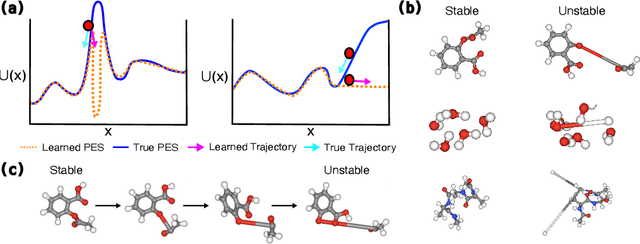

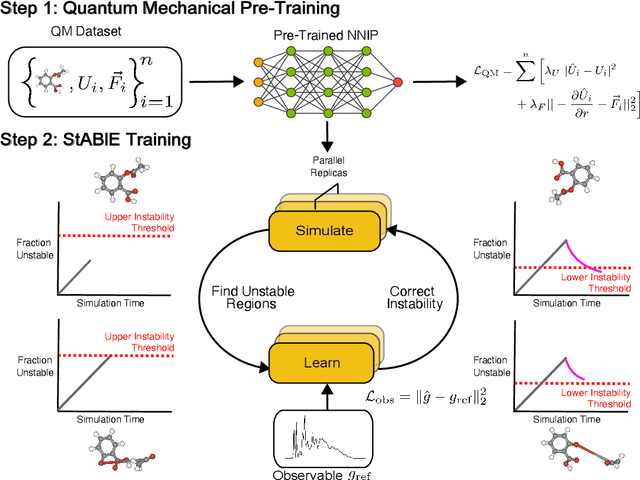

Neural network interatomic potentials (NNIPs) are an attractive alternative to ab-initio methods for molecular dynamics (MD) simulations. However, they can produce unstable simulations which sample unphysical states, limiting their usefulness for modeling phenomena occurring over longer timescales. To address these challenges, we present Stability-Aware Boltzmann Estimator (StABlE) Training, a multi-modal training procedure which combines conventional supervised training from quantum-mechanical energies and forces with reference system observables, to produce stable and accurate NNIPs. StABlE Training iteratively runs MD simulations to seek out unstable regions, and corrects the instabilities via supervision with a reference observable. The training procedure is enabled by the Boltzmann Estimator, which allows efficient computation of gradients required to train neural networks to system observables, and can detect both global and local instabilities. We demonstrate our methodology across organic molecules, tetrapeptides, and condensed phase systems, along with using three modern NNIP architectures. In all three cases, StABlE-trained models achieve significant improvements in simulation stability and recovery of structural and dynamic observables. In some cases, StABlE-trained models outperform conventional models trained on datasets 50 times larger. As a general framework applicable across NNIP architectures and systems, StABlE Training is a powerful tool for training stable and accurate NNIPs, particularly in the absence of large reference datasets.
FourCastNet: A Global Data-driven High-resolution Weather Model using Adaptive Fourier Neural Operators
Feb 22, 2022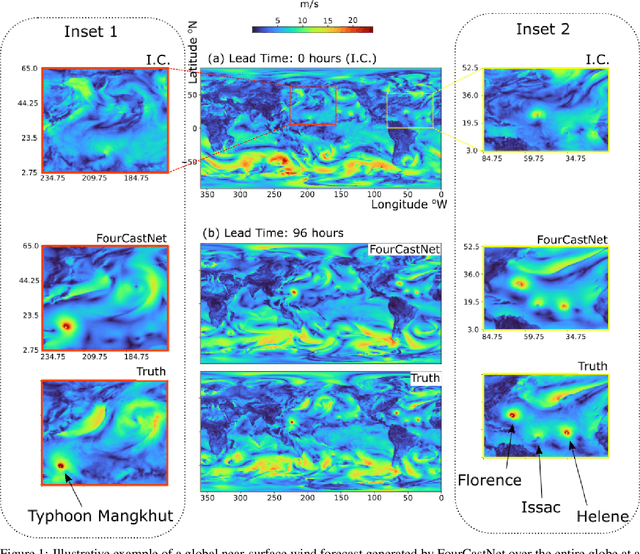
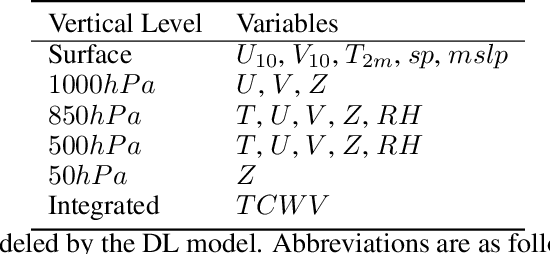
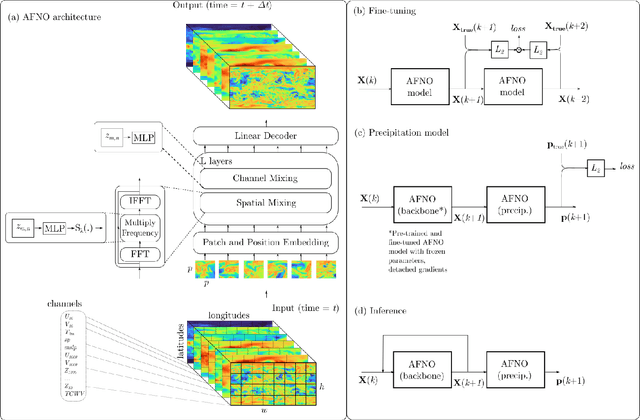
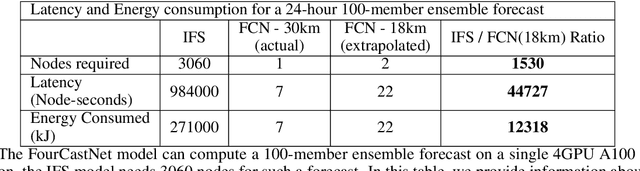
FourCastNet, short for Fourier Forecasting Neural Network, is a global data-driven weather forecasting model that provides accurate short to medium-range global predictions at $0.25^{\circ}$ resolution. FourCastNet accurately forecasts high-resolution, fast-timescale variables such as the surface wind speed, precipitation, and atmospheric water vapor. It has important implications for planning wind energy resources, predicting extreme weather events such as tropical cyclones, extra-tropical cyclones, and atmospheric rivers. FourCastNet matches the forecasting accuracy of the ECMWF Integrated Forecasting System (IFS), a state-of-the-art Numerical Weather Prediction (NWP) model, at short lead times for large-scale variables, while outperforming IFS for variables with complex fine-scale structure, including precipitation. FourCastNet generates a week-long forecast in less than 2 seconds, orders of magnitude faster than IFS. The speed of FourCastNet enables the creation of rapid and inexpensive large-ensemble forecasts with thousands of ensemble-members for improving probabilistic forecasting. We discuss how data-driven deep learning models such as FourCastNet are a valuable addition to the meteorology toolkit to aid and augment NWP models.
Multi-Stage Fault Warning for Large Electric Grids Using Anomaly Detection and Machine Learning
Mar 15, 2019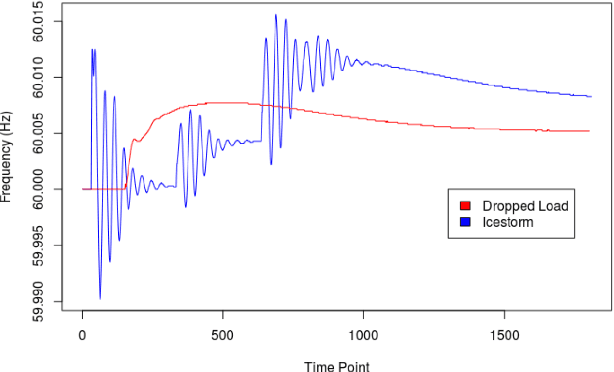
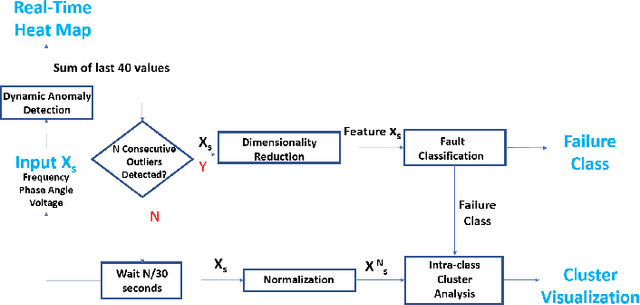
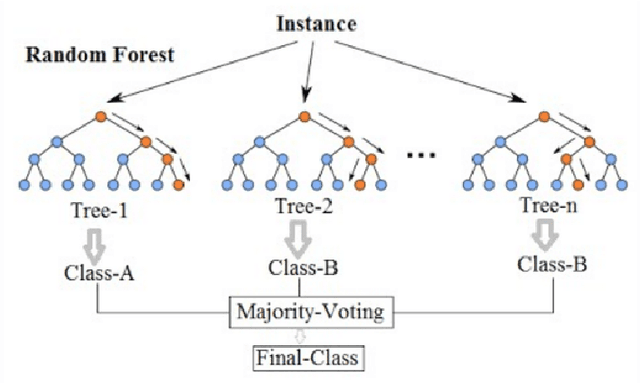
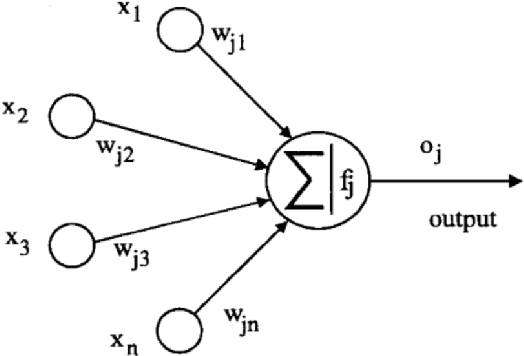
In the monitoring of a complex electric grid, it is of paramount importance to provide operators with early warnings of anomalies detected on the network, along with a precise classification and diagnosis of the specific fault type. In this paper, we propose a novel multi-stage early warning system prototype for electric grid fault detection, classification, subgroup discovery, and visualization. In the first stage, a computationally efficient anomaly detection method based on quartiles detects the presence of a fault in real time. In the second stage, the fault is classified into one of nine pre-defined disaster scenarios. The time series data are first mapped to highly discriminative features by applying dimensionality reduction based on temporal autocorrelation. The features are then mapped through one of three classification techniques: support vector machine, random forest, and artificial neural network. Finally in the third stage, intra-class clustering based on dynamic time warping is used to characterize the fault with further granularity. Results on the Bonneville Power Administration electric grid data show that i) the proposed anomaly detector is both fast and accurate; ii) dimensionality reduction leads to dramatic improvement in classification accuracy and speed; iii) the random forest method offers the most accurate, consistent, and robust fault classification; and iv) time series within a given class naturally separate into five distinct clusters which correspond closely to the geographical distribution of electric grid buses.