 Add to Chrome
 Add to Firefox
 Add to Edge
Assignment-Routing Optimization: Solvers for Problems Under Constraints
Dec 21, 2025
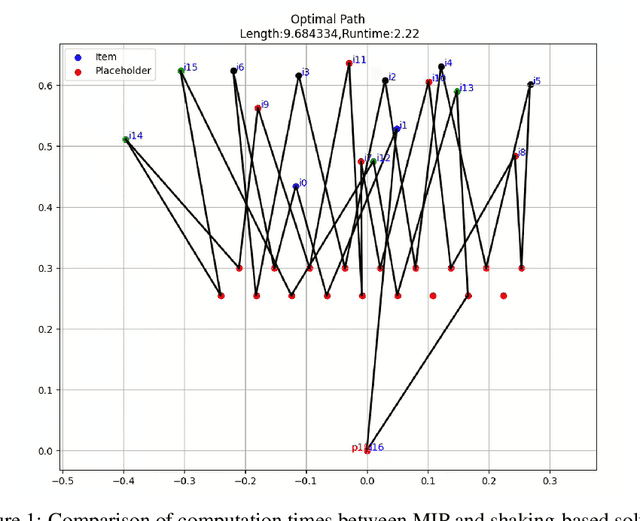
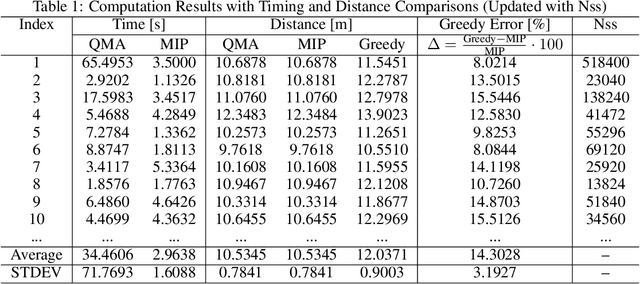
We study the Joint Routing-Assignment (JRA) problem in which items must be assigned one-to-one to placeholders while simultaneously determining a Hamiltonian cycle visiting all nodes exactly once. Extending previous exact MIP solvers with Gurobi and cutting-plane subtour elimination, we develop a solver tailored for practical packaging-planning scenarios with richer constraints.These include multiple placeholder options, time-frame restrictions, and multi-class item packaging. Experiments on 46 mobile manipulation datasets demonstrate that the proposed MIP approach achieves global optima with stable and low computation times, significantly outperforming the shaking-based exact solver by up to an orders of magnitude. Compared to greedy baselines, the MIP solutions achieve consistent optimal distances with an average deviation of 14% for simple heuristics, confirming both efficiency and solution quality. The results highlight the practical applicability of MIP-based JRA optimization for robotic packaging, motion planning, and complex logistics .

Action-Minimization Meets Generative Modeling: Efficient Transition Path Sampling with the Onsager-Machlup Functional
May 01, 2025Transition path sampling (TPS), which involves finding probable paths connecting two points on an energy landscape, remains a challenge due to the complexity of real-world atomistic systems. Current machine learning approaches use expensive, task-specific, and data-free training procedures, limiting their ability to benefit from recent advances in atomistic machine learning, such as high-quality datasets and large-scale pre-trained models. In this work, we address TPS by interpreting candidate paths as trajectories sampled from stochastic dynamics induced by the learned score function of pre-trained generative models, specifically denoising diffusion and flow matching. Under these dynamics, finding high-likelihood transition paths becomes equivalent to minimizing the Onsager-Machlup (OM) action functional. This enables us to repurpose pre-trained generative models for TPS in a zero-shot manner, in contrast with bespoke, task-specific TPS models trained in previous work. We demonstrate our approach on varied molecular systems, obtaining diverse, physically realistic transition pathways and generalizing beyond the pre-trained model's original training dataset. Our method can be easily incorporated into new generative models, making it practically relevant as models continue to scale and improve with increased data availability.