 Add to Chrome
 Add to Firefox
 Add to Edge
Traceable Multi-Agent System for Knowledge-Based Forecasting
Aug 04, 2026
Enterprise forecasting increasingly relies on autonomous agents that interpret documents, search for data, generate code, and revise models. While this autonomy helps build adaptive forecasting pipelines, it also makes it difficult for practitioners to inspect why a forecast changed, which evidence supported the change, and how data and modeling choices were revised. We present TraceMAS, an interactive demo system for traceable multi-agent forecasting. TraceMAS organizes agent outputs around two causal-loop representations: an Ideal Causal Loop Diagram (Ideal CLD), which captures key factors and their causal relations extracted from domain documents, and a Data-Grounded Causal Loop Diagram (Data-Grounded CLD), which links those factors to internal variables, external data, or documented proxies. The Data-Grounded CLD guides feature construction and model design while preserving the connection between textual evidence, data choices, and model revisions. We demonstrate TraceMAS on crude oil price forecasting. The demo interface allows users to compare forecasting iterations, inspect agent-level revisions, explore causal maps, review feature-data mappings and model architecture, and connect scenario forecasts to market narratives. This demonstration shows how autonomous forecasting agents can retain flexibility while making the evidence-to-forecast process inspectable.

FinVerse: Financial Time-Series Benchmark
Aug 04, 2026As time-series foundation models have emerged, the need for benchmarks that can evaluate their forecasting ability in meaningful ways has become increasingly important. Existing time-series forecasting benchmarks provide useful standardized comparisons, but they often evaluate heterogeneous series with uniform error-based metrics. Strong performance under such metrics does not necessarily imply that a model's forecasts will support the best real-world decisions across domains. For example, in stock forecasting, correctly predicting whether a price will rise or fall can be more directly relevant to realized returns than minimizing point-wise forecast error alone. To this end, we introduce FinVerse, a finance-domain time-series forecasting benchmark that takes a first step toward more realistic evaluation. The released FinVerse data artifact contains 116,897 financial time series with 171.1M observations, of which 60,232 series with 17.4M observations are selected as evaluated targets based on their economic relevance to financial decisions. Unlike generic forecasting benchmarks that primarily emphasize uniform point-forecast or probabilistic accuracy, FinVerse defines 11 metric families comprising 78 evaluation metrics and assigns the most appropriate evaluation metrics to each individual time series based on its underlying economic meaning. Our analysis of 43 public time-series forecasting foundation models shows that strong performance under generic forecasting criteria does not necessarily translate into useful financial forecasts. This finding highlights the need for domain-aware benchmarks that evaluate models under objectives closer to real-world decision making.
ReasonCast: Towards Explainable Time Series Forecasting with Reasoning
Aug 03, 2026Most time series (TS) models are specialized for a single task, either understanding (i.e., returning text answers about a TS) or generation (i.e., returning a numeric forecast). Only recently have unified models begun to handle the two within a single architecture. Even these models, however, produce the two outputs as task-separated paths and cannot predict a series and explain why that prediction arises within a single coherent response. In this paper, we argue for a task-fused model that jointly produces 1) prediction (generation) and 2) selfexplanation (understanding), thereby integrating 1) numerical TS forecasting and 2) interpretable text reasoning within a single response. To enable the systematic study of this capability, we present both a benchmark and a recipe that jointly address the two tasks. The benchmark, ReasonTS-Bench, identifies five fundamental patterns underlying TS and enables the joint evaluation of both tasks. ReasonCast, our recipe for finetuning any LLM to perform both tasks jointly, yields a model that generates a reasoning chain and a forecast together in a single autoregressive pass. Extensive experiments show that ReasonCast outperforms both LLMs and TS models on prediction accuracy while producing verifiable, causal reasoning. Code is available at: https://github.com/seunghan96/reasoncast.
Beyond Magnitude and Shape: A Direction-Aware Loss for Time Series Forecasting
Aug 03, 2026The direction of change --- whether a series will move up or down --- is often as important as its exact value in decisiondriven applications such as risk management and financial forecasting. However, most forecasting losses optimize either point magnitude or shape and frequency structure, and none explicitly targets the direction of change. In this paper, we find that MSE-trained forecasters fail on the direction of small moves. To address this, we propose CosDir, a simple yet effective direction-aware loss that aligns the difference vectors of the prediction and the target via cosine similarity. Being scale-invariant, CosDir keeps a directional gradient on small moves, re-injecting learning signal exactly where MSE neglects it. CosDir is a lightweight, plug-in term that attaches to any backbone without architectural modification. Since the best ratio for mixing the directional and magnitude terms differs across datasets, we further propose CosDir-UW, an extension that makes this ratio adaptive by learning it during training, matching a per-dataset tuned weight with no hyperparameter. We conduct over 100K experiments, demonstrating that our method consistently and significantly improves directional accuracy while preserving magnitude accuracy, and that it outperforms various loss functions. Code is available at: https://github.com/seunghan96/cosdir.
Channel-wise Retrieval for Multivariate Time Series Forecasting
Apr 07, 2026Multivariate time series forecasting often struggles to capture long-range dependencies due to fixed lookback windows. Retrieval-augmented forecasting addresses this by retrieving historical segments from memory, but existing approaches rely on a channel-agnostic strategy that applies the same references to all variables. This neglects inter-variable heterogeneity, where different channels exhibit distinct periodicities and spectral profiles. We propose CRAFT (Channel-wise retrieval-augmented forecasting), a novel framework that performs retrieval independently for each channel. To ensure efficiency, CRAFT adopts a two-stage pipeline: a sparse relation graph constructed in the time domain prunes irrelevant candidates, and spectral similarity in the frequency domain ranks references, emphasizing dominant periodic components while suppressing noise. Experiments on seven public benchmarks demonstrate that CRAFT outperforms state-of-the-art forecasting baselines, achieving superior accuracy with practical inference efficiency.
Detail Loss in Super-Resolution Models Based on the Laplacian Pyramid and Repeated Upscaling and Downscaling Process
Jan 14, 2026With advances in artificial intelligence, image processing has gained significant interest. Image super-resolution is a vital technology closely related to real-world applications, as it enhances the quality of existing images. Since enhancing fine details is crucial for the super-resolution task, pixels that contribute to high-frequency information should be emphasized. This paper proposes two methods to enhance high-frequency details in super-resolution images: a Laplacian pyramid-based detail loss and a repeated upscaling and downscaling process. Total loss with our detail loss guides a model by separately generating and controlling super-resolution and detail images. This approach allows the model to focus more effectively on high-frequency components, resulting in improved super-resolution images. Additionally, repeated upscaling and downscaling amplify the effectiveness of the detail loss by extracting diverse information from multiple low-resolution features. We conduct two types of experiments. First, we design a CNN-based model incorporating our methods. This model achieves state-of-the-art results, surpassing all currently available CNN-based and even some attention-based models. Second, we apply our methods to existing attention-based models on a small scale. In all our experiments, attention-based models adding our detail loss show improvements compared to the originals. These results demonstrate our approaches effectively enhance super-resolution images across different model structures.
* Accepted for publication in IET Image Processing. This is the authors' final accepted manuscript
Adaptive Information Routing for Multimodal Time Series Forecasting
Dec 23, 2025Time series forecasting is a critical task for artificial intelligence with numerous real-world applications. Traditional approaches primarily rely on historical time series data to predict the future values. However, in practical scenarios, this is often insufficient for accurate predictions due to the limited information available. To address this challenge, multimodal time series forecasting methods which incorporate additional data modalities, mainly text data, alongside time series data have been explored. In this work, we introduce the Adaptive Information Routing (AIR) framework, a novel approach for multimodal time series forecasting. Unlike existing methods that treat text data on par with time series data as interchangeable auxiliary features for forecasting, AIR leverages text information to dynamically guide the time series model by controlling how and to what extent multivariate time series information should be combined. We also present a text-refinement pipeline that employs a large language model to convert raw text data into a form suitable for multimodal forecasting, and we introduce a benchmark that facilitates multimodal forecasting experiments based on this pipeline. Experiment results with the real world market data such as crude oil price and exchange rates demonstrate that AIR effectively modulates the behavior of the time series model using textual inputs, significantly enhancing forecasting accuracy in various time series forecasting tasks.
Simplifying Formal Proof-Generating Models with ChatGPT and Basic Searching Techniques
Feb 05, 2025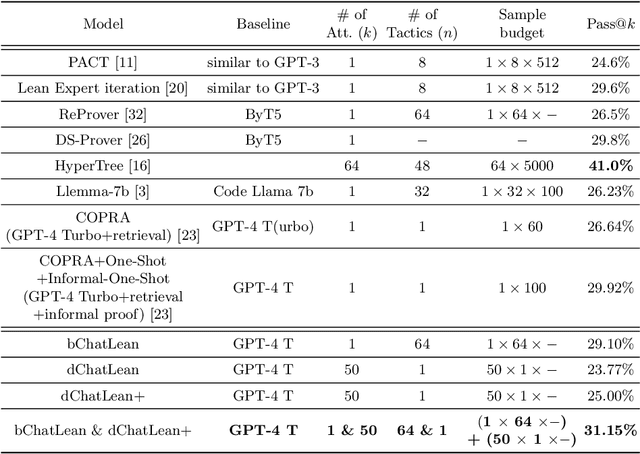
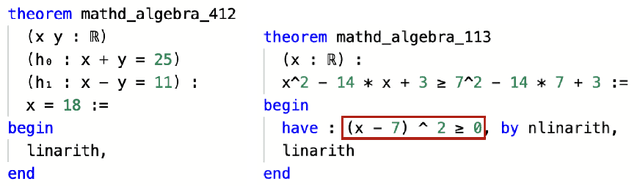
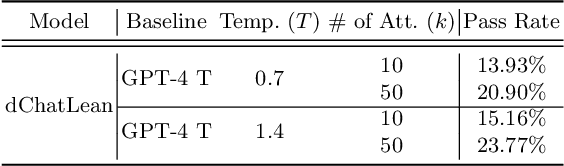
The challenge of formal proof generation has a rich history, but with modern techniques, we may finally be at the stage of making actual progress in real-life mathematical problems. This paper explores the integration of ChatGPT and basic searching techniques to simplify generating formal proofs, with a particular focus on the miniF2F dataset. We demonstrate how combining a large language model like ChatGPT with a formal language such as Lean, which has the added advantage of being verifiable, enhances the efficiency and accessibility of formal proof generation. Despite its simplicity, our best-performing Lean-based model surpasses all known benchmarks with a 31.15% pass rate. We extend our experiments to include other datasets and employ alternative language models, showcasing our models' comparable performance in diverse settings and allowing for a more nuanced analysis of our results. Our findings offer insights into AI-assisted formal proof generation, suggesting a promising direction for future research in formal mathematical proof.
Meent: Differentiable Electromagnetic Simulator for Machine Learning
Jun 11, 2024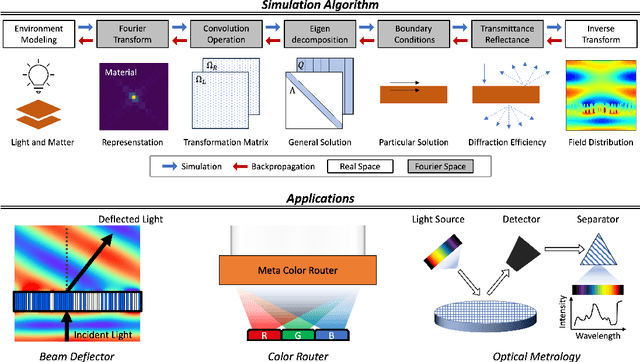
Electromagnetic (EM) simulation plays a crucial role in analyzing and designing devices with sub-wavelength scale structures such as solar cells, semiconductor devices, image sensors, future displays and integrated photonic devices. Specifically, optics problems such as estimating semiconductor device structures and designing nanophotonic devices provide intriguing research topics with far-reaching real world impact. Traditional algorithms for such tasks require iteratively refining parameters through simulations, which often yield sub-optimal results due to the high computational cost of both the algorithms and EM simulations. Machine learning (ML) emerged as a promising candidate to mitigate these challenges, and optics research community has increasingly adopted ML algorithms to obtain results surpassing classical methods across various tasks. To foster a synergistic collaboration between the optics and ML communities, it is essential to have an EM simulation software that is user-friendly for both research communities. To this end, we present Meent, an EM simulation software that employs rigorous coupled-wave analysis (RCWA). Developed in Python and equipped with automatic differentiation (AD) capabilities, Meent serves as a versatile platform for integrating ML into optics research and vice versa. To demonstrate its utility as a research platform, we present three applications of Meent: 1) generating a dataset for training neural operator, 2) serving as an environment for the reinforcement learning of nanophotonic device optimization, and 3) providing a solution for inverse problems with gradient-based optimizers. These applications highlight Meent's potential to advance both EM simulation and ML methodologies. The code is available at https://github.com/kc-ml2/meent with the MIT license to promote the cross-polinations of ideas among academic researchers and industry practitioners.
Can We Utilize Pre-trained Language Models within Causal Discovery Algorithms?
Nov 19, 2023Scaling laws have allowed Pre-trained Language Models (PLMs) into the field of causal reasoning. Causal reasoning of PLM relies solely on text-based descriptions, in contrast to causal discovery which aims to determine the causal relationships between variables utilizing data. Recently, there has been current research regarding a method that mimics causal discovery by aggregating the outcomes of repetitive causal reasoning, achieved through specifically designed prompts. It highlights the usefulness of PLMs in discovering cause and effect, which is often limited by a lack of data, especially when dealing with multiple variables. Conversely, the characteristics of PLMs which are that PLMs do not analyze data and they are highly dependent on prompt design leads to a crucial limitation for directly using PLMs in causal discovery. Accordingly, PLM-based causal reasoning deeply depends on the prompt design and carries out the risk of overconfidence and false predictions in determining causal relationships. In this paper, we empirically demonstrate the aforementioned limitations of PLM-based causal reasoning through experiments on physics-inspired synthetic data. Then, we propose a new framework that integrates prior knowledge obtained from PLM with a causal discovery algorithm. This is accomplished by initializing an adjacency matrix for causal discovery and incorporating regularization using prior knowledge. Our proposed framework not only demonstrates improved performance through the integration of PLM and causal discovery but also suggests how to leverage PLM-extracted prior knowledge with existing causal discovery algorithms.