 Add to Chrome
 Add to Firefox
 Add to Edge
FinVerse: Financial Time-Series Benchmark
Aug 04, 2026
As time-series foundation models have emerged, the need for benchmarks that can evaluate their forecasting ability in meaningful ways has become increasingly important. Existing time-series forecasting benchmarks provide useful standardized comparisons, but they often evaluate heterogeneous series with uniform error-based metrics. Strong performance under such metrics does not necessarily imply that a model's forecasts will support the best real-world decisions across domains. For example, in stock forecasting, correctly predicting whether a price will rise or fall can be more directly relevant to realized returns than minimizing point-wise forecast error alone. To this end, we introduce FinVerse, a finance-domain time-series forecasting benchmark that takes a first step toward more realistic evaluation. The released FinVerse data artifact contains 116,897 financial time series with 171.1M observations, of which 60,232 series with 17.4M observations are selected as evaluated targets based on their economic relevance to financial decisions. Unlike generic forecasting benchmarks that primarily emphasize uniform point-forecast or probabilistic accuracy, FinVerse defines 11 metric families comprising 78 evaluation metrics and assigns the most appropriate evaluation metrics to each individual time series based on its underlying economic meaning. Our analysis of 43 public time-series forecasting foundation models shows that strong performance under generic forecasting criteria does not necessarily translate into useful financial forecasts. This finding highlights the need for domain-aware benchmarks that evaluate models under objectives closer to real-world decision making.

Traceable Multi-Agent System for Knowledge-Based Forecasting
Aug 04, 2026Enterprise forecasting increasingly relies on autonomous agents that interpret documents, search for data, generate code, and revise models. While this autonomy helps build adaptive forecasting pipelines, it also makes it difficult for practitioners to inspect why a forecast changed, which evidence supported the change, and how data and modeling choices were revised. We present TraceMAS, an interactive demo system for traceable multi-agent forecasting. TraceMAS organizes agent outputs around two causal-loop representations: an Ideal Causal Loop Diagram (Ideal CLD), which captures key factors and their causal relations extracted from domain documents, and a Data-Grounded Causal Loop Diagram (Data-Grounded CLD), which links those factors to internal variables, external data, or documented proxies. The Data-Grounded CLD guides feature construction and model design while preserving the connection between textual evidence, data choices, and model revisions. We demonstrate TraceMAS on crude oil price forecasting. The demo interface allows users to compare forecasting iterations, inspect agent-level revisions, explore causal maps, review feature-data mappings and model architecture, and connect scenario forecasts to market narratives. This demonstration shows how autonomous forecasting agents can retain flexibility while making the evidence-to-forecast process inspectable.
Beyond Magnitude and Shape: A Direction-Aware Loss for Time Series Forecasting
Aug 03, 2026The direction of change --- whether a series will move up or down --- is often as important as its exact value in decisiondriven applications such as risk management and financial forecasting. However, most forecasting losses optimize either point magnitude or shape and frequency structure, and none explicitly targets the direction of change. In this paper, we find that MSE-trained forecasters fail on the direction of small moves. To address this, we propose CosDir, a simple yet effective direction-aware loss that aligns the difference vectors of the prediction and the target via cosine similarity. Being scale-invariant, CosDir keeps a directional gradient on small moves, re-injecting learning signal exactly where MSE neglects it. CosDir is a lightweight, plug-in term that attaches to any backbone without architectural modification. Since the best ratio for mixing the directional and magnitude terms differs across datasets, we further propose CosDir-UW, an extension that makes this ratio adaptive by learning it during training, matching a per-dataset tuned weight with no hyperparameter. We conduct over 100K experiments, demonstrating that our method consistently and significantly improves directional accuracy while preserving magnitude accuracy, and that it outperforms various loss functions. Code is available at: https://github.com/seunghan96/cosdir.
ReasonCast: Towards Explainable Time Series Forecasting with Reasoning
Aug 03, 2026Most time series (TS) models are specialized for a single task, either understanding (i.e., returning text answers about a TS) or generation (i.e., returning a numeric forecast). Only recently have unified models begun to handle the two within a single architecture. Even these models, however, produce the two outputs as task-separated paths and cannot predict a series and explain why that prediction arises within a single coherent response. In this paper, we argue for a task-fused model that jointly produces 1) prediction (generation) and 2) selfexplanation (understanding), thereby integrating 1) numerical TS forecasting and 2) interpretable text reasoning within a single response. To enable the systematic study of this capability, we present both a benchmark and a recipe that jointly address the two tasks. The benchmark, ReasonTS-Bench, identifies five fundamental patterns underlying TS and enables the joint evaluation of both tasks. ReasonCast, our recipe for finetuning any LLM to perform both tasks jointly, yields a model that generates a reasoning chain and a forecast together in a single autoregressive pass. Extensive experiments show that ReasonCast outperforms both LLMs and TS models on prediction accuracy while producing verifiable, causal reasoning. Code is available at: https://github.com/seunghan96/reasoncast.
Channel-wise Retrieval for Multivariate Time Series Forecasting
Apr 07, 2026Multivariate time series forecasting often struggles to capture long-range dependencies due to fixed lookback windows. Retrieval-augmented forecasting addresses this by retrieving historical segments from memory, but existing approaches rely on a channel-agnostic strategy that applies the same references to all variables. This neglects inter-variable heterogeneity, where different channels exhibit distinct periodicities and spectral profiles. We propose CRAFT (Channel-wise retrieval-augmented forecasting), a novel framework that performs retrieval independently for each channel. To ensure efficiency, CRAFT adopts a two-stage pipeline: a sparse relation graph constructed in the time domain prunes irrelevant candidates, and spectral similarity in the frequency domain ranks references, emphasizing dominant periodic components while suppressing noise. Experiments on seven public benchmarks demonstrate that CRAFT outperforms state-of-the-art forecasting baselines, achieving superior accuracy with practical inference efficiency.
Adaptive Information Routing for Multimodal Time Series Forecasting
Dec 23, 2025Time series forecasting is a critical task for artificial intelligence with numerous real-world applications. Traditional approaches primarily rely on historical time series data to predict the future values. However, in practical scenarios, this is often insufficient for accurate predictions due to the limited information available. To address this challenge, multimodal time series forecasting methods which incorporate additional data modalities, mainly text data, alongside time series data have been explored. In this work, we introduce the Adaptive Information Routing (AIR) framework, a novel approach for multimodal time series forecasting. Unlike existing methods that treat text data on par with time series data as interchangeable auxiliary features for forecasting, AIR leverages text information to dynamically guide the time series model by controlling how and to what extent multivariate time series information should be combined. We also present a text-refinement pipeline that employs a large language model to convert raw text data into a form suitable for multimodal forecasting, and we introduce a benchmark that facilitates multimodal forecasting experiments based on this pipeline. Experiment results with the real world market data such as crude oil price and exchange rates demonstrate that AIR effectively modulates the behavior of the time series model using textual inputs, significantly enhancing forecasting accuracy in various time series forecasting tasks.
VarDrop: Enhancing Training Efficiency by Reducing Variate Redundancy in Periodic Time Series Forecasting
Jan 24, 2025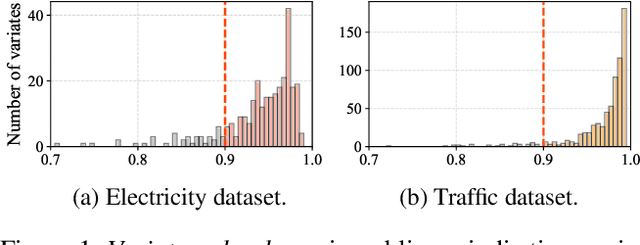
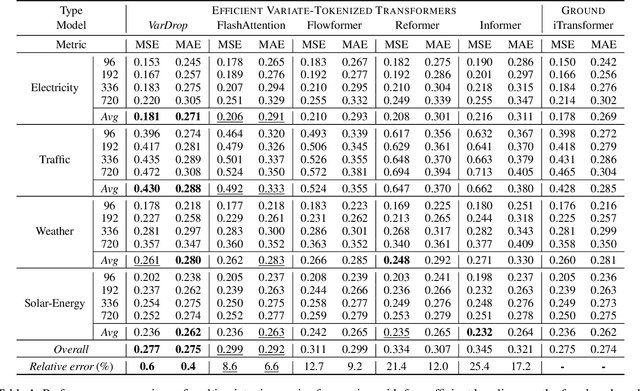
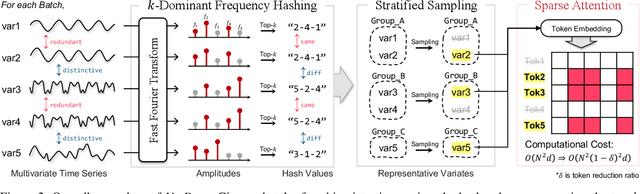
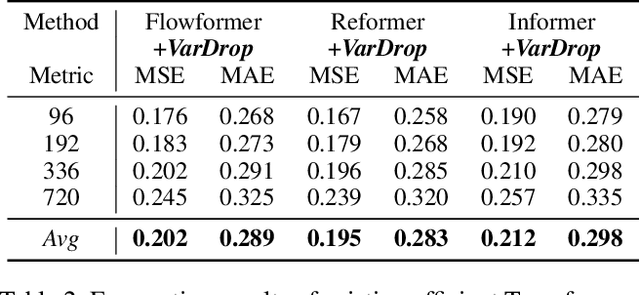
Variate tokenization, which independently embeds each variate as separate tokens, has achieved remarkable improvements in multivariate time series forecasting. However, employing self-attention with variate tokens incurs a quadratic computational cost with respect to the number of variates, thus limiting its training efficiency for large-scale applications. To address this issue, we propose VarDrop, a simple yet efficient strategy that reduces the token usage by omitting redundant variate tokens during training. VarDrop adaptively excludes redundant tokens within a given batch, thereby reducing the number of tokens used for dot-product attention while preserving essential information. Specifically, we introduce k-dominant frequency hashing (k-DFH), which utilizes the ranked dominant frequencies in the frequency domain as a hash value to efficiently group variate tokens exhibiting similar periodic behaviors. Then, only representative tokens in each group are sampled through stratified sampling. By performing sparse attention with these selected tokens, the computational cost of scaled dot-product attention is significantly alleviated. Experiments conducted on public benchmark datasets demonstrate that VarDrop outperforms existing efficient baselines.
Universal Time-Series Representation Learning: A Survey
Jan 08, 2024


Time-series data exists in every corner of real-world systems and services, ranging from satellites in the sky to wearable devices on human bodies. Learning representations by extracting and inferring valuable information from these time series is crucial for understanding the complex dynamics of particular phenomena and enabling informed decisions. With the learned representations, we can perform numerous downstream analyses more effectively. Among several approaches, deep learning has demonstrated remarkable performance in extracting hidden patterns and features from time-series data without manual feature engineering. This survey first presents a novel taxonomy based on three fundamental elements in designing state-of-the-art universal representation learning methods for time series. According to the proposed taxonomy, we comprehensively review existing studies and discuss their intuitions and insights into how these methods enhance the quality of learned representations. Finally, as a guideline for future studies, we summarize commonly used experimental setups and datasets and discuss several promising research directions. An up-to-date corresponding resource is available at https://github.com/itouchz/awesome-deep-time-series-representations.