 Add to Chrome
 Add to Firefox
 Add to Edge
PCBWorld: A Benchmark Environment for Engine-Grounded PCB Design Automation
Jul 07, 2026
PCB routing is the task of connecting the nets of a board with copper traces under strict design rules, yet learning-based methods still lag behind rule-based routers. We introduce PCBWorld, an open-source engine-grounded PCB routing environment built on the KiCad EDA engine. As a human engineer does, agents in PCBWorld interactively route a board through the engine's native operations, using its Design Rule Check (DRC) feedback to keep the routing within the design rules. The environment supports both RL policies and tool-using LLM agents. Alongside the environment, PCBWorld-Bench provides three dataset families in KiCad's native board format (.kicad_pcb), covering two types of controllable synthetic instances and 679 real open-source boards. It scores any completed board with eight engine-checked evaluation metrics, regardless of the routing method. In our experiments, agents in PCBWorld consistently outperformed grid-action RL policies and open-loop LLM baselines, and an RL policy trained only on synthetic boards transferred zero-shot to real boards, approaching rule-based routers. These results position the engine-grounded, interactive approach of PCBWorld as a promising foundation for advancing the routing ability of both RL and LLM agents.

Channel-wise Retrieval for Multivariate Time Series Forecasting
Apr 07, 2026Multivariate time series forecasting often struggles to capture long-range dependencies due to fixed lookback windows. Retrieval-augmented forecasting addresses this by retrieving historical segments from memory, but existing approaches rely on a channel-agnostic strategy that applies the same references to all variables. This neglects inter-variable heterogeneity, where different channels exhibit distinct periodicities and spectral profiles. We propose CRAFT (Channel-wise retrieval-augmented forecasting), a novel framework that performs retrieval independently for each channel. To ensure efficiency, CRAFT adopts a two-stage pipeline: a sparse relation graph constructed in the time domain prunes irrelevant candidates, and spectral similarity in the frequency domain ranks references, emphasizing dominant periodic components while suppressing noise. Experiments on seven public benchmarks demonstrate that CRAFT outperforms state-of-the-art forecasting baselines, achieving superior accuracy with practical inference efficiency.
Align While Search: Belief-Guided Exploratory Inference for World-Grounded Embodied Agents
Dec 30, 2025In this paper, we propose a test-time adaptive agent that performs exploratory inference through posterior-guided belief refinement without relying on gradient-based updates or additional training for LLM agent operating under partial observability. Our agent maintains an external structured belief over the environment state, iteratively updates it via action-conditioned observations, and selects actions by maximizing predicted information gain over the belief space. We estimate information gain using a lightweight LLM-based surrogate and assess world alignment through a novel reward that quantifies the consistency between posterior belief and ground-truth environment configuration. Experiments show that our method outperforms inference-time scaling baselines such as prompt-augmented or retrieval-enhanced LLMs, in aligning with latent world states with significantly lower integration overhead.
Adaptive Information Routing for Multimodal Time Series Forecasting
Dec 23, 2025Time series forecasting is a critical task for artificial intelligence with numerous real-world applications. Traditional approaches primarily rely on historical time series data to predict the future values. However, in practical scenarios, this is often insufficient for accurate predictions due to the limited information available. To address this challenge, multimodal time series forecasting methods which incorporate additional data modalities, mainly text data, alongside time series data have been explored. In this work, we introduce the Adaptive Information Routing (AIR) framework, a novel approach for multimodal time series forecasting. Unlike existing methods that treat text data on par with time series data as interchangeable auxiliary features for forecasting, AIR leverages text information to dynamically guide the time series model by controlling how and to what extent multivariate time series information should be combined. We also present a text-refinement pipeline that employs a large language model to convert raw text data into a form suitable for multimodal forecasting, and we introduce a benchmark that facilitates multimodal forecasting experiments based on this pipeline. Experiment results with the real world market data such as crude oil price and exchange rates demonstrate that AIR effectively modulates the behavior of the time series model using textual inputs, significantly enhancing forecasting accuracy in various time series forecasting tasks.
Gradient Surgery for One-shot Unlearning on Generative Model
Jul 18, 2023
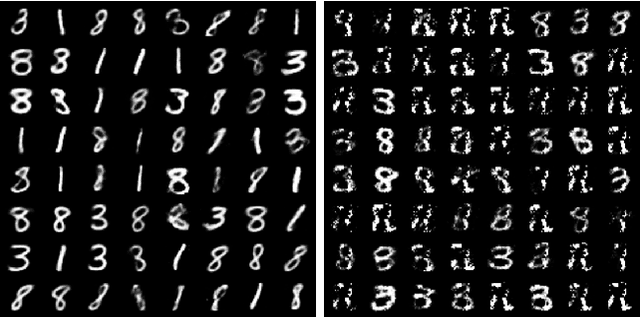
Recent regulation on right-to-be-forgotten emerges tons of interest in unlearning pre-trained machine learning models. While approximating a straightforward yet expensive approach of retrain-from-scratch, recent machine unlearning methods unlearn a sample by updating weights to remove its influence on the weight parameters. In this paper, we introduce a simple yet effective approach to remove a data influence on the deep generative model. Inspired by works in multi-task learning, we propose to manipulate gradients to regularize the interplay of influence among samples by projecting gradients onto the normal plane of the gradients to be retained. Our work is agnostic to statistics of the removal samples, outperforming existing baselines while providing theoretical analysis for the first time in unlearning a generative model.