 Add to Chrome
 Add to Firefox
 Add to Edge
GaP: A Graph-as-Policy Multi-Agent Self-Learning Harness For Variational Automation Tasks
Jul 06, 2026
For robots to work reliably in commercial and industrial applications, can recent advances in agentic coding systems combine interpretable robot programming with the open-world adaptability of model-free policies? We focus on "Variational Automation" (VA), a class of tasks that have larger variations in object geometry and pose than fixed automation. Model-free policies often struggle to close the reliability gap for VA tasks, which must be executed persistently and reliably in commercial and industrial applications. Motivated by prior work on Task and Motion Planning (TAMP) and the Robot Operating System (ROS), we introduce Graph-as-Policy (GaP), a multi-agent coding harness that generates directed computation graphs with perception, planning, and control nodes from a Modular Open Robot Skill Library (MORSL). GaP then generates an internal simulation environment to rehearse task instances with different graphs in parallel to iteratively refine the graph structure and parameters to improve success rates and throughput. Evaluation with 8 new open VA task benchmarks, 4 in-simulation and 4 in real-world, suggests that GaP can achieve success rates that significantly outperform baselines. Details, code, and data can be found online: https://graph-robots.github.io/gap

MonoDuo: Using One Robot Arm to Learn Bimanual Policies
May 28, 2026Bimanual coordination is essential for many real-world manipulation tasks, yet learning bimanual robot policies is limited by the scarcity of bimanual robots and datasets. Single-arm robots, however, are widely available in research labs. Can we leverage them to train bimanual robot policies? We present MonoDuo, a framework for learning bimanual manipulation policies using single-arm robot demonstrations paired with human collaboration. MonoDuo collects data by teleoperating a single-arm robot to perform one side of a bimanual task while a human performs the other, then swapping roles to cover both sides. RGB-D observations from a wrist-mounted and fixed camera are augmented into synthetic demonstrations for target bimanual robots using state-of-the-art hand pose estimation, image and point cloud segmentation, and inpainting. These synthetic demonstrations, grounded in real robot kinematics, are used to train bimanual policies. We evaluate MonoDuo on five tasks: box lifting, backpack packing, cloth folding, jacket zipping, and plate handover. Compared to approaches relying solely on human bimanual videos, MonoDuo enables zero-shot deployment on unseen bimanual robot configurations, achieving success rates up to 70%. With only 25 target robot demonstrations, few-shot finetuning further boosts success rates by 65-70% over training from scratch, demonstrating MonoDuo's effectiveness in efficiently transferring knowledge from single-arm robot data to bimanual robot policies.
OXE-AugE: A Large-Scale Robot Augmentation of OXE for Scaling Cross-Embodiment Policy Learning
Dec 15, 2025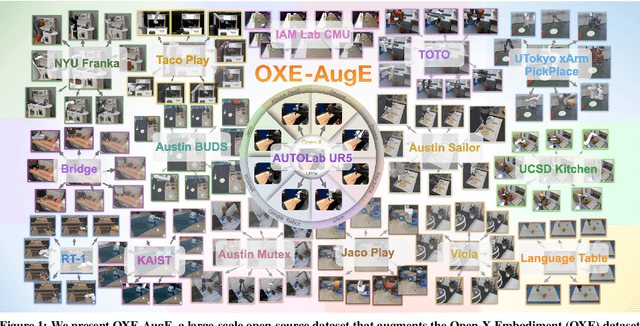
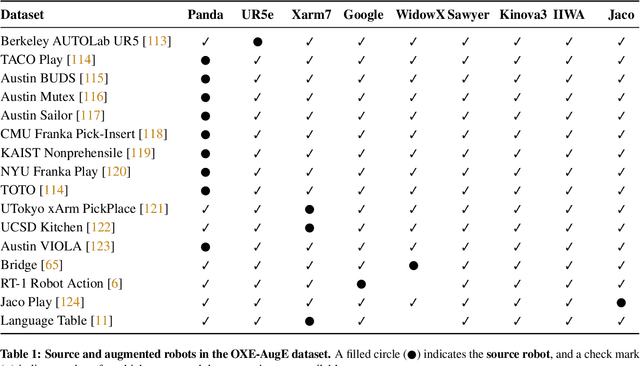
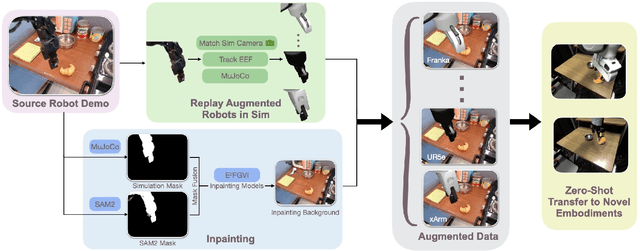
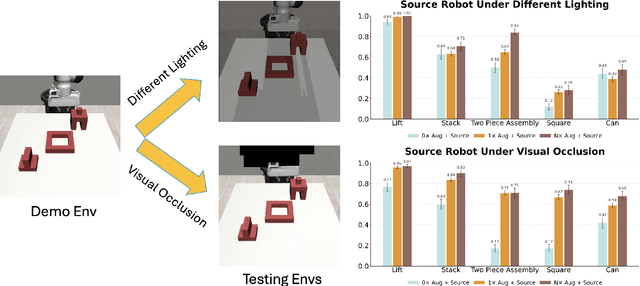
Large and diverse datasets are needed for training generalist robot policies that have potential to control a variety of robot embodiments -- robot arm and gripper combinations -- across diverse tasks and environments. As re-collecting demonstrations and retraining for each new hardware platform are prohibitively costly, we show that existing robot data can be augmented for transfer and generalization. The Open X-Embodiment (OXE) dataset, which aggregates demonstrations from over 60 robot datasets, has been widely used as the foundation for training generalist policies. However, it is highly imbalanced: the top four robot types account for over 85\% of its real data, which risks overfitting to robot-scene combinations. We present AugE-Toolkit, a scalable robot augmentation pipeline, and OXE-AugE, a high-quality open-source dataset that augments OXE with 9 different robot embodiments. OXE-AugE provides over 4.4 million trajectories, more than triple the size of the original OXE. We conduct a systematic study of how scaling robot augmentation impacts cross-embodiment learning. Results suggest that augmenting datasets with diverse arms and grippers improves policy performance not only on the augmented robots, but also on unseen robots and even the original robots under distribution shifts. In physical experiments, we demonstrate that state-of-the-art generalist policies such as OpenVLA and $π_0$ benefit from fine-tuning on OXE-AugE, improving success rates by 24-45% on previously unseen robot-gripper combinations across four real-world manipulation tasks. Project website: https://OXE-AugE.github.io/.