 Add to Chrome
 Add to Firefox
 Add to Edge
HetGPS: Scalable Graph Multi-Agent Reinforcement Learning with Physics-Anchored Adaptive Safety for EV Charging
Aug 01, 2026
Safety interventions for large populations of network-coupled agents must protect shared constraints without unnecessarily overriding task-oriented policy decisions. We present HetGPS, a hybrid graph-control framework synergizing learned graph risk with physics-anchored correction by separating intervention magnitude from corrective direction. An action-conditioned graph residual model schedules state-dependent intervention authority, while a physics model determines its direction. For electric vehicle (EV) charging, we couple this filter with a parameter-shared heterogeneous graph soft actor-critic policy, enabling topology-aware coordination with a learned model size independent of fleet size. Across five nested distribution networks with 200--3,218 EVs and 100 evaluation days, Adaptive Authority reduces bus--step voltage violations from 3.93--7.74\% without filtering to 0.52--3.44\%, while maintaining 99.06--100\% departure success. Relative to the same physics-directed projection with fixed authority, it improves mean reward on all five networks and lowers the mean safety score on four. The deployed policy-and-risk model contains 383,702 learned parameters at every scale; at 3,218 EVs, a matched centralized SAC actor is about $170\times$ larger. A policy trained on the eight-transformer system transfers zero-shot to the 16- and 32-transformer systems, attaining 0.57--0.75\% violation rates and at least 99.99\% departure success. These results show that learned graph risk can allocate intervention authority at scale while feeder physics anchors corrective action.

FedLAS: Feature-Modulated Bidirectional Label Smoothing for Neural Network Calibration
Jun 26, 2026Deep Neural Network (DNN) classifiers suffer from poor calibration when their softmax outputs (predictive confidence) deviate from the empirical likelihoods. This manifests itself as either overconfident incorrect predictions or under-confident correct predictions. Label smoothing (LS) enhances model calibration by introducing entropy regularization during training through redistributing probability mass from the ground-truth label to the remaining classes. LS, including Margin-based LS (MbLS), have restrictive assumptions: they rely on predefined, uniform smoothing rules and only tackle overconfidence. In reality, samples exhibit diverse characteristics, such as difficulty/ambiguity, that interact with the evolving nature of the model being trained. In training, samples may have various degrees of under- or overconfidence. To overcome this, a mechanism that identifies the specific confidence state of each sample and determines the appropriate degree of smoothing in each training step is needed, tailoring the adjustment to the individual sample. We propose FedLAS: Feature-Modulated Bidirectional Label Smoothing, a plug-and-play algorithm for label smoothing-based losses. In FedLAS, we introduce a Feature Norm-based Confidence Indicator (NCI) to control smoothing and a Bidirectional Calibration Gating (BCG) module to detect both over and under-confidence. Our algorithm can be integrated with LS and MbLS based losses when applied to standard DNNs, enhancing performance. Extensive experiments on standard and fine-grained high-resolution vision benchmarks show that FedLAS consistently improves calibration compared to modern baselines, reducing Expected Calibration Error (ECE) and Adaptive ECE while maintaining Top-1 accuracy. Code: github.com/nadarasarbahavan/FEDLAS
Knowledge-Inclusive Adaptive Physics-Informed Neural Network for Microbial Interaction Modelling
Jun 05, 2026Physics-Informed Neural Network (PINN) is a way of including knowledge in the form of equations in Machine Learning methods. Beyond equations, knowledge exists in other forms, such as text and network structure. While existing PINN-based approaches discover equation parameters from data, they rely solely on experimental measurements. We propose a new PINN framework that enriches parameter discovery by incorporating auxiliary knowledge sources. We instantiate our framework for microbiology, where generalised Lotka-Volterra (gLV) serves as a biological foundation for modelling microbial communities. We demonstrate that incorporating knowledge improves microbial community modelling. Our framework enriches the gLV parameters using peer-reviewed metagenomics literature, as text provides biological context on external influences that gLV alone cannot capture. We combine this knowledge with experimental measurements of microbial abundance using a data-driven integration approach. We integrate network-based structural knowledge by explicitly modelling microbial interactions. Our knowledge-inclusive framework infers microbial networks, revealing ecological insights. We validate these findings against ecological roles documented in the literature. We evaluate on real and simulated datasets spanning human- and plant-associated microbial communities. Our framework improves over the state-of-the-art by up to 53%, even without knowledge. Knowledge addition yields gains of up to 23% in Bray-Curtis Dissimilarity-based accuracy and 47% in $\mathrm{R}^2$.
Parameter-efficient Prompt Tuning and Hierarchical Textual Guidance for Few-shot Whole Slide Image Classification
Mar 23, 2026Whole Slide Images (WSIs) are giga-pixel in scale and are typically partitioned into small instances in WSI classification pipelines for computational feasibility. However, obtaining extensive instance level annotations is costly, making few-shot weakly supervised WSI classification (FSWC) crucial for learning from limited slide-level labels. Recently, pre-trained vision-language models (VLMs) have been adopted in FSWC, yet they exhibit several limitations. Existing prompt tuning methods in FSWC substantially increase both the number of trainable parameters and inference overhead. Moreover, current methods discard instances with low alignment to text embeddings from VLMs, potentially leading to information loss. To address these challenges, we propose two key contributions. First, we introduce a new parameter efficient prompt tuning method by scaling and shifting features in text encoder, which significantly reduces the computational cost. Second, to leverage not only the pre-trained knowledge of VLMs, but also the inherent hierarchical structure of WSIs, we introduce a WSI representation learning approach with a soft hierarchical textual guidance strategy without utilizing hard instance filtering. Comprehensive evaluations on pathology datasets covering breast, lung, and ovarian cancer types demonstrate consistent improvements up-to 10.9%, 7.8%, and 13.8% respectively, over the state-of-the-art methods in FSWC. Our method reduces the number of trainable parameters by 18.1% on both breast and lung cancer datasets, and 5.8% on the ovarian cancer dataset, while also excelling at weakly-supervised tumor localization. Code at https://github.com/Jayanie/HIPSS.
MSRAMIE: Multimodal Structured Reasoning Agent for Multi-instruction Image Editing
Mar 17, 2026Existing instruction-based image editing models perform well with simple, single-step instructions but degrade in realistic scenarios that involve multiple, lengthy, and interdependent directives. A main cause is the scarcity of training data with complex multi-instruction annotations. However, it is costly to collect such data and retrain these models. To address this challenge, we propose MSRAMIE, a training-free agent framework built on Multimodal Large Language Model (MLLM). MSRAMIE takes existing editing models as plug-in components and handle multi-instruction tasks via structured multimodal reasoning. It orchestrates iterative interactions between an MLLM-based Instructor and an image editing Actor, introducing a novel reasoning topology that comprises the proposed Tree-of-States and Graph-of-References. During inference, complex instructions are decomposed into multiple editing steps which enable state transitions, cross-step information aggregation, and original input recall, which enables systematic exploration of the image editing space and flexible progressive output refinement. The visualizable inference topology further provides interpretable and controllable decision pathways. Experiments show that as the instruction complexity increases, MSRAMIE can improve instruction following over 15% and increases the probability of finishing all modifications in a single run over 100%, while preserving perceptual quality and maintaining visual consistency.
From Specification to Architecture: A Theory Compiler for Knowledge-Guided Machine Learning
Mar 15, 2026Theory-guided machine learning has demonstrated that including authentic domain knowledge directly into model design improves performance, sample efficiency and out-of-distribution generalisation. Yet the process by which a formal domain theory is translated into architectural constraints remains entirely manual, specific to each domain formalism, and devoid of any formal correctness guarantee. This translation is non-transferable between domains, not verified, and does not scale. We propose the Theory Compiler: a system that accepts a typed, machine-readable domain theory as input and automatically produces an architecture whose function space is provably constrained to be consistent with that theory by construction, not by regularisation. We identify three foundational open problems whose resolution defines our research agenda: (1) designing a universal theory formalisation language with decidable type-checking; (2) constructing a compositionally correct compilation algorithm from theory primitives to architectural modules; and (3) establishing soundness and completeness criteria for formal verification. We further conjecture that compiled architectures match or exceed manually-designed counterparts in generalisation performance while requiring substantially less training data, a claim we ground in classical statistical learning theory. We argue that recent advances in formal machine learning theory, large language models, and the growth of an interdisciplinary research community have made this paradigm achievable for the first time.
Invariant-Stratified Propagation for Expressive Graph Neural Networks
Mar 02, 2026Graph Neural Networks (GNNs) face fundamental limitations in expressivity and capturing structural heterogeneity. Standard message-passing architectures are constrained by the 1-dimensional Weisfeiler-Leman (1-WL) test, unable to distinguish graphs beyond degree sequences, and aggregate information uniformly from neighbors, failing to capture how nodes occupy different structural positions within higher-order patterns. While methods exist to achieve higher expressivity, they incur prohibitive computational costs and lack unified frameworks for flexibly encoding diverse structural properties. To address these limitations, we introduce Invariant-Stratified Propagation (ISP), a framework comprising both a novel WL variant (ISP-WL) and its efficient neural network implementation (ISPGNN). ISP stratifies nodes according to graph invariants, processing them in hierarchical strata that reveal structural distinctions invisible to 1-WL. Through hierarchical structural heterogeneity encoding, ISP quantifies differences in nodes' structural positions within higher-order patterns, distinguishing interactions where participants occupy different roles from those with uniform participation. We provide formal theoretical analysis establishing enhanced expressivity beyond 1-WL, convergence guarantees, and inherent resistance to oversmoothing. Extensive experiments across graph classification, node classification, and influence estimation demonstrate consistent improvements over standard architectures and state-of-the-art expressive baselines.
Discovering Process-Outcome Credit in Multi-Step LLM Reasoning
Feb 01, 2026Reinforcement Learning (RL) serves as a potent paradigm for enhancing reasoning capabilities in Large Language Models (LLMs), yet standard outcome-based approaches often suffer from reward sparsity and inefficient credit assignment. In this paper, we propose a novel framework designed to provide continuous reward signals, which introduces a Step-wise Marginal Information Gain (MIG) mechanism that quantifies the intrinsic value of reasoning steps against a Monotonic Historical Watermark, effectively filtering out training noise. To ensure disentangled credit distribution, we implement a Decoupled Masking Strategy, applying process-oriented rewards specifically to the chain-of-thought (CoT) and outcome-oriented rewards to the full completion. Additionally, we incorporate a Dual-Gated SFT objective to stabilize training with high-quality structural and factual signals. Extensive experiments across textual and multi-modal benchmarks (e.g., MATH, Super-CLEVR) demonstrate that our approach consistently outperforms baselines such as GRPO in both sample efficiency and final accuracy. Furthermore, our model exhibits superior out-of-distribution robustness, demonstrating promising zero-shot transfer capabilities to unseen and challenging reasoning tasks.
Graph-Eq: Discovering Mathematical Equations using Graph Generative Models
Mar 30, 2025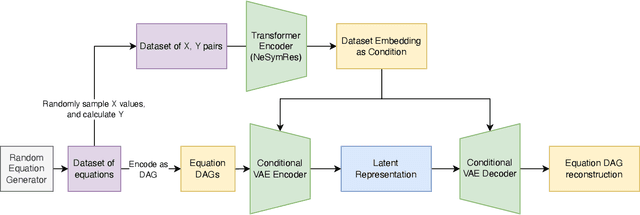
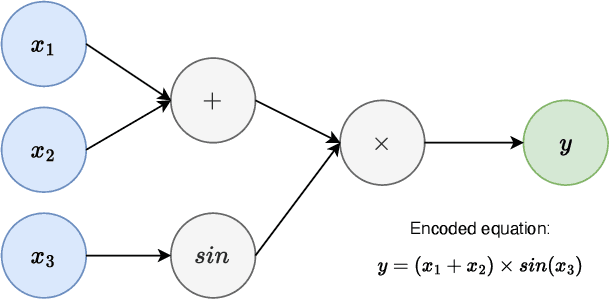
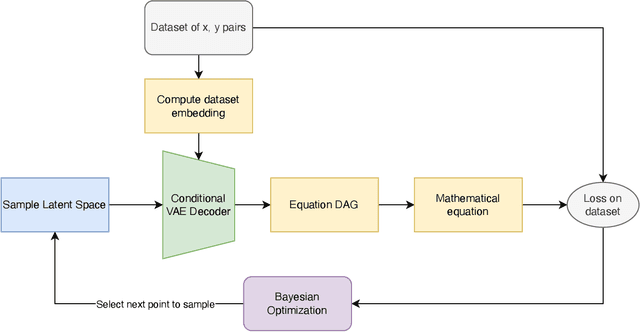
The ability to discover meaningful, accurate, and concise mathematical equations that describe datasets is valuable across various domains. Equations offer explicit relationships between variables, enabling deeper insights into underlying data patterns. Most existing equation discovery methods rely on genetic programming, which iteratively searches the equation space but is often slow and prone to overfitting. By representing equations as directed acyclic graphs, we leverage the use of graph neural networks to learn the underlying semantics of equations, and generate new, previously unseen equations. Although graph generative models have been shown to be successful in discovering new types of graphs in many fields, there application in discovering equations remains largely unexplored. In this work, we propose Graph-EQ, a deep graph generative model designed for efficient equation discovery. Graph-EQ uses a conditional variational autoencoder (CVAE) to learn a rich latent representation of the equation space by training it on a large corpus of equations in an unsupervised manner. Instead of directly searching the equation space, we employ Bayesian optimization to efficiently explore this learned latent space. We show that the encoder-decoder architecture of Graph-Eq is able to accurately reconstruct input equations. Moreover, we show that the learned latent representation can be sampled and decoded into valid equations, including new and previously unseen equations in the training data. Finally, we assess Graph-Eq's ability to discover equations that best fit a dataset by exploring the latent space using Bayesian optimization. Latent space exploration is done on 20 dataset with known ground-truth equations, and Graph-Eq is shown to successfully discover the grountruth equation in the majority of datasets.
Arch-LLM: Taming LLMs for Neural Architecture Generation via Unsupervised Discrete Representation Learning
Mar 28, 2025Unsupervised representation learning has been widely explored across various modalities, including neural architectures, where it plays a key role in downstream applications like Neural Architecture Search (NAS). These methods typically learn an unsupervised representation space before generating/ sampling architectures for the downstream search. A common approach involves the use of Variational Autoencoders (VAEs) to map discrete architectures onto a continuous representation space, however, sampling from these spaces often leads to a high percentage of invalid or duplicate neural architectures. This could be due to the unnatural mapping of inherently discrete architectural space onto a continuous space, which emphasizes the need for a robust discrete representation of these architectures. To address this, we introduce a Vector Quantized Variational Autoencoder (VQ-VAE) to learn a discrete latent space more naturally aligned with the discrete neural architectures. In contrast to VAEs, VQ-VAEs (i) map each architecture into a discrete code sequence and (ii) allow the prior to be learned by any generative model rather than assuming a normal distribution. We then represent these architecture latent codes as numerical sequences and train a text-to-text model leveraging a Large Language Model to learn and generate sequences representing architectures. We experiment our method with Inception/ ResNet-like cell-based search spaces, namely NAS-Bench-101 and NAS-Bench-201. Compared to VAE-based methods, our approach improves the generation of valid and unique architectures by over 80% on NASBench-101 and over 8% on NASBench-201. Finally, we demonstrate the applicability of our method in NAS employing a sequence-modeling-based NAS algorithm.