 Add to Chrome
 Add to Firefox
 Add to Edge
Parameter-efficient Prompt Tuning and Hierarchical Textual Guidance for Few-shot Whole Slide Image Classification
Mar 23, 2026
Whole Slide Images (WSIs) are giga-pixel in scale and are typically partitioned into small instances in WSI classification pipelines for computational feasibility. However, obtaining extensive instance level annotations is costly, making few-shot weakly supervised WSI classification (FSWC) crucial for learning from limited slide-level labels. Recently, pre-trained vision-language models (VLMs) have been adopted in FSWC, yet they exhibit several limitations. Existing prompt tuning methods in FSWC substantially increase both the number of trainable parameters and inference overhead. Moreover, current methods discard instances with low alignment to text embeddings from VLMs, potentially leading to information loss. To address these challenges, we propose two key contributions. First, we introduce a new parameter efficient prompt tuning method by scaling and shifting features in text encoder, which significantly reduces the computational cost. Second, to leverage not only the pre-trained knowledge of VLMs, but also the inherent hierarchical structure of WSIs, we introduce a WSI representation learning approach with a soft hierarchical textual guidance strategy without utilizing hard instance filtering. Comprehensive evaluations on pathology datasets covering breast, lung, and ovarian cancer types demonstrate consistent improvements up-to 10.9%, 7.8%, and 13.8% respectively, over the state-of-the-art methods in FSWC. Our method reduces the number of trainable parameters by 18.1% on both breast and lung cancer datasets, and 5.8% on the ovarian cancer dataset, while also excelling at weakly-supervised tumor localization. Code at https://github.com/Jayanie/HIPSS.

Rethinking Time Series Forecasting with LLMs via Nearest Neighbor Contrastive Learning
Dec 06, 2024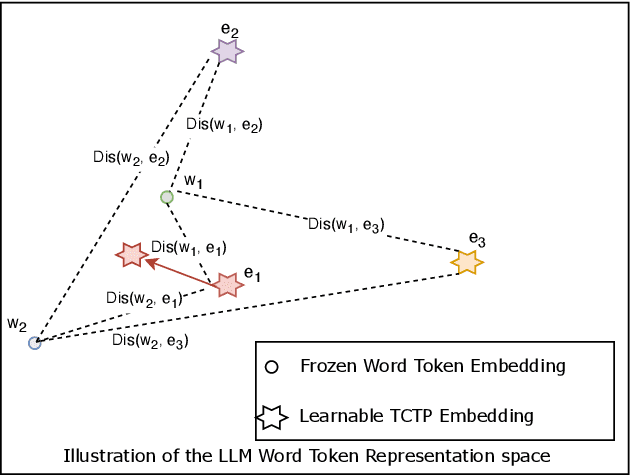

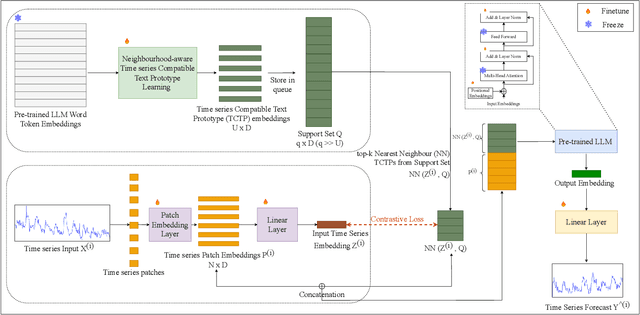

Adapting Large Language Models (LLMs) that are extensively trained on abundant text data, and customizing the input prompt to enable time series forecasting has received considerable attention. While recent work has shown great potential for adapting the learned prior of LLMs, the formulation of the prompt to finetune LLMs remains challenging as prompt should be aligned with time series data. Additionally, current approaches do not effectively leverage word token embeddings which embody the rich representation space learned by LLMs. This emphasizes the need for a robust approach to formulate the prompt which utilizes the word token embeddings while effectively representing the characteristics of the time series. To address these challenges, we propose NNCL-TLLM: Nearest Neighbor Contrastive Learning for Time series forecasting via LLMs. First, we generate time series compatible text prototypes such that each text prototype represents both word token embeddings in its neighborhood and time series characteristics via end-to-end finetuning. Next, we draw inspiration from Nearest Neighbor Contrastive Learning to formulate the prompt while obtaining the top-$k$ nearest neighbor time series compatible text prototypes. We then fine-tune the layer normalization and positional embeddings of the LLM, keeping the other layers intact, reducing the trainable parameters and decreasing the computational cost. Our comprehensive experiments demonstrate that NNCL-TLLM outperforms in few-shot forecasting while achieving competitive or superior performance over the state-of-the-art methods in long-term and short-term forecasting tasks.