 Add to Chrome
 Add to Firefox
 Add to Edge
CARE: Privacy-Compliant Agentic Reasoning with Evidence Discordance
Apr 01, 2026
Large language model (LLM) systems are increasingly used to support high-stakes decision-making, but they typically perform worse when the available evidence is internally inconsistent. Such a scenario exists in real-world healthcare settings, with patient-reported symptoms contradicting medical signs. To study this problem, we introduce MIMIC-DOS, a dataset for short-horizon organ dysfunction worsening prediction in the intensive care unit (ICU) setting. We derive this dataset from the widely recognized MIMIC-IV, a publicly available electronic health record dataset, and construct it exclusively from cases in which discordance between signs and symptoms exists. This setting poses a substantial challenge for existing LLM-based approaches, with single-pass LLMs and agentic pipelines often struggling to reconcile such conflicting signals. To address this problem, we propose CARE: a multi-stage privacy-compliant agentic reasoning framework in which a remote LLM provides guidance by generating structured categories and transitions without accessing sensitive patient data, while a local LLM uses these categories and transitions to support evidence acquisition and final decision-making. Empirically, CARE achieves stronger performance across all key metrics compared to multiple baseline settings, showing that CARE can more robustly handle conflicting clinical evidence while preserving privacy.

Gaussian Process-Driven History Matching for Physical Layer Parameter Estimation in Optical Fiber Communication Networks
Feb 16, 2022
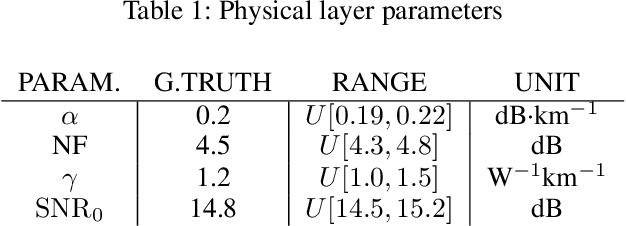


We present a methodology for the estimation of optical network physical layer parameters from signal to noise ratio via history matching. An expensive network link simulator is emulated by a Gaussian process surrogate model, which is used to estimate a set of physical layer parameters from simulated ground truth data. The a priori knowledge assumed consists of broad parameter bounds obtained from the literature and specification sheets of typical network components, and the physics-based model of the simulator. Accurate estimation of the physical layer parameters is demonstrated with a signal to noise ratio penalty of 1~dB or greater, using only 3 simulated measurements. The proposed approach is highly flexible, allowing for the calibration of any unknown simulator input from broad a priori bounds. The role of this method in the improvement of optical network modeling is discussed.