Get our free extension to see links to code for papers anywhere online!Free add-on: code for papers everywhere!Free add-on: See code for papers anywhere!
 Add to Chrome
 Add to Firefox
 Add to Edge
On the Use of Self-Supervised Representation Learning for Speaker Diarization and Separation
Paper and Code
Dec 17, 2025
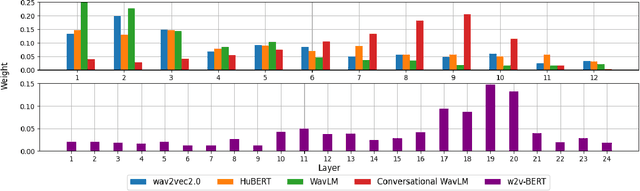
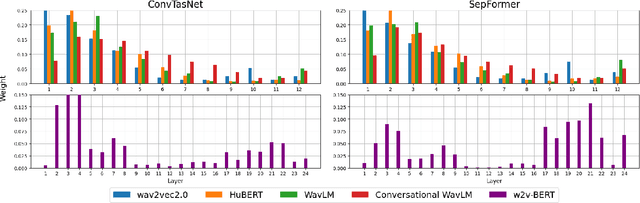
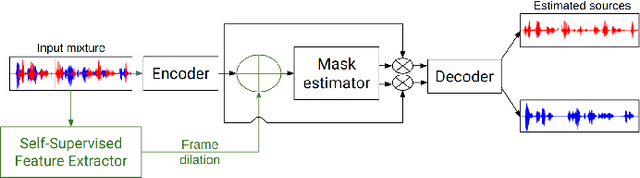
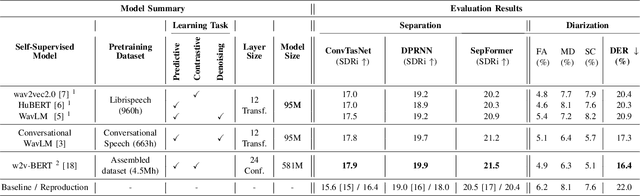
Self-supervised speech models such as wav2vec2.0 and WavLM have been shown to significantly improve the performance of many downstream speech tasks, especially in low-resource settings, over the past few years. Despite this, evaluations on tasks such as Speaker Diarization and Speech Separation remain limited. This paper investigates the quality of recent self-supervised speech representations on these two speaker identity-related tasks, highlighting gaps in the current literature that stem from limitations in the existing benchmarks, particularly the lack of diversity in evaluation datasets and variety in downstream systems associated to both diarization and separation.
* accepted at ASRU25
View paper on