 Add to Chrome
 Add to Firefox
 Add to Edge
Revisiting Observation Reduction for Web Agents: Comprehensive Evaluation with a Lightweight Framework
May 28, 2026
HTML observations in LLM-based web agents are extremely long, and while many reduction methods have been proposed, it remains unclear which methods reduce overall agent latency while maintaining performance. The main obstacle is the high cost of end-to-end evaluation: in our experiments, evaluating 11 methods across 32 configurations on 33 tasks of WorkArena L1 required 232.4 cumulative hours. To address this, we propose a lightweight evaluation framework based on the Minimal Failure Set (MFS), the minimal set of HTML elements whose removal causes task failure. We define coverage as the fraction of instances in which a reduction method fully retains the MFS, which serves as a proxy metric that requires neither web access nor LLM inference. We validate that coverage strongly correlates with end-to-end success rate, with over 100$\times$ speedup in cumulative evaluation time on both benchmarks. Using this framework, we find that extractive HTML reduction methods require either high computation cost or domain-specific optimization to reduce agent latency while maintaining performance. Building on this, we optimize a pruning program on MFS training data, achieving 2.2$\times$ faster per-step latency on WorkArena L1 while retaining 84\% of the original success rate, and 3.1$\times$ faster on WebLinx while retaining 89\%.

cotomi Act: Learning to Automate Work by Watching You
May 04, 2026What if a browser agent could learn your work simply by watching you do it? We present cotomi Act, a browser-based computer-using agent that combines reliable multi-step task execution with persistent organizational knowledge learned from user behavior. For execution, an agent scaffold with adaptive lazy observation, verbal-diff-based history compression, coarse-grained actions, and test-time scaling via best-of-N action selection achieves 80.4% on the 179-task WebArena human-evaluation subset, exceeding the reported 78.2% human baseline. For organizational knowledge, a behavior-to-knowledge pipeline passively observes the user's browsing and progressively abstracts it into artifacts (task boards, wiki) exposed through a shared workspace editable by both user and agent. A controlled proxy evaluation confirms that task success improves as behavior-derived knowledge accumulates. In our live demonstration, attendees interact with the system in a real browser, issuing tasks and observing end-to-end autonomous execution and shared knowledge management.
Read More, Think More: Revisiting Observation Reduction for Web Agents
Apr 02, 2026Web agents based on large language models (LLMs) rely on observations of web pages -- commonly represented as HTML -- as the basis for identifying available actions and planning subsequent steps. Prior work has treated the verbosity of HTML as an obstacle to performance and adopted observation reduction as a standard practice. We revisit this trend and demonstrate that the optimal observation representation depends on model capability and thinking token budget: (1) compact observations (accessibility trees) are preferable for lower-capability models, while detailed observations (HTML) are advantageous for higher-capability models; moreover, increasing thinking tokens further amplifies the benefit of HTML. (2) Our error analysis suggests that higher-capability models exploit layout information in HTML for better action grounding, while lower-capability models suffer from increased hallucination under longer inputs. We also find that incorporating observation history improves performance across most models and settings, and a diff-based representation offers a token-efficient alternative. Based on these findings, we suggest practical guidelines: adaptively select observation representations based on model capability and thinking token budget, and incorporate observation history using diff-based representations.
Understanding the Impact of Confidence in Retrieval Augmented Generation: A Case Study in the Medical Domain
Dec 29, 2024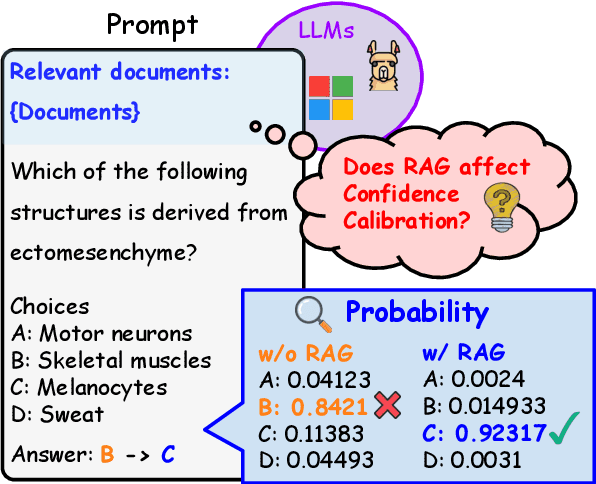
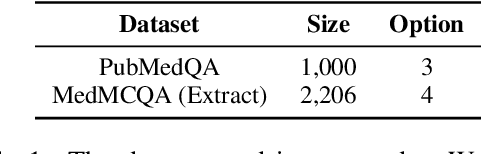
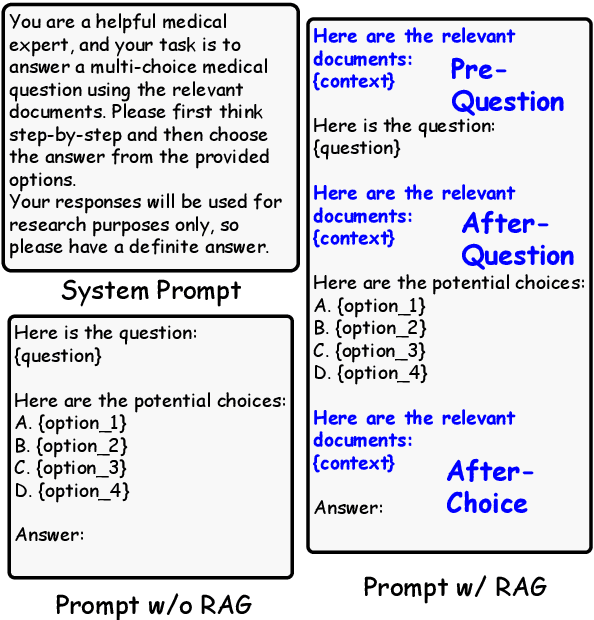
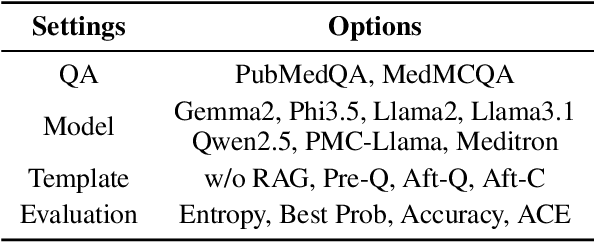
Retrieval Augmented Generation (RAG) complements the knowledge of Large Language Models (LLMs) by leveraging external information to enhance response accuracy for queries. This approach is widely applied in several fields by taking its advantage of injecting the most up-to-date information, and researchers are focusing on understanding and improving this aspect to unlock the full potential of RAG in such high-stakes applications. However, despite the potential of RAG to address these needs, the mechanisms behind the confidence levels of its outputs remain underexplored, although the confidence of information is very critical in some domains, such as finance, healthcare, and medicine. Our study focuses the impact of RAG on confidence within the medical domain under various configurations and models. We evaluate confidence by treating the model's predicted probability as its output and calculating Expected Calibration Error (ECE) and Adaptive Calibration Error (ACE) scores based on the probabilities and accuracy. In addition, we analyze whether the order of retrieved documents within prompts calibrates the confidence. Our findings reveal large variation in confidence and accuracy depending on the model, settings, and the format of input prompts. These results underscore the necessity of optimizing configurations based on the specific model and conditions.