 Add to Chrome
 Add to Firefox
 Add to Edge
Revisiting Observation Reduction for Web Agents: Comprehensive Evaluation with a Lightweight Framework
May 28, 2026
HTML observations in LLM-based web agents are extremely long, and while many reduction methods have been proposed, it remains unclear which methods reduce overall agent latency while maintaining performance. The main obstacle is the high cost of end-to-end evaluation: in our experiments, evaluating 11 methods across 32 configurations on 33 tasks of WorkArena L1 required 232.4 cumulative hours. To address this, we propose a lightweight evaluation framework based on the Minimal Failure Set (MFS), the minimal set of HTML elements whose removal causes task failure. We define coverage as the fraction of instances in which a reduction method fully retains the MFS, which serves as a proxy metric that requires neither web access nor LLM inference. We validate that coverage strongly correlates with end-to-end success rate, with over 100$\times$ speedup in cumulative evaluation time on both benchmarks. Using this framework, we find that extractive HTML reduction methods require either high computation cost or domain-specific optimization to reduce agent latency while maintaining performance. Building on this, we optimize a pruning program on MFS training data, achieving 2.2$\times$ faster per-step latency on WorkArena L1 while retaining 84\% of the original success rate, and 3.1$\times$ faster on WebLinx while retaining 89\%.

cotomi Act: Learning to Automate Work by Watching You
May 04, 2026What if a browser agent could learn your work simply by watching you do it? We present cotomi Act, a browser-based computer-using agent that combines reliable multi-step task execution with persistent organizational knowledge learned from user behavior. For execution, an agent scaffold with adaptive lazy observation, verbal-diff-based history compression, coarse-grained actions, and test-time scaling via best-of-N action selection achieves 80.4% on the 179-task WebArena human-evaluation subset, exceeding the reported 78.2% human baseline. For organizational knowledge, a behavior-to-knowledge pipeline passively observes the user's browsing and progressively abstracts it into artifacts (task boards, wiki) exposed through a shared workspace editable by both user and agent. A controlled proxy evaluation confirms that task success improves as behavior-derived knowledge accumulates. In our live demonstration, attendees interact with the system in a real browser, issuing tasks and observing end-to-end autonomous execution and shared knowledge management.
Read More, Think More: Revisiting Observation Reduction for Web Agents
Apr 02, 2026Web agents based on large language models (LLMs) rely on observations of web pages -- commonly represented as HTML -- as the basis for identifying available actions and planning subsequent steps. Prior work has treated the verbosity of HTML as an obstacle to performance and adopted observation reduction as a standard practice. We revisit this trend and demonstrate that the optimal observation representation depends on model capability and thinking token budget: (1) compact observations (accessibility trees) are preferable for lower-capability models, while detailed observations (HTML) are advantageous for higher-capability models; moreover, increasing thinking tokens further amplifies the benefit of HTML. (2) Our error analysis suggests that higher-capability models exploit layout information in HTML for better action grounding, while lower-capability models suffer from increased hallucination under longer inputs. We also find that incorporating observation history improves performance across most models and settings, and a diff-based representation offers a token-efficient alternative. Based on these findings, we suggest practical guidelines: adaptively select observation representations based on model capability and thinking token budget, and incorporate observation history using diff-based representations.
Can a Crow Hatch a Falcon? Lineage Matters in Predicting Large Language Model Performance
Apr 28, 2025
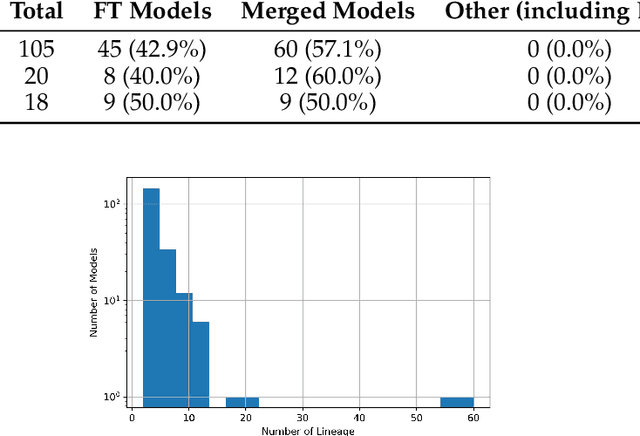

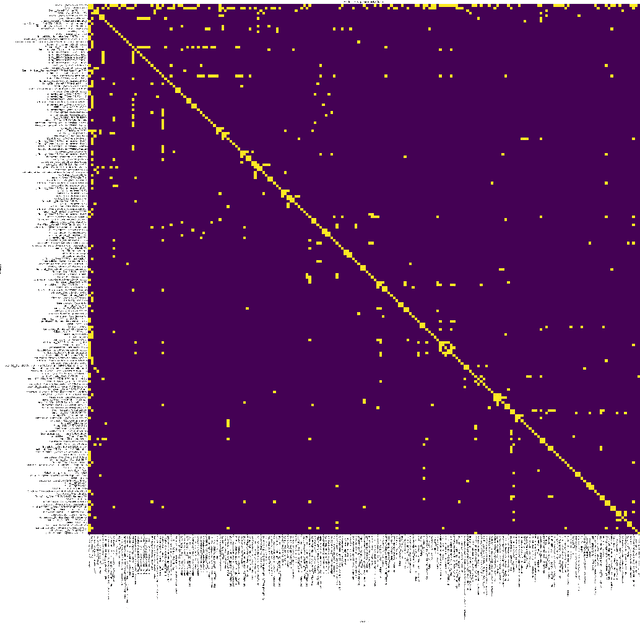
Accurately forecasting the performance of Large Language Models (LLMs) before extensive fine-tuning or merging can substantially reduce both computational expense and development time. Although prior approaches like scaling laws account for global factors such as parameter size or training tokens, they often overlook explicit lineage relationships - i.e., which models are derived or merged from which parents. In this work, we propose a novel Lineage-Regularized Matrix Factorization (LRMF) framework that encodes ancestral ties among LLMs via a graph Laplacian regularizer. By leveraging multi-hop parent-child connections, LRMF consistently outperforms conventional matrix factorization and collaborative filtering methods in both instance-level and benchmark-level performance prediction. Our large-scale study includes 2,934 publicly available Hugging Face models and 21,000+ instances across 6 major benchmarks, showing that lineage constraints yield up to 7-10 percentage points higher correlation with actual performance compared to baselines. Moreover, LRMF effectively addresses the cold-start problem, providing accurate estimates for newly derived or merged models even with minimal data. This lineage-guided strategy thus offers a resource-efficient way to inform hyperparameter tuning, data selection, and model combination in modern LLM development.
LightPAL: Lightweight Passage Retrieval for Open Domain Multi-Document Summarization
Jun 18, 2024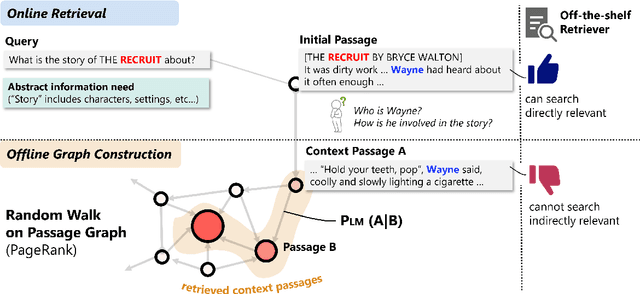
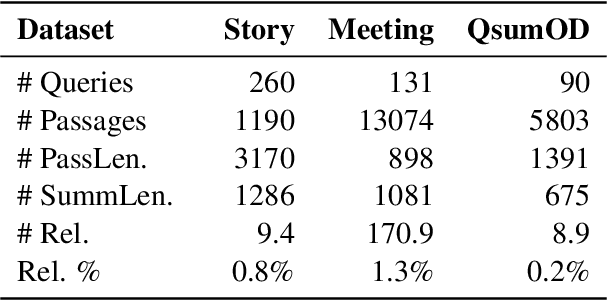
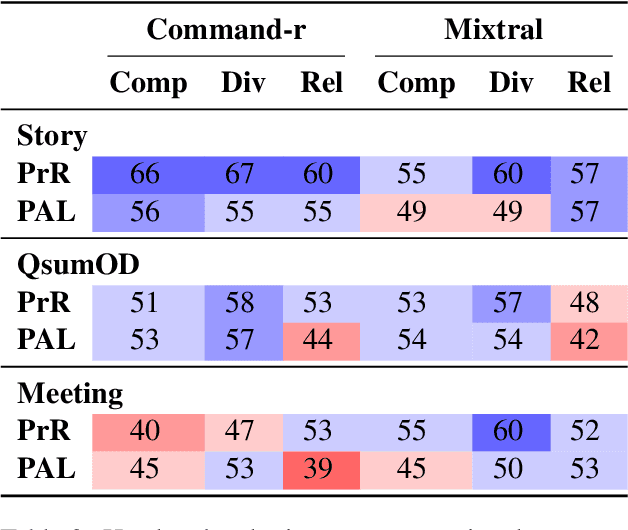
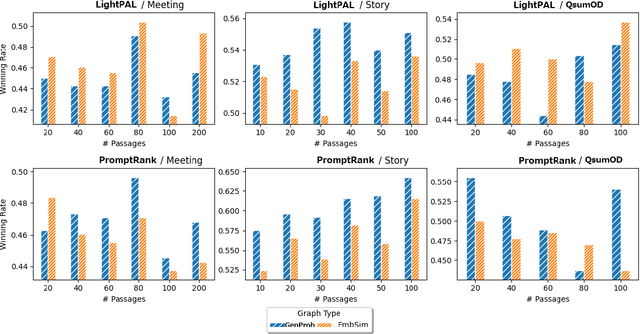
Open-Domain Multi-Document Summarization (ODMDS) is crucial for addressing diverse information needs, which aims to generate a summary as answer to user's query, synthesizing relevant content from multiple documents in a large collection. Existing approaches that first find relevant passages and then generate a summary using a language model are inadequate for ODMDS. This is because open-ended queries often require additional context for the retrieved passages to cover the topic comprehensively, making it challenging to retrieve all relevant passages initially. While iterative retrieval methods have been explored for multi-hop question answering (MQA), they are impractical for ODMDS due to high latency from repeated large language model (LLM) inference for reasoning. To address this issue, we propose LightPAL, a lightweight passage retrieval method for ODMDS that constructs a graph representing passage relationships using an LLM during indexing and employs random walk instead of iterative reasoning and retrieval at inference time. Experiments on ODMDS benchmarks show that LightPAL outperforms baseline retrievers in summary quality while being significantly more efficient than an iterative MQA approach.
DeepJoin: Joinable Table Discovery with Pre-trained Language Models
Dec 15, 2022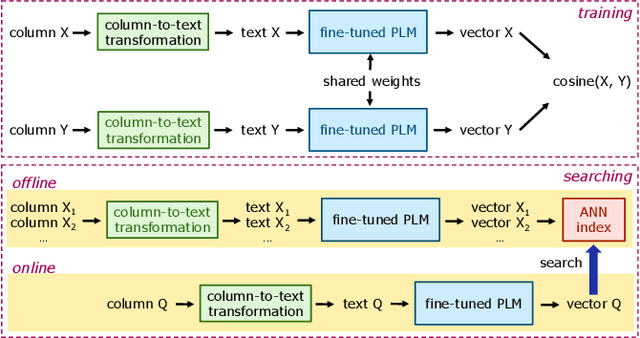
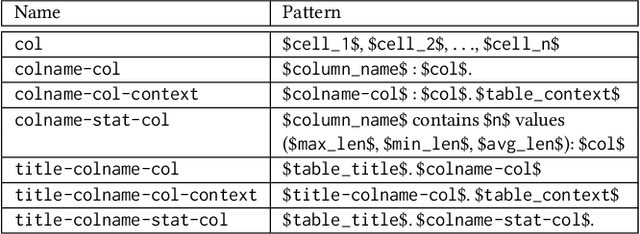
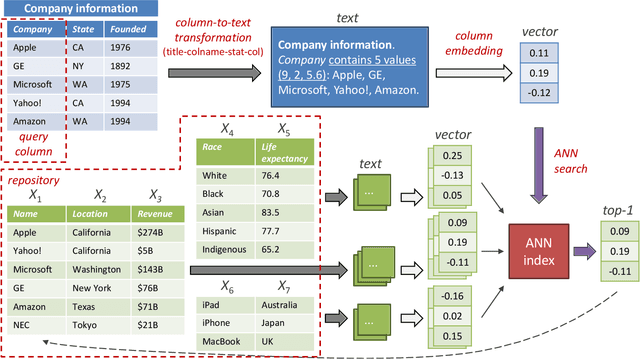
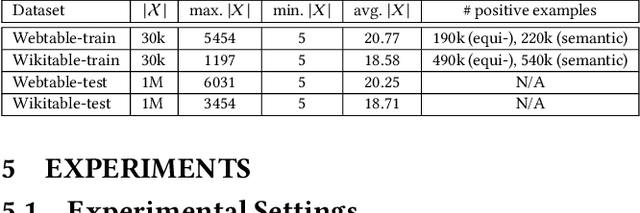
Due to the usefulness in data enrichment for data analysis tasks, joinable table discovery has become an important operation in data lake management. Existing approaches target equi-joins, the most common way of combining tables for creating a unified view, or semantic joins, which tolerate misspellings and different formats to deliver more join results. They are either exact solutions whose running time is linear in the sizes of query column and target table repository or approximate solutions lacking precision. In this paper, we propose Deepjoin, a deep learning model for accurate and efficient joinable table discovery. Our solution is an embedding-based retrieval, which employs a pre-trained language model (PLM) and is designed as one framework serving both equi- and semantic joins. We propose a set of contextualization options to transform column contents to a text sequence. The PLM reads the sequence and is fine-tuned to embed columns to vectors such that columns are expected to be joinable if they are close to each other in the vector space. Since the output of the PLM is fixed in length, the subsequent search procedure becomes independent of the column size. With a state-of-the-art approximate nearest neighbor search algorithm, the search time is logarithmic in the repository size. To train the model, we devise the techniques for preparing training data as well as data augmentation. The experiments on real datasets demonstrate that by training on a small subset of a corpus, Deepjoin generalizes to large datasets and its precision consistently outperforms other approximate solutions'. Deepjoin is even more accurate than an exact solution to semantic joins when evaluated with labels from experts. Moreover, when equipped with a GPU, Deepjoin is up to two orders of magnitude faster than existing solutions.