 Add to Chrome
 Add to Firefox
 Add to Edge
Full-Body Dynamic Safety for Robot Manipulators: 3D Poisson Safety Functions for CBF-Based Safety Filters
Apr 23, 2026
Collision avoidance for robotic manipulators requires enforcing full-body safety constraints in high-dimensional configuration spaces. Control Barrier Function (CBF) based safety filters have proven effective in enabling safe behaviors, but enforcing the high number of constraints needed for safe manipulation leads to theoretic and computational challenges. This work presents a framework for full-body collision avoidance for manipulators in dynamic environments by leveraging 3D Poisson Safety Functions (PSFs). In particular, given environmental occupancy data, we sample the manipulator surface at a prescribed resolution and shrink free space via a Pontryagin difference according to this resolution. On this buffered domain, we synthesize a globally smooth CBF by solving Poisson's equation, yielding a single safety function for the entire environment. This safety function, evaluated at each sampled point, yields task-space CBF constraints enforced by a real-time safety filter via a multi-constraint quadratic program. We prove that keeping the sample points safe in the buffered region guarantees collision avoidance for the entire continuous robot surface. The framework is validated on a 7-degree-of-freedom manipulator in dynamic environments.

Chasing Autonomy: Dynamic Retargeting and Control Guided RL for Performant and Controllable Humanoid Running
Mar 26, 2026Humanoid robots have the promise of locomoting like humans, including fast and dynamic running. Recently, reinforcement learning (RL) controllers that can mimic human motions have become popular as they can generate very dynamic behaviors, but they are often restricted to single motion play-back which hinders their deployment in long duration and autonomous locomotion. In this paper, we present a pipeline to dynamically retarget human motions through an optimization routine with hard constraints to generate improved periodic reference libraries from a single human demonstration. We then study the effect of both the reference motion and the reward structure on the reference and commanded velocity tracking, concluding that a goal-conditioned and control-guided reward which tracks dynamically optimized human data results in the best performance. We deploy the policy on hardware, demonstrating its speed and endurance by achieving running speeds of up to 3.3 m/s on a Unitree G1 robot and traversing hundreds of meters in real-world environments. Additionally, to demonstrate the controllability of the locomotion, we use the controller in a full perception and planning autonomy stack for obstacle avoidance while running outdoors.
Safe-SAGE: Social-Semantic Adaptive Guidance for Safe Engagement through Laplace-Modulated Poisson Safety Functions
Mar 05, 2026Traditional safety-critical control methods, such as control barrier functions, suffer from semantic blindness, exhibiting the same behavior around obstacles regardless of contextual significance. This limitation leads to the uniform treatment of all obstacles, despite their differing semantic meanings. We present Safe-SAGE (Social-Semantic Adaptive Guidance for Safe Engagement), a unified framework that bridges the gap between high-level semantic understanding and low-level safety-critical control through a Poisson safety function (PSF) modulated using a Laplace guidance field. Our approach perceives the environment by fusing multi-sensor point clouds with vision-based instance segmentation and persistent object tracking to maintain up-to-date semantics beyond the camera's field of view. A multi-layer safety filter is then used to modulate system inputs to achieve safe navigation using this semantic understanding of the environment. This safety filter consists of both a model predictive control layer and a control barrier function layer. Both layers utilize the PSF and flux modulation of the guidance field to introduce varying levels of conservatism and multi-agent passing norms for different obstacles in the environment. Our framework enables legged robots to navigate semantically rich, dynamic environments with context-dependent safety margins while maintaining rigorous safety guarantees.
Layered Safety: Enhancing Autonomous Collision Avoidance via Multistage CBF Safety Filters
Feb 27, 2026This paper presents a general end-to-end framework for constructing robust and reliable layered safety filters that can be leveraged to perform dynamic collision avoidance over a broad range of applications using only local perception data. Given a robot-centric point cloud, we begin by constructing an occupancy map which is used to synthesize a Poisson safety function (PSF). The resultant PSF is employed as a control barrier function (CBF) within two distinct safety filtering stages. In the first stage, we propose a predictive safety filter to compute optimal safe trajectories based on nominal potentially-unsafe commands. The resultant short-term plans are constrained to satisfy the CBF condition along a finite prediction horizon. In the second stage, instantaneous velocity commands are further refined by a real-time CBF-based safety filter and tracked by the full-order low-level robot controller. Assuming accurate tracking of velocity commands, we obtain formal guarantees of safety for the full-order system. We validate the optimality and robustness of our multistage architecture, in comparison to traditional single-stage safety filters, via a detailed Pareto analysis. We further demonstrate the effectiveness and generality of our collision avoidance methodology on multiple legged robot platforms across a variety of real-world dynamic scenarios.
A Class of Axis-Angle Attitude Control Laws for Rotational Systems
Dec 22, 2025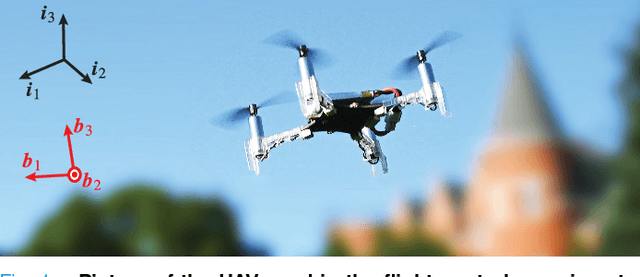
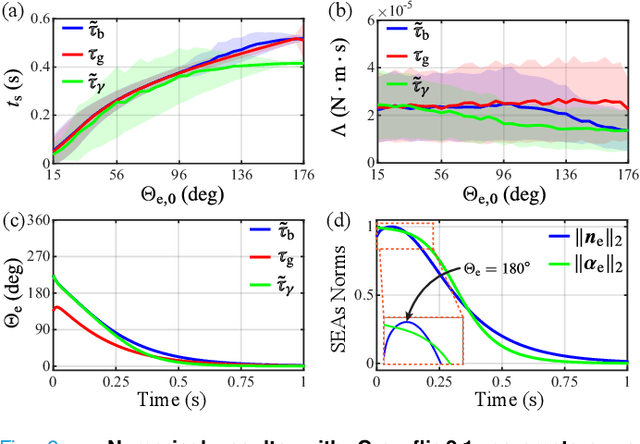
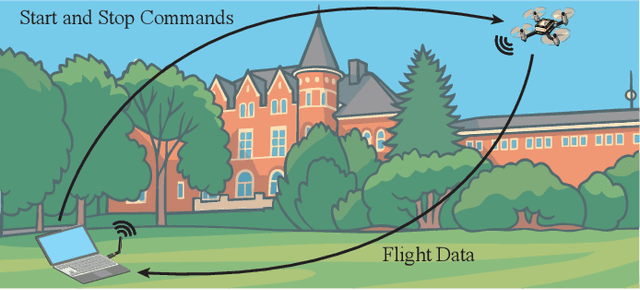
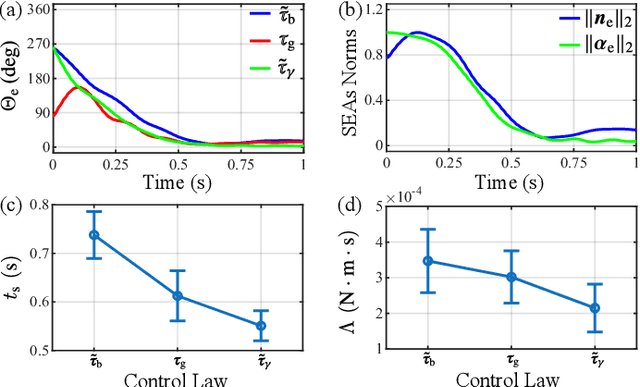
We introduce a new class of attitude control laws for rotational systems, which generalizes the use of the Euler axis-angle representation beyond quaternion-based formulations. Using basic Lyapunov's stability theory and the notion of extended $K_{\infty}$ functions, we developed a method for determining and enforcing the global asymptotic stability of the single fixed point of the resulting closed-loop (CL) scheme. In contrast with traditional quaternion-based methods, the proposed generalized axis-angle approach enables greater flexibility in the design of the control law, which is of great utility when employed in combination with a switching scheme whose transition state depends on the angular velocity of the controlled rotational system. Through simulation and real-time experimental results, we demonstrate the effectiveness of the proposed approach. According to the recorded data, in the execution of high-speed tumble-recovery maneuvers, the new method consistently achieves shorter stabilization times and requires lower control effort relative to those corresponding to the quaternion-based and geometric-control methods used as benchmarks.
A New Type of Axis-Angle Attitude Control Law for Rotational Systems: Synthesis, Analysis, and Experiments
Oct 29, 2025Over the past few decades, continuous quaternion-based attitude control has been proven highly effective for driving rotational systems that can be modeled as rigid bodies, such as satellites and drones. However, methods rooted in this approach do not enforce the existence of a unique closed-loop (CL) equilibrium attitude-error quaternion (AEQ); and, for rotational errors about the attitude-error Euler axis larger than {\pi}rad, their proportional-control effect diminishes as the system state moves away from the stable equilibrium of the CL rotational dynamics. In this paper, we introduce a new type of attitude control law that more effectively leverages the attitude-error Euler axis-angle information to guarantee a unique CL equilibrium AEQ and to provide greater flexibility in the use of proportional-control efforts. Furthermore, using two different control laws as examples-through the construction of a strict Lyapunov function for the CL dynamics-we demonstrate that the resulting unique equilibrium of the CL rotational system can be enforced to be uniformly asymptotically stable. To assess and demonstrate the functionality and performance of the proposed approach, we performed numerical simulations and executed dozens of real-time tumble-recovery maneuvers using a small quadrotor. These simulations and flight tests compellingly demonstrate that the proposed axis-angle-based method achieves superior flight performance-compared with that obtained using a high-performance quaternion-based controller-in terms of stabilization time.
Risk-Aware Safety Filters with Poisson Safety Functions and Laplace Guidance Fields
Oct 29, 2025Robotic systems navigating in real-world settings require a semantic understanding of their environment to properly determine safe actions. This work aims to develop the mathematical underpinnings of such a representation -- specifically, the goal is to develop safety filters that are risk-aware. To this end, we take a two step approach: encoding an understanding of the environment via Poisson's equation, and associated risk via Laplace guidance fields. That is, we first solve a Dirichlet problem for Poisson's equation to generate a safety function that encodes system safety as its 0-superlevel set. We then separately solve a Dirichlet problem for Laplace's equation to synthesize a safe \textit{guidance field} that encodes variable levels of caution around obstacles -- by enforcing a tunable flux boundary condition. The safety function and guidance fields are then combined to define a safety constraint and used to synthesize a risk-aware safety filter which, given a semantic understanding of an environment with associated risk levels of environmental features, guarantees safety while prioritizing avoidance of higher risk obstacles. We demonstrate this method in simulation and discuss how \textit{a priori} understandings of obstacle risk can be directly incorporated into the safety filter to generate safe behaviors that are risk-aware.
Safe Navigation under State Uncertainty: Online Adaptation for Robust Control Barrier Functions
Aug 26, 2025Measurements and state estimates are often imperfect in control practice, posing challenges for safety-critical applications, where safety guarantees rely on accurate state information. In the presence of estimation errors, several prior robust control barrier function (R-CBF) formulations have imposed strict conditions on the input. These methods can be overly conservative and can introduce issues such as infeasibility, high control effort, etc. This work proposes a systematic method to improve R-CBFs, and demonstrates its advantages on a tracked vehicle that navigates among multiple obstacles. A primary contribution is a new optimization-based online parameter adaptation scheme that reduces the conservativeness of existing R-CBFs. In order to reduce the complexity of the parameter optimization, we merge several safety constraints into one unified numerical CBF via Poisson's equation. We further address the dual relative degree issue that typically causes difficulty in vehicle tracking. Experimental trials demonstrate the overall performance improvement of our approach over existing formulations.
Dynamic Safety in Complex Environments: Synthesizing Safety Filters with Poisson's Equation
May 11, 2025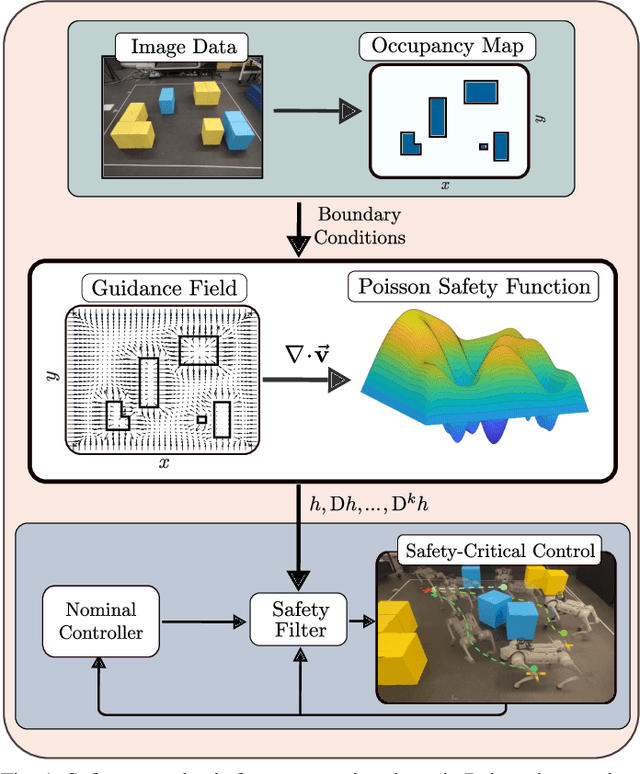
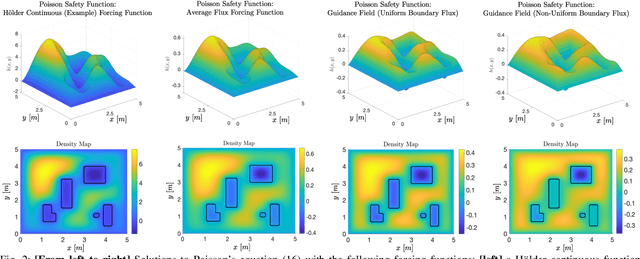
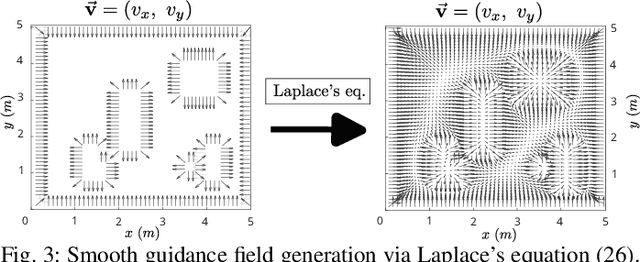
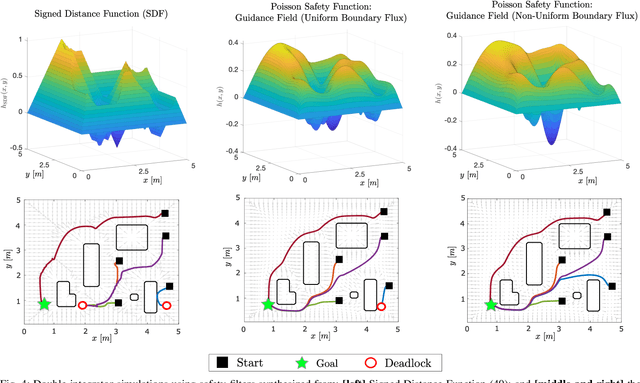
Synthesizing safe sets for robotic systems operating in complex and dynamically changing environments is a challenging problem. Solving this problem can enable the construction of safety filters that guarantee safe control actions -- most notably by employing Control Barrier Functions (CBFs). This paper presents an algorithm for generating safe sets from perception data by leveraging elliptic partial differential equations, specifically Poisson's equation. Given a local occupancy map, we solve Poisson's equation subject to Dirichlet boundary conditions, with a novel forcing function. Specifically, we design a smooth guidance vector field, which encodes gradient information required for safety. The result is a variational problem for which the unique minimizer -- a safety function -- characterizes the safe set. After establishing our theoretical result, we illustrate how safety functions can be used in CBF-based safety filtering. The real-time utility of our synthesis method is highlighted through hardware demonstrations on quadruped and humanoid robots navigating dynamically changing obstacle-filled environments.
Closed-Loop Stability of a Lyapunov-Based Switching Attitude Controller for Energy-Efficient Torque-Input-Selection During Flight
Nov 01, 2024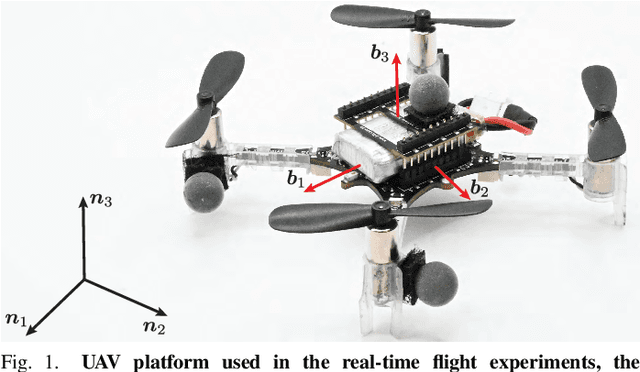
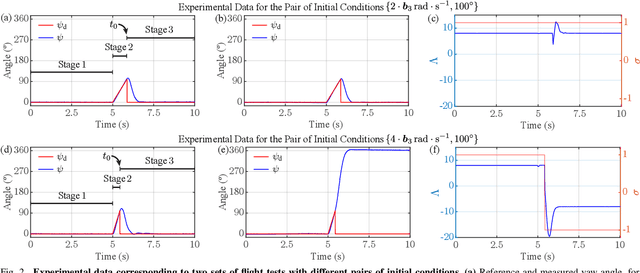
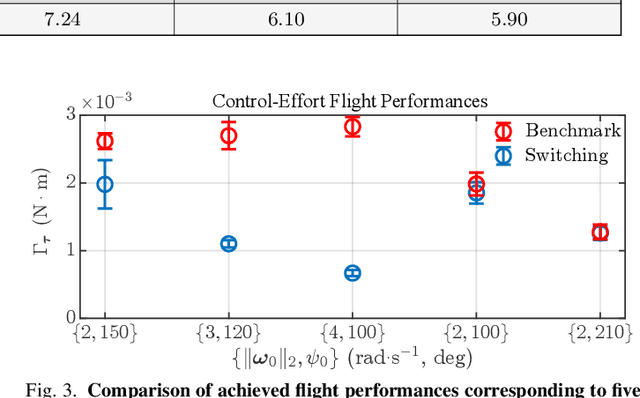
We present a new Lyapunov-based switching attitude controller for energy-efficient real-time selection of the torque inputted to an uncrewed aerial vehicle (UAV) during flight. The proposed method, using quaternions to describe the attitude of the controlled UAV, interchanges the stability properties of the two fixed points-one locally asymptotically stable and another unstable-of the resulting closed-loop (CL) switching dynamics of the system. In this approach, the switching events are triggered by the value of a compound energy-based function. To analyze and ensure the stability of the CL switching dynamics, we use classical nonlinear Lyapunov techniques, in combination with switching-systems theory. For this purpose, we introduce a new compound Lyapunov function (LF) that not only enables us to derive the conditions for CL asymptotic and exponential stability, but also provides us with an estimate of the CL system's region of attraction. This new estimate is considerably larger than those previously reported for systems of the type considered in this paper. To test and demonstrate the functionality, suitability, and performance of the proposed method, we present and discuss experimental data obtained using a 31-g quadrotor during the execution of high-speed yaw-tracking maneuvers. Also, we provide empirical evidence indicating that all the initial conditions chosen for these maneuvers, as estimated, lie inside the system's region of attraction. Last, experimental data obtained through these flight tests show that the proposed switching controller reduces the control effort by about 53%, on average, with respect to that corresponding to a commonly used benchmark control scheme, when executing a particular type of high-speed yaw-tracking maneuvers.