 Add to Chrome
 Add to Firefox
 Add to Edge
Learning with a Single Rollout via Monte Carlo Pass@k Critic
Jun 24, 2026
Estimating token-level advantages in reinforcement learning (RL) for language models remains challenging because scaling up episodic experience collection is expensive. The difficulty intensifies for baseline advantage estimation methods, where repeated sampling causes trajectories to diverge into substantially different reasoning prefixes. In this context, RL algorithms such as GRPO prove limited: an outcome reward is too sparse to be attributed to specific actions like intermediate steps, and comparisons across sampled traces are non-trivial because they are heterogeneous. To mitigate both the computational cost of repeated sampling and the difficulty of credit assignment, we study single-rollout proximal policy optimization (SR-PPO) featuring token-level credit assignment in RL for language models. Instead of estimating advantages by normalizing episodic returns within the candidate group, we train a calibrated token-level credit critic using Monte Carlo outcomes from one rollout per prompt. Specifically, we use the critic to predict the Pass@k success probability at the prompt prefix, which is derived from a Pass@1 attempt. This choice yields a more selective learning signal than Pass@1: it discounts easily solved prefixes while prioritizing hard ones whose success probability remains marginal. We show that as $k$ increases, Pass@k converges to a reachability indicator, reflecting whether a prefix can lead to at least one successful continuation. In an explicit state graph, the limit ($k \rightarrow \infty$) can be computed in $O(|V|+|E|)$ time, offering a promising surrogate for direct credit assignment without the need to sample contrastive traces. As an initial validation, SR-PPO exhibits stable learning dynamics, along with consistent gains in Pass@128 success rates on mathematical reasoning benchmarks such as HMMT26 and AIME24.

Heteroscedastic Uncertainty for Robust Generative Latent Dynamics
Aug 18, 2020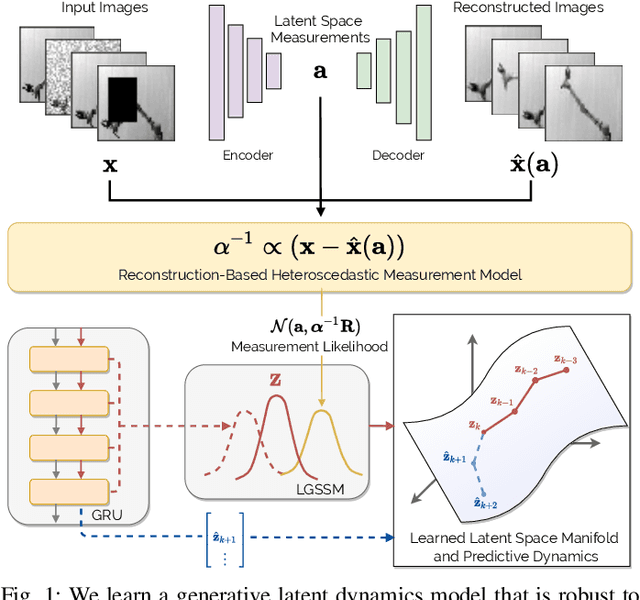

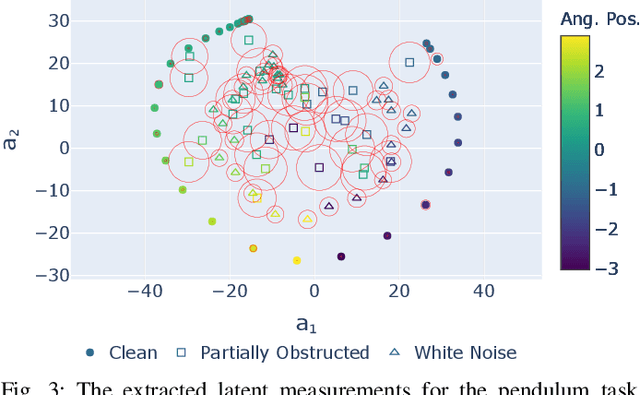

Learning or identifying dynamics from a sequence of high-dimensional observations is a difficult challenge in many domains, including reinforcement learning and control. The problem has recently been studied from a generative perspective through latent dynamics: high-dimensional observations are embedded into a lower-dimensional space in which the dynamics can be learned. Despite some successes, latent dynamics models have not yet been applied to real-world robotic systems where learned representations must be robust to a variety of perceptual confounds and noise sources not seen during training. In this paper, we present a method to jointly learn a latent state representation and the associated dynamics that is amenable for long-term planning and closed-loop control under perceptually difficult conditions. As our main contribution, we describe how our representation is able to capture a notion of heteroscedastic or input-specific uncertainty at test time by detecting novel or out-of-distribution (OOD) inputs. We present results from prediction and control experiments on two image-based tasks: a simulated pendulum balancing task and a real-world robotic manipulator reaching task. We demonstrate that our model produces significantly more accurate predictions and exhibits improved control performance, compared to a model that assumes homoscedastic uncertainty only, in the presence of varying degrees of input degradation.