 Add to Chrome
 Add to Firefox
 Add to Edge
Tube-Structured Incremental Semantic HARQ for Generative Video Receivers
May 11, 2026
Generative semantic communication uses receiver-side generative priors to reconstruct visual content from compact semantics, making it attractive for bandwidth-limited multimedia delivery. For video, reliable recovery remains difficult because errors accumulate over time, useful evidence is temporally correlated, and the receiver must make decisions under limited interaction, retransmission, and reconstruction budgets. Existing generative semantic communication studies mainly emphasize representation, compression, or generative reconstruction, while recent error-resilient and semantic-HARQ methods still largely operate on encoder-defined or frame-block retransmission units. This paper studies receiver-driven semantic HARQ for generative video reconstruction under a budget-constrained AoIS-AUC objective and argues that the retransmission primitive is itself an important system design variable. We propose tube-structured package-native requests, in which temporally local packages are the channel-visible HARQ objects and are transmitted, dropped, received, and committed at package granularity. Under a controlled comparison protocol with matched backbone, budgets, and channel model, this primitive yields lower time-weighted recovery cost than competitive block-based baselines in practically relevant moderate-to-harsh regimes, while the gap naturally shrinks in near-clean channels. The gain mainly appears as earlier stabilization of the recovery trajectory, while final-quality endpoints remain broadly comparable, and it persists even against a tube-aware block-ranking baseline.

Multi-Mode Pinching-Antenna Systems: Polarization-Aware Full-Wave Modeling and Optimization
Apr 02, 2026Millimeter-wave and terahertz communications face a fundamental challenge: overcoming severe path loss without sacrificing spectral efficiency. Pinching antenna systems (PASS) address this by bringing radiators physically close to users, yet existing frameworks treat the waveguide as a mere transmission line, overlooking its inherent multi-mode capabilities and the critical role of polarization. This paper develops the first polarization-aware, full-wave electromagnetic model for multi-mode PASS (MMPASS), capturing spatial radiation patterns, modal polarization states, and polarization matching efficiency from first principles. Leveraging this physically grounded model, we reveal fundamental trade-offs among waveguide attenuation, atmospheric absorption, and geometric spreading, yielding closed-form solutions for optimal PA placement and orientation in single-user scenarios. Extending to multi-user settings, we propose a modular optimization framework that integrates fractional programming with closed-form polarization updates, scaling gracefully to arbitrary numbers of waveguides, PAs, and users. Numerical results show that MMPASS achieves up to a 167% increase in spectral efficiency compared with single-mode PASS. Moreover, when comparing MMPASS with its polarization-ignorant counterpart, polarization awareness alone improves the sum rate by up to 23%. By bridging rigorous electromagnetic theory with scalable optimization, MMPASS establishes a physically complete and practically viable foundation for future high-frequency wireless networks.
Capacity-Optimized Pre-Equalizer Design for Visible Light Communication Systems
May 26, 2025Since commercial LEDs are primarily designed for illumination rather than data transmission, their modulation bandwidth is inherently limited to a few MHz. This becomes a major bottleneck in the implementation of visible light communication (VLC) systems necessiating the design of pre-equalizers. While state-of-the-art equalizer designs primarily focus on the data rate increasing through bandwidth expansion, they often overlook the accompanying degradation in signal-to-noise ratio (SNR). Achieving effective bandwidth extension without introducing excessive SNR penalties remains a significant challenge, since the channel capacity is a non-linear function of both parameters. In this paper, we present a fundamental analysis of how the parameters of the LED and pre-equalization circuits influence the channel capacity in intensity modulation and direct detection (IMDD)-based VLC systems. We derive a closed-form expression for channel capacity model that is an explicitly function of analog pre-equalizer circuit parameters. Building upon the derived capacity expression, we propose a systematic design methodology for analog pre-equalizers that effectively balances bandwidth and SNR, thereby maximizing the overall channel capacity across a wide range of channel attenuations. We present extensive numerical results to validate the effectiveness of the proposed design and demonstrate the improvements over conventional bandwidth-optimized pre-equalizer designs.
Polarization Aware Movable Antenna
Nov 11, 2024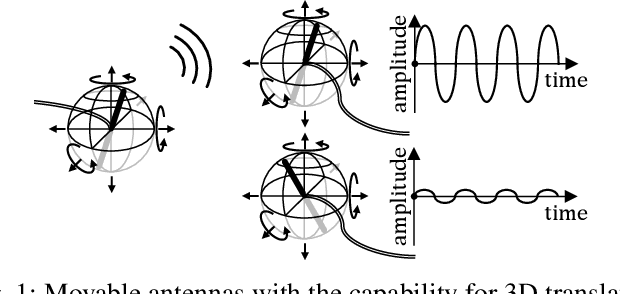
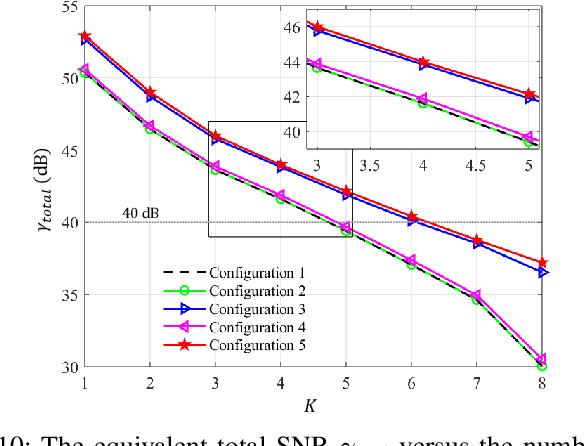
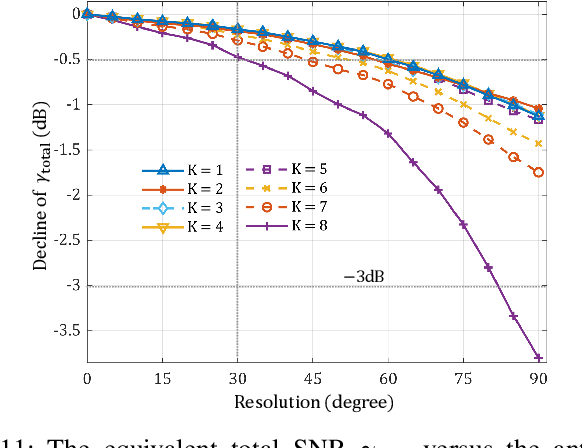
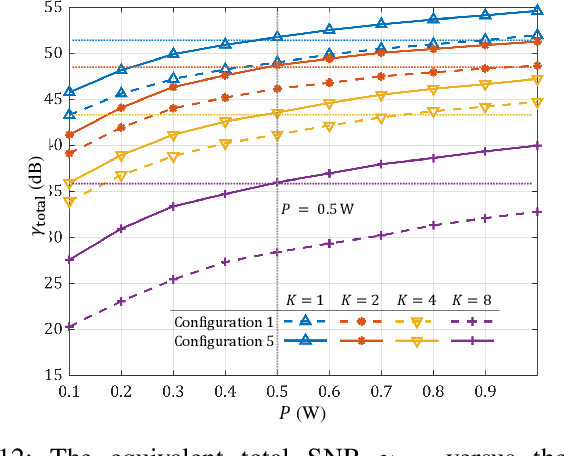
This paper presents a polarization-aware movable antenna (PAMA) framework that integrates polarization effects into the design and optimization of movable antennas (MAs). While MAs have proven effective at boosting wireless communication performance, existing studies primarily focus on phase variations caused by different propagation paths and leverage antenna movements to maximize channel gains. This narrow focus limits the full potential of MAs. In this work, we introduce a polarization-aware channel model rooted in electromagnetic theory, unveiling a defining advantage of MAs over other wireless technologies such as precoding: the ability to optimize polarization matching. This new understanding enables PAMA to extend the applicability of MAs beyond radio-frequency, multipath-rich scenarios to higher-frequency bands, such as mmWave, even with a single line-of-sight (LOS) path. Our findings demonstrate that incorporating polarization considerations into MAs significantly enhances efficiency, link reliability, and data throughput, paving the way for more robust and efficient future wireless networks.
Optical Integrated Sensing and Communication
May 24, 2023
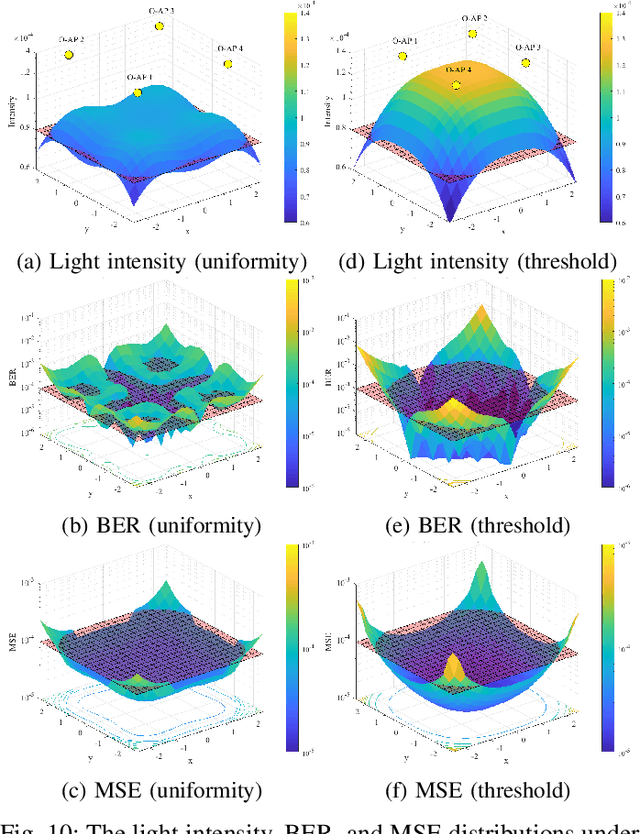
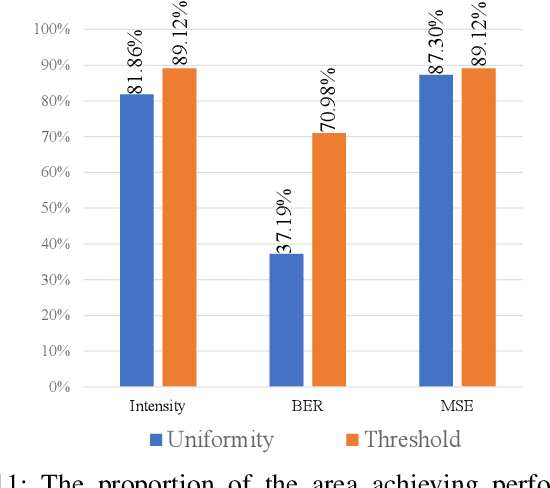
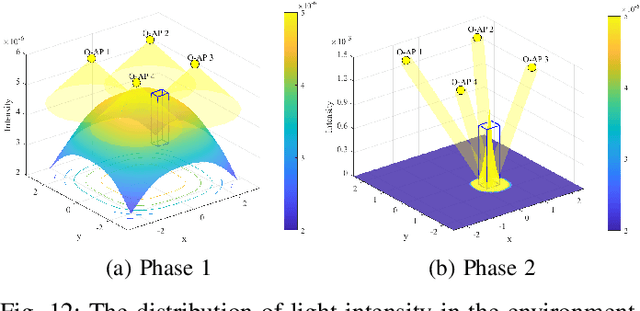
This paper explores a new paradigm of optical integrated sensing and communication (O-ISAC). Our investigation reveals that optical communication and optical sensing are two inherently complementary technologies. On the one hand, optical communication provides the necessary illumination for optical sensing. On the other hand, optical sensing provides environmental information for optical communication. These insights form the foundation of a directionless integrated system, which constitutes the first phase of O-ISAC. We further put forth the concept of optical beamforming using the collimating lens, whereby the light emitted by optical sources is concentrated onto the target device. This greatly improves communication rate and sensing accuracy, thanks to remarkably increased light intensity. Simulation results confirm the significant performance gains of our O-ISAC system over a separated sensing and communication system. With the collimating lens, the light intensity arrived at the target object is increased from 1.09% to 78.06%. The sensing accuracy and communication BER are improved by 62.06dB and 65.52dB, respectively.
Phase Code Discovery for Pulse Compression Radar: A Genetic Algorithm Approach
Jul 29, 2022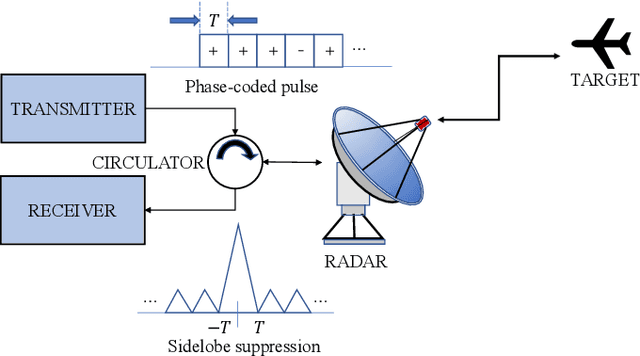
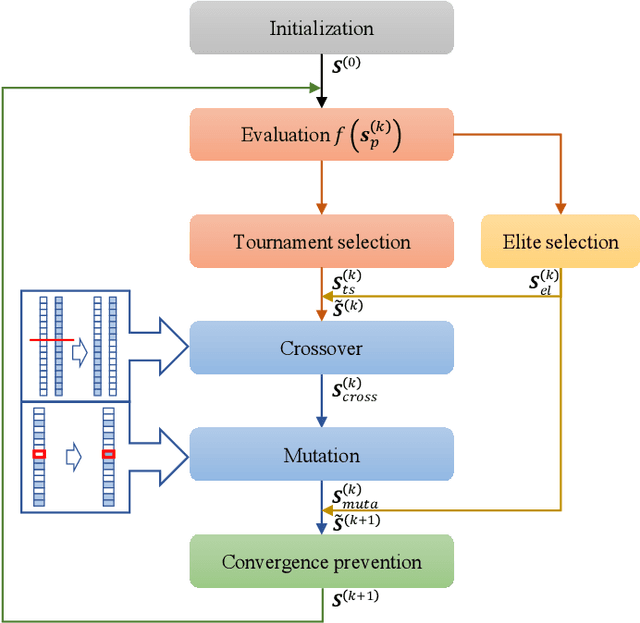
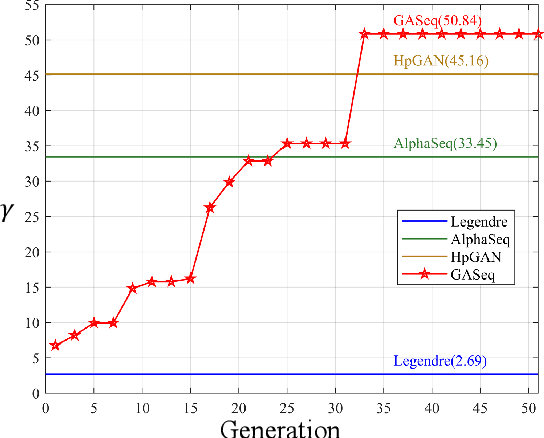
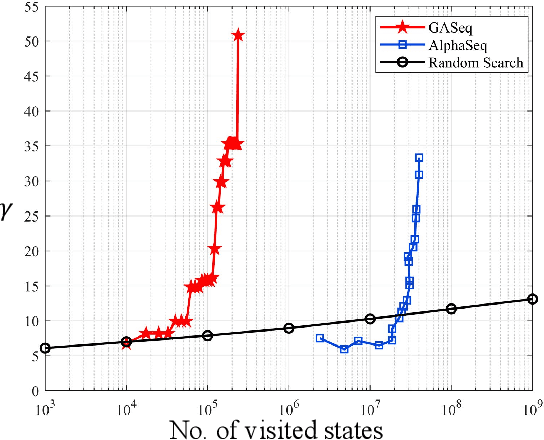
Discovering sequences with desired properties has long been an interesting intellectual pursuit. In pulse compression radar (PCR), discovering phase codes with low aperiodic autocorrelations is essential for a good estimation performance. The design of phase code, however, is mathematically non-trivial as the aperiodic autocorrelation properties of a sequence are intractable to characterize. In this paper, we put forth a genetic algorithm (GA) approach to discover new phase codes for PCR with the mismatched filter (MMF) receiver. The developed GA, dubbed GASeq, discovers better phase codes than the state of the art. At a code length of 59, the sequence discovered by GASeq achieves a signal-to-clutter ratio (SCR) of 50.84, while the best-known sequence has an SCR of 45.16. In addition, the efficiency and scalability of GASeq enable us to search phase codes with a longer code length, which thwarts existing deep learning-based approaches. At a code length of 100, the best phase code discovered by GASeq exhibit an SCR of 63.23.