 Add to Chrome
 Add to Firefox
 Add to Edge
Tube-Structured Incremental Semantic HARQ for Generative Video Receivers
May 11, 2026
Generative semantic communication uses receiver-side generative priors to reconstruct visual content from compact semantics, making it attractive for bandwidth-limited multimedia delivery. For video, reliable recovery remains difficult because errors accumulate over time, useful evidence is temporally correlated, and the receiver must make decisions under limited interaction, retransmission, and reconstruction budgets. Existing generative semantic communication studies mainly emphasize representation, compression, or generative reconstruction, while recent error-resilient and semantic-HARQ methods still largely operate on encoder-defined or frame-block retransmission units. This paper studies receiver-driven semantic HARQ for generative video reconstruction under a budget-constrained AoIS-AUC objective and argues that the retransmission primitive is itself an important system design variable. We propose tube-structured package-native requests, in which temporally local packages are the channel-visible HARQ objects and are transmitted, dropped, received, and committed at package granularity. Under a controlled comparison protocol with matched backbone, budgets, and channel model, this primitive yields lower time-weighted recovery cost than competitive block-based baselines in practically relevant moderate-to-harsh regimes, while the gap naturally shrinks in near-clean channels. The gain mainly appears as earlier stabilization of the recovery trajectory, while final-quality endpoints remain broadly comparable, and it persists even against a tube-aware block-ranking baseline.

Revisiting the Independence Assumption in LEO Satellite-to-Ground Optical Links: A State-Coupled Joint Fading Model
May 11, 2026Performance analysis of low Earth orbit (LEO) satellite-to-ground optical links relies on composite fading models that typically evaluate scintillation and angular loss under the assumption of statistical independence. While ensuring analytical tractability, this assumption decouples fading mechanisms driven by the same atmospheric turbulence and fails to capture the distinct effects of free atmosphere (FA) and boundary layer (BL) perturbations. To model this coupling while preserving tractability, this paper develops a state-coupled joint fading model. In the proposed framework, aperture-averaged scintillation and effective angular loss are jointly characterized by a discrete slow atmospheric state, parameterized by separate FA and BL scaling factors. By replacing unconditional independence with state-conditioned independence, the model enables a closed-form derivation of the outage probability, preserving the computational simplicity of the independent baseline. Numerical results show that the independent baseline can misestimate outage under non-nominal layered turbulence states. This outage prediction bias varies with elevation because the relative roles of scintillation and angular loss change with the link geometry, resulting in different residual angular correction requirements for a given outage target.
Phase Code Discovery for Pulse Compression Radar: A Genetic Algorithm Approach
Jul 29, 2022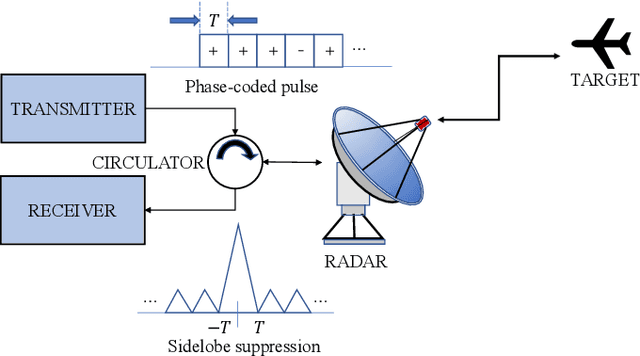
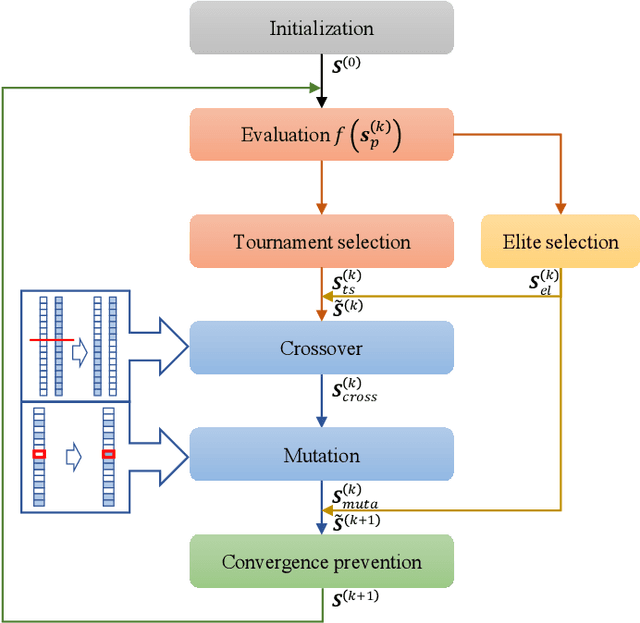
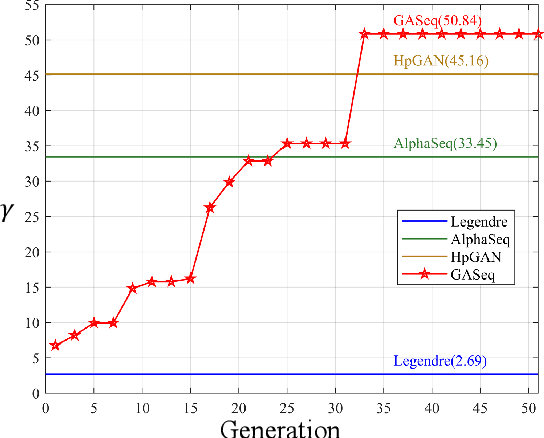
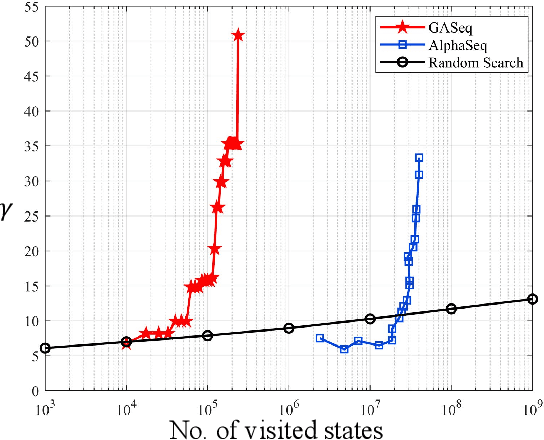
Discovering sequences with desired properties has long been an interesting intellectual pursuit. In pulse compression radar (PCR), discovering phase codes with low aperiodic autocorrelations is essential for a good estimation performance. The design of phase code, however, is mathematically non-trivial as the aperiodic autocorrelation properties of a sequence are intractable to characterize. In this paper, we put forth a genetic algorithm (GA) approach to discover new phase codes for PCR with the mismatched filter (MMF) receiver. The developed GA, dubbed GASeq, discovers better phase codes than the state of the art. At a code length of 59, the sequence discovered by GASeq achieves a signal-to-clutter ratio (SCR) of 50.84, while the best-known sequence has an SCR of 45.16. In addition, the efficiency and scalability of GASeq enable us to search phase codes with a longer code length, which thwarts existing deep learning-based approaches. At a code length of 100, the best phase code discovered by GASeq exhibit an SCR of 63.23.