 Add to Chrome
 Add to Firefox
 Add to Edge
HPRO: Hierarchical Progressive Reward Optimization via Preference Extraction for Emotional Text-to-Speech
Jun 26, 2026
Recently, Large Language Model (LLM)-based Text-to-Speech (TTS) models have achieved remarkable naturalness. However, the standard Supervised Fine-Tuning paradigm often converges to statistically averaged prosody, limiting emotional expressiveness. While preference-driven optimization offers a promising alternative, existing approaches suffer from two structural mismatches: information conflict, where content and emotion in a shared latent space produce conflicting gradients, leading to reward hacking and semantic degradation; and scale gap, where sparse sentence-level rewards struggle to guide dense frame-level generation. To overcome these challenges, we propose HPRO, a hierarchical progressive reward optimization framework. Within HPRO, we introduce the HD-Emo codec as a novel differentiable reward model to resolve the information conflict. It extracts speech into distinct content and style preference tokens, structurally isolating emotional optimization from semantic content. Building upon this structured preference space, HPRO bridges the scale gap by progressively aligning frame-, word- and sentence-level objectives. Experiments demonstrate that HPRO significantly enhances emotional expressiveness, while effectively preserving linguistic intelligibility. The code and audio samples are publicly available at https://xxh333.github.io/hpro-demo/.

F5R-TTS: Improving Flow Matching based Text-to-Speech with Group Relative Policy Optimization
Apr 03, 2025We present F5R-TTS, a novel text-to-speech (TTS) system that integrates Gradient Reward Policy Optimization (GRPO) into a flow-matching based architecture. By reformulating the deterministic outputs of flow-matching TTS into probabilistic Gaussian distributions, our approach enables seamless integration of reinforcement learning algorithms. During pretraining, we train a probabilistically reformulated flow-matching based model which is derived from F5-TTS with an open-source dataset. In the subsequent reinforcement learning (RL) phase, we employ a GRPO-driven enhancement stage that leverages dual reward metrics: word error rate (WER) computed via automatic speech recognition and speaker similarity (SIM) assessed by verification models. Experimental results on zero-shot voice cloning demonstrate that F5R-TTS achieves significant improvements in both speech intelligibility (relatively 29.5\% WER reduction) and speaker similarity (relatively 4.6\% SIM score increase) compared to conventional flow-matching based TTS systems. Audio samples are available at https://frontierlabs.github.io/F5R.
DGC-vector: A new speaker embedding for zero-shot voice conversion
Mar 18, 2022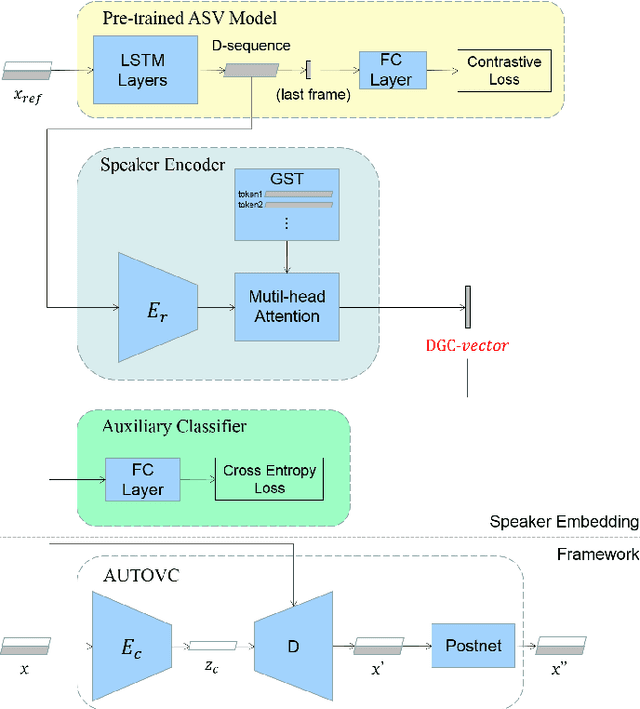
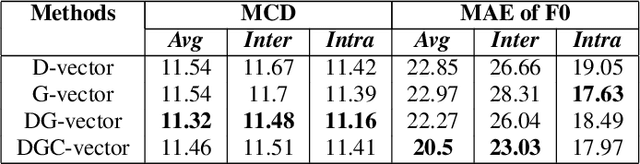
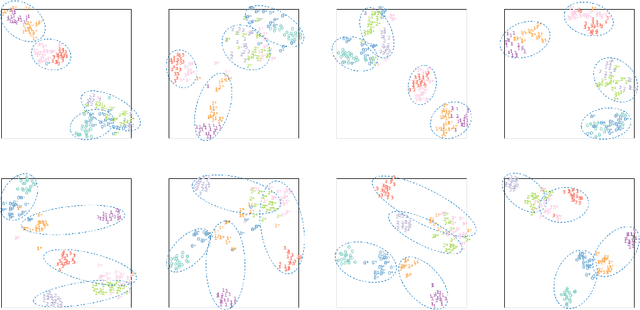
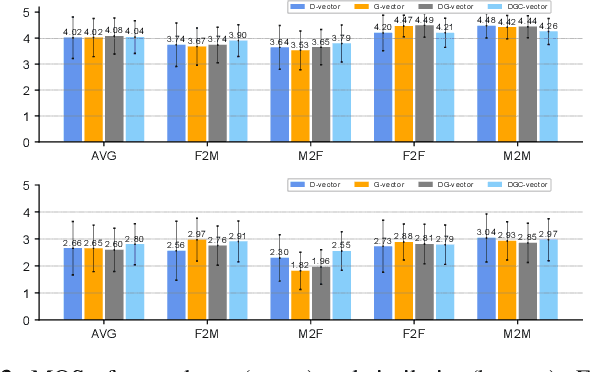
Recently, more and more zero-shot voice conversion algorithms have been proposed. As a fundamental part of zero-shot voice conversion, speaker embeddings are the key to improving the converted speech's speaker similarity. In this paper, we study the impact of speaker embeddings on zero-shot voice conversion performance. To better represent the characteristics of the target speaker and improve the speaker similarity in zero-shot voice conversion, we propose a novel speaker representation method in this paper. Our method combines the advantages of D-vector, global style token (GST) based speaker representation and auxiliary supervision. Objective and subjective evaluations show that the proposed method achieves a decent performance on zero-shot voice conversion and significantly improves speaker similarity over D-vector and GST-based speaker embedding.