 Add to Chrome
 Add to Firefox
 Add to Edge
HPRO: Hierarchical Progressive Reward Optimization via Preference Extraction for Emotional Text-to-Speech
Jun 26, 2026
Recently, Large Language Model (LLM)-based Text-to-Speech (TTS) models have achieved remarkable naturalness. However, the standard Supervised Fine-Tuning paradigm often converges to statistically averaged prosody, limiting emotional expressiveness. While preference-driven optimization offers a promising alternative, existing approaches suffer from two structural mismatches: information conflict, where content and emotion in a shared latent space produce conflicting gradients, leading to reward hacking and semantic degradation; and scale gap, where sparse sentence-level rewards struggle to guide dense frame-level generation. To overcome these challenges, we propose HPRO, a hierarchical progressive reward optimization framework. Within HPRO, we introduce the HD-Emo codec as a novel differentiable reward model to resolve the information conflict. It extracts speech into distinct content and style preference tokens, structurally isolating emotional optimization from semantic content. Building upon this structured preference space, HPRO bridges the scale gap by progressively aligning frame-, word- and sentence-level objectives. Experiments demonstrate that HPRO significantly enhances emotional expressiveness, while effectively preserving linguistic intelligibility. The code and audio samples are publicly available at https://xxh333.github.io/hpro-demo/.

CB-Conformer: Contextual biasing Conformer for biased word recognition
Apr 25, 2023
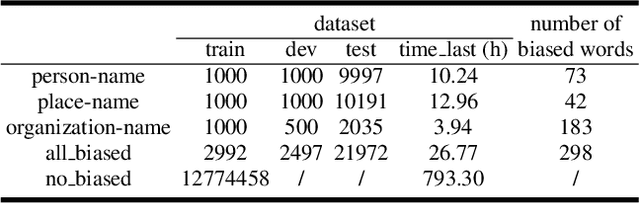
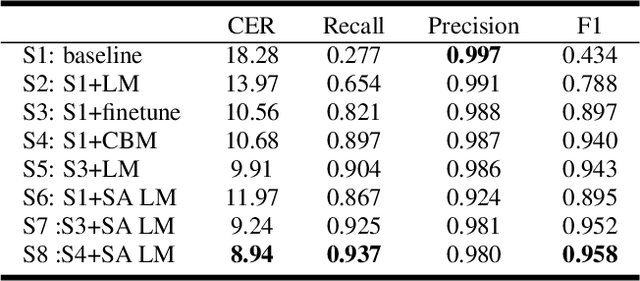
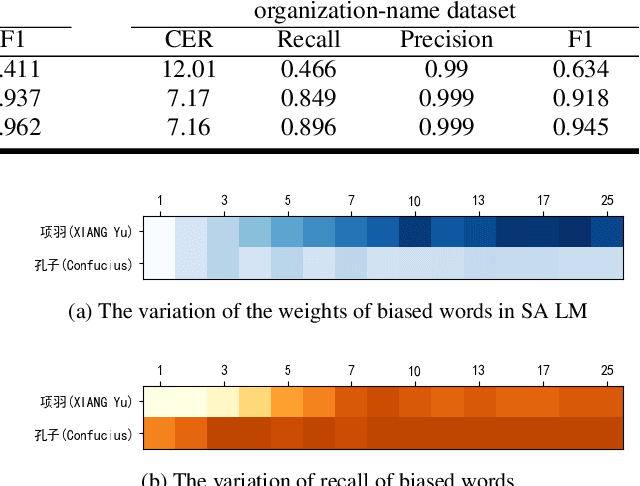
Due to the mismatch between the source and target domains, how to better utilize the biased word information to improve the performance of the automatic speech recognition model in the target domain becomes a hot research topic. Previous approaches either decode with a fixed external language model or introduce a sizeable biasing module, which leads to poor adaptability and slow inference. In this work, we propose CB-Conformer to improve biased word recognition by introducing the Contextual Biasing Module and the Self-Adaptive Language Model to vanilla Conformer. The Contextual Biasing Module combines audio fragments and contextual information, with only 0.2% model parameters of the original Conformer. The Self-Adaptive Language Model modifies the internal weights of biased words based on their recall and precision, resulting in a greater focus on biased words and more successful integration with the automatic speech recognition model than the standard fixed language model. In addition, we construct and release an open-source Mandarin biased-word dataset based on WenetSpeech. Experiments indicate that our proposed method brings a 15.34% character error rate reduction, a 14.13% biased word recall increase, and a 6.80% biased word F1-score increase compared with the base Conformer.
Multi-head Monotonic Chunkwise Attention For Online Speech Recognition
May 01, 2020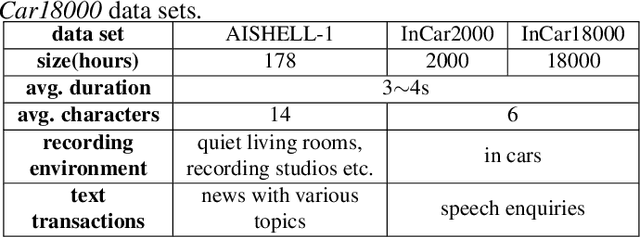
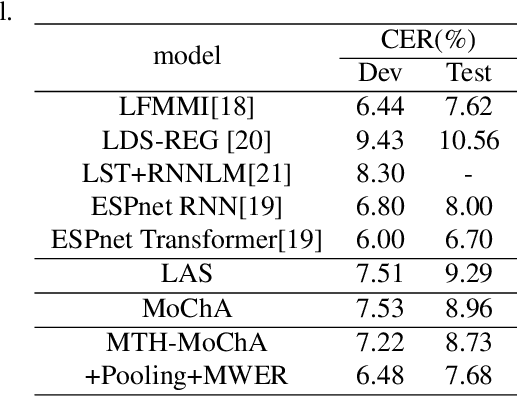
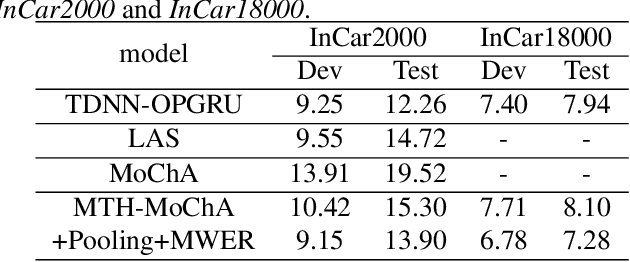
The attention mechanism of the Listen, Attend and Spell (LAS) model requires the whole input sequence to calculate the attention context and thus is not suitable for online speech recognition. To deal with this problem, we propose multi-head monotonic chunk-wise attention (MTH-MoChA), an improved version of MoChA. MTH-MoChA splits the input sequence into small chunks and computes multi-head attentions over the chunks. We also explore useful training strategies such as LSTM pooling, minimum world error rate training and SpecAugment to further improve the performance of MTH-MoChA. Experiments on AISHELL-1 data show that the proposed model, along with the training strategies, improve the character error rate (CER) of MoChA from 8.96% to 7.68% on test set. On another 18000 hours in-car speech data set, MTH-MoChA obtains 7.28% CER, which is significantly better than a state-of-the-art hybrid system.