 Add to Chrome
 Add to Firefox
 Add to Edge
What Papers Don't Tell You: Recovering Tacit Knowledge for Automated Paper Reproduction
Mar 02, 2026
Automated paper reproduction -- generating executable code from academic papers -- is bottlenecked not by information retrieval but by the tacit knowledge that papers inevitably leave implicit. We formalize this challenge as the progressive recovery of three types of tacit knowledge -- relational, somatic, and collective -- and propose \method, a graph-based agent framework with a dedicated mechanism for each: node-level relation-aware aggregation recovers relational knowledge by analyzing implementation-unit-level reuse and adaptation relationships between the target paper and its citation neighbors; execution-feedback refinement recovers somatic knowledge through iterative debugging driven by runtime signals; and graph-level knowledge induction distills collective knowledge from clusters of papers sharing similar implementations. On an extended ReproduceBench spanning 3 domains, 10 tasks, and 40 recent papers, \method{} achieves an average performance gap of 10.04\% against official implementations, improving over the strongest baseline by 24.68\%. The code will be publicly released upon acceptance; the repository link will be provided in the final version.

Attention Mechanism for Contrastive Learning in GAN-based Image-to-Image Translation
Feb 23, 2023

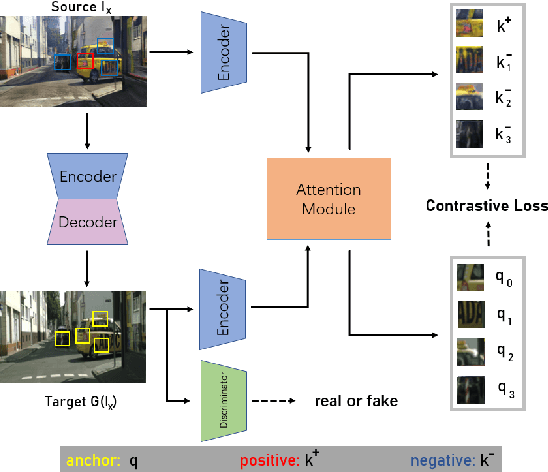
Using real road testing to optimize autonomous driving algorithms is time-consuming and capital-intensive. To solve this problem, we propose a GAN-based model that is capable of generating high-quality images across different domains. We further leverage Contrastive Learning to train the model in a self-supervised way using image data acquired in the real world using real sensors and simulated images from 3D games. In this paper, we also apply an Attention Mechanism module to emphasize features that contain more information about the source domain according to their measurement of significance. Finally, the generated images are used as datasets to train neural networks to perform a variety of downstream tasks to verify that the approach can fill in the gaps between the virtual and real worlds.