 Add to Chrome
 Add to Firefox
 Add to Edge
PRM-as-a-Judge 1.5: A Toolkit for Robot Process Assessment
Aug 14, 2026
Fine-grained robotic evaluation matters for understanding embodied models, going beyond binary success rates and rule-based process scores. We present PRM-as-a-Judge 1.5, a toolkit for robot process assessment that turns rollout videos into dense progress curves and derives multiple fine metrics. PRM-as-a-Judge 1.5 introduces three metrics, building on version 1.0, that characterize failure-side progress, post-drawdown recovery, and success-side execution quality, helping users understand embodied model capability. Based on the rollout videos from benchmarks, we perform a comprehensive assessment of the embodied models, providing some fine-grained metric results and key findings. We further introduce RoboPulse++ to evaluate the reliability of process reward models (PRM), providing evaluators with a more accurate testing platform. Moreover, we release a user-friendly assessment suite, including the benchmark, metric implementation, and visualization tools, to support reproducible manipulation process evaluation. We call on the community to rethink how robots are evaluated and establish transparent, procedural, and reproducible assessment as a foundation for the next generation of embodied intelligence.

Orca: The World is in Your Mind
Jun 30, 2026We introduce Orca, an initial instantiation of a general world foundation model. Orca learns a unified world latent space from multimodal world signals and exposes it through multimodal readout interfaces. Rather than optimizing isolated next-token, next-frame, or next-action prediction, we are centered on Next-State-Prediction modeling, offering a unified state-transition modeling route toward understanding, predicting, and acting upon the world. Orca learns through two complementary paradigms: unconscious learning captures dense natural state transitions from continuous videos, and conscious learning models sparse meaningful state transitions by language-described events and VQA supervision. For pre-training, we construct a large-scale world-learning inventory data, including 125K hours of video data and 160M event annotations. After pre-training, Orca learns a unified world latent space. To examine whether the learned latent supports downstream, we evaluate it by three representative downstream readouts: text generation, image prediction, and embodied action generation. Orca's backbone is frozen, and only the lightweight modality-specific decoders are trainable. Experiments show the scalability of the proposed paradigm and verify that stronger world latent enables stronger downstream readouts. Orca outperforms similar-sized specialized baselines. These results show that Orca, as a general world foundation model, presents a promising approach to understanding, predicting, and acting upon the world. Finally, we discuss the current limitations, aiming to provide useful insights and inspiration for the community.
Enhancing Small LLM Alignment through Margin-Based Objective Modifications under Resource Constraints
Aug 11, 2025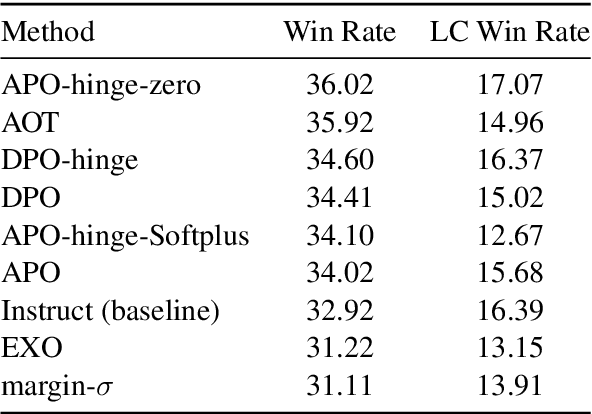
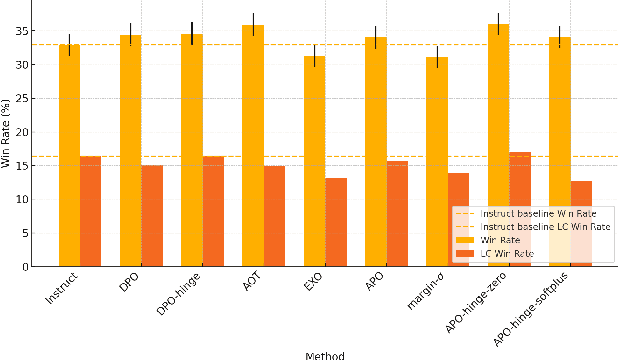
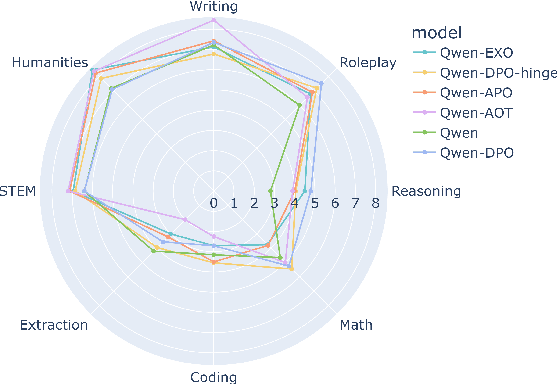
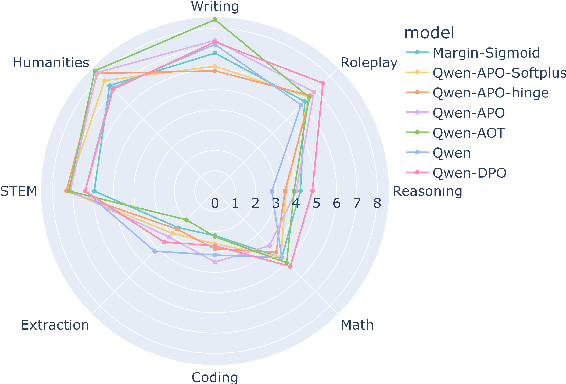
Small large language models (LLMs) often face difficulties in aligning output to human preferences, particularly when operating under severe performance gaps. In this work, we propose two lightweight DPO-based variants -- Adaptive Margin-Sigmoid Loss and APO-hinge-zero -- to better address underperformance scenarios by introducing margin-based objectives and selective update mechanisms. Our APO-hinge-zero method, which combines hinge-induced hard-example mining with the chosen-focused optimization of APO-zero, achieves strong results. In AlpacaEval, APO-hinge-zero improves the win rate by +2.0 points and the length-controlled win rate by +1.4 points compared to the APO-zero baseline. In MT-Bench, our methods maintain competitive performance in diverse categories, particularly excelling in STEM and Humanities tasks. These results demonstrate that simple modifications to preference-based objectives can significantly enhance small LLM alignment under resource constraints, offering a practical path toward more efficient deployment.