 Add to Chrome
 Add to Firefox
 Add to Edge
PRM-as-a-Judge 1.5: A Toolkit for Robot Process Assessment
Aug 14, 2026
Fine-grained robotic evaluation matters for understanding embodied models, going beyond binary success rates and rule-based process scores. We present PRM-as-a-Judge 1.5, a toolkit for robot process assessment that turns rollout videos into dense progress curves and derives multiple fine metrics. PRM-as-a-Judge 1.5 introduces three metrics, building on version 1.0, that characterize failure-side progress, post-drawdown recovery, and success-side execution quality, helping users understand embodied model capability. Based on the rollout videos from benchmarks, we perform a comprehensive assessment of the embodied models, providing some fine-grained metric results and key findings. We further introduce RoboPulse++ to evaluate the reliability of process reward models (PRM), providing evaluators with a more accurate testing platform. Moreover, we release a user-friendly assessment suite, including the benchmark, metric implementation, and visualization tools, to support reproducible manipulation process evaluation. We call on the community to rethink how robots are evaluated and establish transparent, procedural, and reproducible assessment as a foundation for the next generation of embodied intelligence.

DecoratingFusion: A LiDAR-Camera Fusion Network with the Combination of Point-level and Feature-level Fusion
Dec 31, 2024Lidars and cameras play essential roles in autonomous driving, offering complementary information for 3D detection. The state-of-the-art fusion methods integrate them at the feature level, but they mostly rely on the learned soft association between point clouds and images, which lacks interpretability and neglects the hard association between them. In this paper, we combine feature-level fusion with point-level fusion, using hard association established by the calibration matrices to guide the generation of object queries. Specifically, in the early fusion stage, we use the 2D CNN features of images to decorate the point cloud data, and employ two independent sparse convolutions to extract the decorated point cloud features. In the mid-level fusion stage, we initialize the queries with a center heatmap and embed the predicted class labels as auxiliary information into the queries, making the initial positions closer to the actual centers of the targets. Extensive experiments conducted on two popular datasets, i.e. KITTI, Waymo, demonstrate the superiority of DecoratingFusion.
FGFusion: Fine-Grained Lidar-Camera Fusion for 3D Object Detection
Sep 21, 2023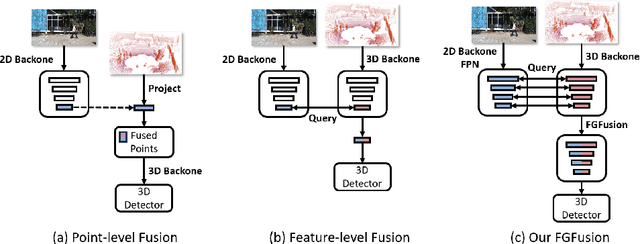
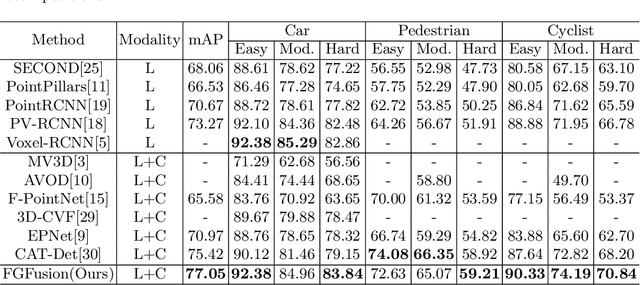
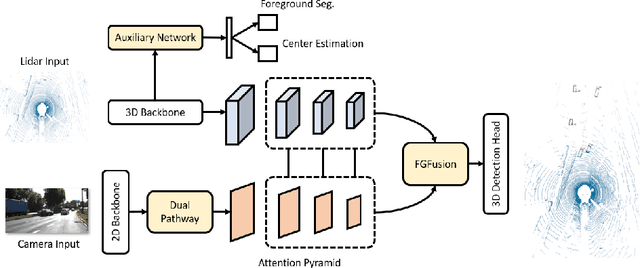
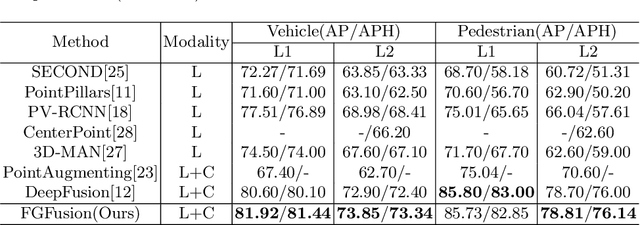
Lidars and cameras are critical sensors that provide complementary information for 3D detection in autonomous driving. While most prevalent methods progressively downscale the 3D point clouds and camera images and then fuse the high-level features, the downscaled features inevitably lose low-level detailed information. In this paper, we propose Fine-Grained Lidar-Camera Fusion (FGFusion) that make full use of multi-scale features of image and point cloud and fuse them in a fine-grained way. First, we design a dual pathway hierarchy structure to extract both high-level semantic and low-level detailed features of the image. Second, an auxiliary network is introduced to guide point cloud features to better learn the fine-grained spatial information. Finally, we propose multi-scale fusion (MSF) to fuse the last N feature maps of image and point cloud. Extensive experiments on two popular autonomous driving benchmarks, i.e. KITTI and Waymo, demonstrate the effectiveness of our method.