 Add to Chrome
 Add to Firefox
 Add to Edge
Online Handwriting Trajectory Reconstruction from Kinematic Sensors using Temporal Convolutional Network
Jul 29, 2026
Handwriting with digital pens is a common way to facilitate human-computer interaction through the use of Online Handwriting (OH) trajectory reconstruction. In this work, we focus on a digital pen equipped with sensors from which one wants to reconstruct the OH trajectory. Such a pen allows to write on any surface and to get the digital trace, which can help learning to write, by writing on paper, and can be useful for many other applications such as collaborative meetings, etc. In this paper, we introduce a novel processing pipeline that maps the sensor signals of the pen to the corresponding OH trajectory. Notably, in order to tackle the difference of sampling rates between the pen and the tablet (which provides ground truth information), our preprocessing pipeline relies on Dynamic Time Warping to align the signals. We introduce a dedicated neural network architecture, inspired by a Temporal Convolutional Network, to reconstruct the online trajectory from the pen sensor signals. Finally, we also present a new benchmark dataset on which our method is evaluated both qualitatively and quantitatively, showing a notable improvement over its most notable competitor.

Mixture-of-experts for handwriting trajectory reconstruction from IMU sensors
Jul 29, 2026The use of digital pens for online handwriting trajectory reconstruction is a prevalent method for human-computer interaction. In this study, we focus on a digital pen equipped with sensors where we aim at reconstructing the online handwriting trajectory. This pen enables writing on any surface and preserving the digital trace of handwriting. This type of pen could be used as an aid to learning to write in classroom. In this paper, we propose a new approach learning to finely reconstruct the touching trajectories while precisely analyzing the hovering part in order to position the next touching trace correctly. This relies on a Mixture-Of-Experts (MOE) approach. The first expert is dedicated for the pencil touch, and is named touching expert model. The second one is dedicated for the hovering pen trajectory, and is named hovering expert model. We improve on the learning of each of these experts based on additional context or specific examples. In addition we introduce a novel public benchmark dataset, to enable future research and comparisons in the field of handwriting reconstruction. The results demonstrates a significant enhancement compared to its primary competitors.
Domain adaptation for handwriting trajectory reconstruction from IMU sensors
Jul 29, 2026Digital pens are commonly used to write on digital devices, providing the handwriting trace and enhancing human-computer interation. This study focuses on a digital pen equipped with kinematic sensors, allowing users to write on any surface while simultaneously preserving a digital trajectory of handwriting. This technology holds significant potential as a valuable educational tool, particularly in classrooms where it can facilitate the process of learning to write. A major issue is based on the difference in captured signals between adults and children. For similar handwriting trace, we have large differences in sensor signals due to differences in speed and confidence in the handwriting gesture of children. To address this, we investigate a domain adaptation approach to build a unified intermediate feature representation aimed at facilitating the trajectory reconstruction. We demonstrate the interest of domain adaptation methods in leveraging existing knowledge for application in different contexts. Specifically, we compare our domain adaptation approach with two other methods: training the model from scratch and fine-tuning the model.
Layer by layer, module by module: Choose both for optimal OOD probing of ViT
Mar 05, 2026Recent studies have observed that intermediate layers of foundation models often yield more discriminative representations than the final layer. While initially attributed to autoregressive pretraining, this phenomenon has also been identified in models trained via supervised and discriminative self-supervised objectives. In this paper, we conduct a comprehensive study to analyze the behavior of intermediate layers in pretrained vision transformers. Through extensive linear probing experiments across a diverse set of image classification benchmarks, we find that distribution shift between pretraining and downstream data is the primary cause of performance degradation in deeper layers. Furthermore, we perform a fine-grained analysis at the module level. Our findings reveal that standard probing of transformer block outputs is suboptimal; instead, probing the activation within the feedforward network yields the best performance under significant distribution shift, whereas the normalized output of the multi-head self-attention module is optimal when the shift is weak.
Vision Transformer Finetuning Benefits from Non-Smooth Components
Feb 09, 2026The smoothness of the transformer architecture has been extensively studied in the context of generalization, training stability, and adversarial robustness. However, its role in transfer learning remains poorly understood. In this paper, we analyze the ability of vision transformer components to adapt their outputs to changes in inputs, or, in other words, their plasticity. Defined as an average rate of change, it captures the sensitivity to input perturbation; in particular, a high plasticity implies low smoothness. We demonstrate through theoretical analysis and comprehensive experiments that this perspective provides principled guidance in choosing the components to prioritize during adaptation. A key takeaway for practitioners is that the high plasticity of the attention modules and feedforward layers consistently leads to better finetuning performance. Our findings depart from the prevailing assumption that smoothness is desirable, offering a novel perspective on the functional properties of transformers. The code is available at https://github.com/ambroiseodt/vit-plasticity.
Differentiable Generalized Sliced Wasserstein Plans
May 28, 2025Optimal Transport (OT) has attracted significant interest in the machine learning community, not only for its ability to define meaningful distances between probability distributions -- such as the Wasserstein distance -- but also for its formulation of OT plans. Its computational complexity remains a bottleneck, though, and slicing techniques have been developed to scale OT to large datasets. Recently, a novel slicing scheme, dubbed min-SWGG, lifts a single one-dimensional plan back to the original multidimensional space, finally selecting the slice that yields the lowest Wasserstein distance as an approximation of the full OT plan. Despite its computational and theoretical advantages, min-SWGG inherits typical limitations of slicing methods: (i) the number of required slices grows exponentially with the data dimension, and (ii) it is constrained to linear projections. Here, we reformulate min-SWGG as a bilevel optimization problem and propose a differentiable approximation scheme to efficiently identify the optimal slice, even in high-dimensional settings. We furthermore define its generalized extension for accommodating to data living on manifolds. Finally, we demonstrate the practical value of our approach in various applications, including gradient flows on manifolds and high-dimensional spaces, as well as a novel sliced OT-based conditional flow matching for image generation -- where fast computation of transport plans is essential.
Match-And-Deform: Time Series Domain Adaptation through Optimal Transport and Temporal Alignment
Aug 25, 2023


While large volumes of unlabeled data are usually available, associated labels are often scarce. The unsupervised domain adaptation problem aims at exploiting labels from a source domain to classify data from a related, yet different, target domain. When time series are at stake, new difficulties arise as temporal shifts may appear in addition to the standard feature distribution shift. In this paper, we introduce the Match-And-Deform (MAD) approach that aims at finding correspondences between the source and target time series while allowing temporal distortions. The associated optimization problem simultaneously aligns the series thanks to an optimal transport loss and the time stamps through dynamic time warping. When embedded into a deep neural network, MAD helps learning new representations of time series that both align the domains and maximize the discriminative power of the network. Empirical studies on benchmark datasets and remote sensing data demonstrate that MAD makes meaningful sample-to-sample pairing and time shift estimation, reaching similar or better classification performance than state-of-the-art deep time series domain adaptation strategies.
Time Series Alignment with Global Invariances
Feb 10, 2020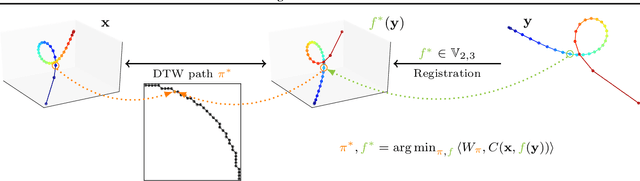

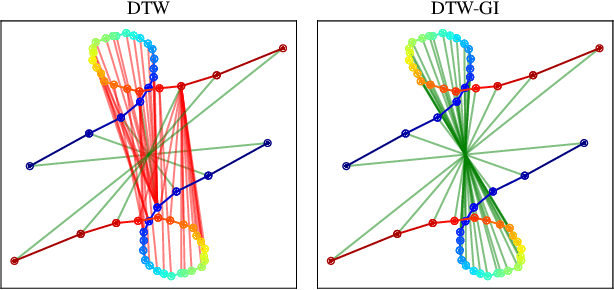
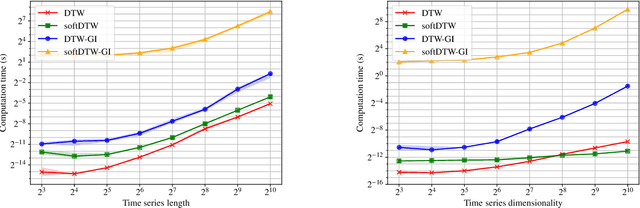
In this work we address the problem of comparing time series while taking into account both feature space transformation and temporal variability. The proposed framework combines a latent global transformation of the feature space with the widely used Dynamic Time Warping (DTW). The latent global transformation captures the feature invariance while the DTW (or its smooth counterpart soft-DTW) deals with the temporal shifts. We cast the problem as a joint optimization over the global transformation and the temporal alignments. The versatility of our framework allows for several variants depending on the invariance class at stake. Among our contributions we define a differentiable loss for time series and present two algorithms for the computation of time series barycenters under our new geometry. We illustrate the interest of our approach on both simulated and real world data.
Early Classification for Agricultural Monitoring from Satellite Time Series
Aug 27, 2019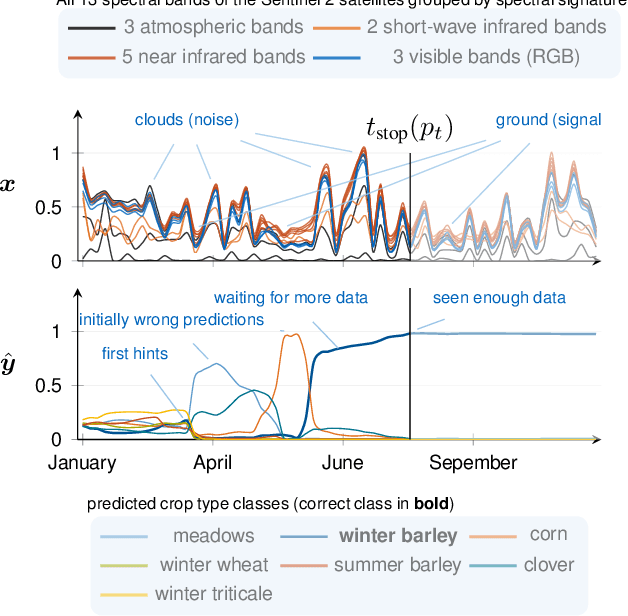
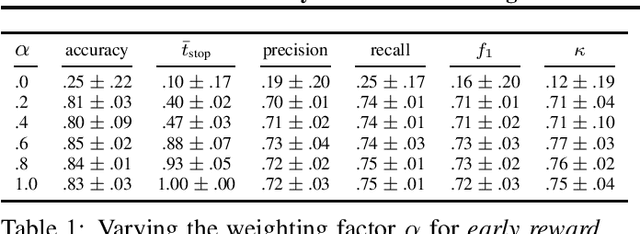
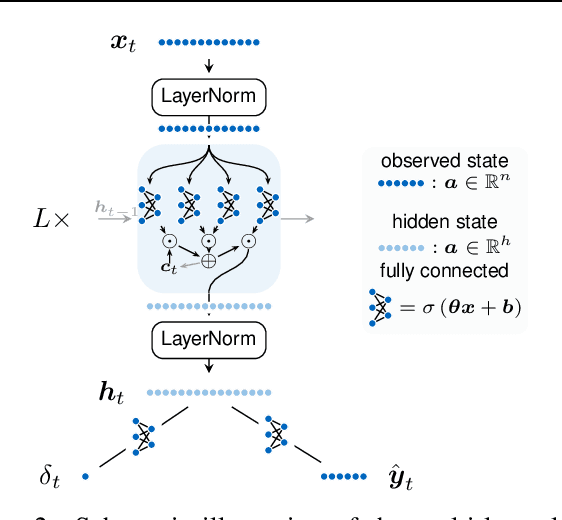
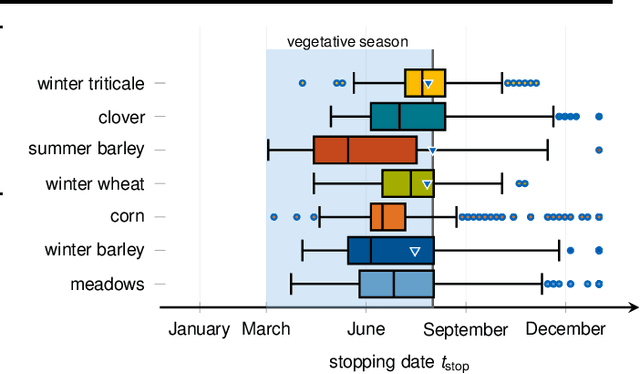
In this work, we introduce a recently developed early classification mechanism to satellite-based agricultural monitoring. It augments existing classification models by an additional stopping probability based on the previously seen information. This mechanism is end-to-end trainable and derives its stopping decision solely from the observed satellite data. We show results on field parcels in central Europe where sufficient ground truth data is available for an empiric evaluation of the results with local phenological information obtained from authorities. We observe that the recurrent neural network outfitted with this early classification mechanism was able to distinguish the many of the crop types before the end of the vegetative period. Further, we associated these stopping times with evaluated ground truth information and saw that the times of classification were related to characteristic events of the observed plants' phenology.
Learning Interpretable Shapelets for Time Series Classification through Adversarial Regularization
Jun 12, 2019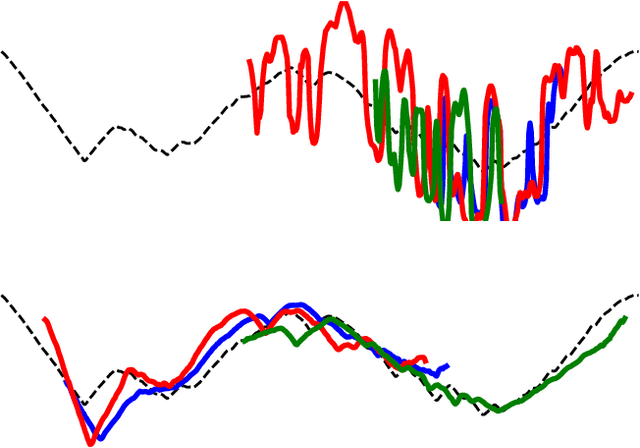

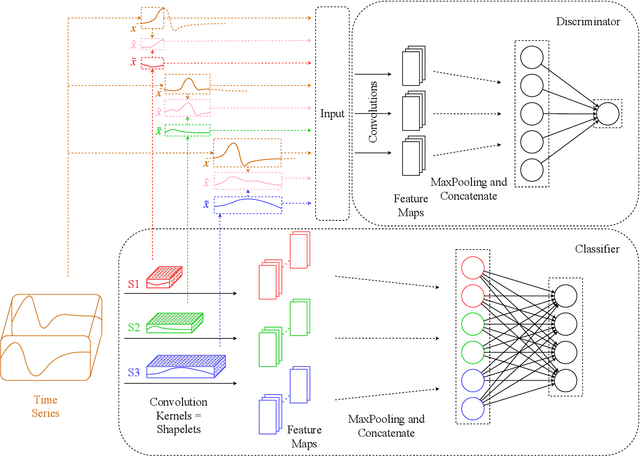
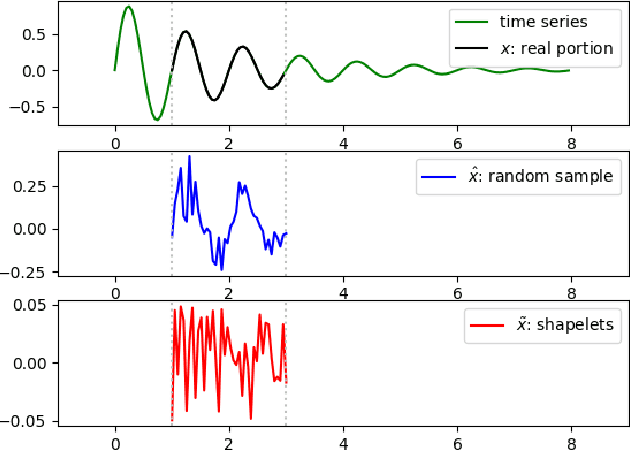
Times series classification can be successfully tackled by jointly learning a shapelet-based representation of the series in the dataset and classifying the series according to this representation. However, although the learned shapelets are discriminative, they are not always similar to pieces of a real series in the dataset. This makes it difficult to interpret the decision, i.e. difficult to analyze if there are particular behaviors in a series that triggered the decision. In this paper, we make use of a simple convolutional network to tackle the time series classification task and we introduce an adversarial regularization to constrain the model to learn more interpretable shapelets. Our classification results on all the usual time series benchmarks are comparable with the results obtained by similar state-of-the-art algorithms but our adversarially regularized method learns shapelets that are, by design, interpretable.