 Add to Chrome
 Add to Firefox
 Add to Edge
Mixture-of-experts for handwriting trajectory reconstruction from IMU sensors
Jul 29, 2026
The use of digital pens for online handwriting trajectory reconstruction is a prevalent method for human-computer interaction. In this study, we focus on a digital pen equipped with sensors where we aim at reconstructing the online handwriting trajectory. This pen enables writing on any surface and preserving the digital trace of handwriting. This type of pen could be used as an aid to learning to write in classroom. In this paper, we propose a new approach learning to finely reconstruct the touching trajectories while precisely analyzing the hovering part in order to position the next touching trace correctly. This relies on a Mixture-Of-Experts (MOE) approach. The first expert is dedicated for the pencil touch, and is named touching expert model. The second one is dedicated for the hovering pen trajectory, and is named hovering expert model. We improve on the learning of each of these experts based on additional context or specific examples. In addition we introduce a novel public benchmark dataset, to enable future research and comparisons in the field of handwriting reconstruction. The results demonstrates a significant enhancement compared to its primary competitors.

Online Handwriting Trajectory Reconstruction from Kinematic Sensors using Temporal Convolutional Network
Jul 29, 2026Handwriting with digital pens is a common way to facilitate human-computer interaction through the use of Online Handwriting (OH) trajectory reconstruction. In this work, we focus on a digital pen equipped with sensors from which one wants to reconstruct the OH trajectory. Such a pen allows to write on any surface and to get the digital trace, which can help learning to write, by writing on paper, and can be useful for many other applications such as collaborative meetings, etc. In this paper, we introduce a novel processing pipeline that maps the sensor signals of the pen to the corresponding OH trajectory. Notably, in order to tackle the difference of sampling rates between the pen and the tablet (which provides ground truth information), our preprocessing pipeline relies on Dynamic Time Warping to align the signals. We introduce a dedicated neural network architecture, inspired by a Temporal Convolutional Network, to reconstruct the online trajectory from the pen sensor signals. Finally, we also present a new benchmark dataset on which our method is evaluated both qualitatively and quantitatively, showing a notable improvement over its most notable competitor.
Domain adaptation for handwriting trajectory reconstruction from IMU sensors
Jul 29, 2026Digital pens are commonly used to write on digital devices, providing the handwriting trace and enhancing human-computer interation. This study focuses on a digital pen equipped with kinematic sensors, allowing users to write on any surface while simultaneously preserving a digital trajectory of handwriting. This technology holds significant potential as a valuable educational tool, particularly in classrooms where it can facilitate the process of learning to write. A major issue is based on the difference in captured signals between adults and children. For similar handwriting trace, we have large differences in sensor signals due to differences in speed and confidence in the handwriting gesture of children. To address this, we investigate a domain adaptation approach to build a unified intermediate feature representation aimed at facilitating the trajectory reconstruction. We demonstrate the interest of domain adaptation methods in leveraging existing knowledge for application in different contexts. Specifically, we compare our domain adaptation approach with two other methods: training the model from scratch and fine-tuning the model.
N-gram Injection into Transformers for Dynamic Language Model Adaptation in Handwritten Text Recognition
Mar 04, 2026Transformer-based encoder-decoder networks have recently achieved impressive results in handwritten text recognition, partly thanks to their auto-regressive decoder which implicitly learns a language model. However, such networks suffer from a large performance drop when evaluated on a target corpus whose language distribution is shifted from the source text seen during training. To retain recognition accuracy despite this language shift, we propose an external n-gram injection (NGI) for dynamic adaptation of the network's language modeling at inference time. Our method allows switching to an n-gram language model estimated on a corpus close to the target distribution, therefore mitigating bias without any extra training on target image-text pairs. We opt for an early injection of the n-gram into the transformer decoder so that the network learns to fully leverage text-only data at the low additional cost of n-gram inference. Experiments on three handwritten datasets demonstrate that the proposed NGI significantly reduces the performance gap between source and target corpora.
Have convolutions already made recurrence obsolete for unconstrained handwritten text recognition ?
Dec 09, 2020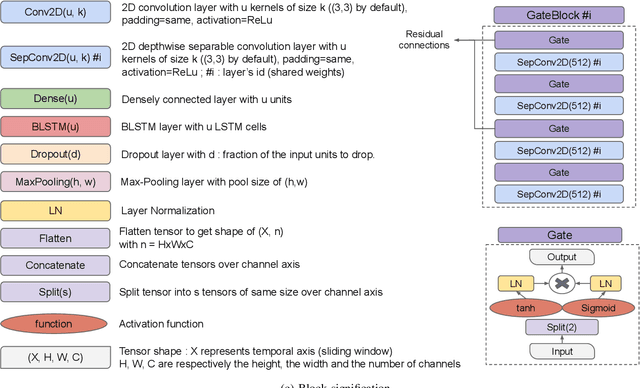
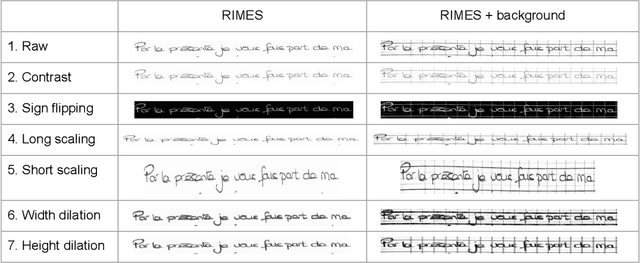
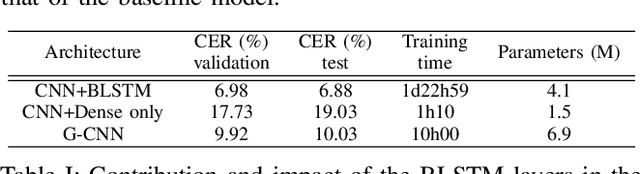
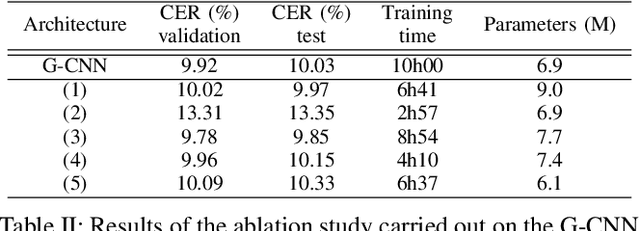
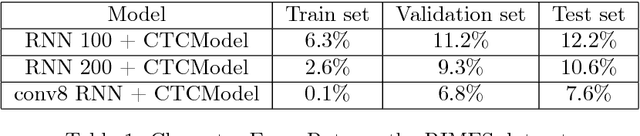
Unconstrained handwritten text recognition remains an important challenge for deep neural networks. These last years, recurrent networks and more specifically Long Short-Term Memory networks have achieved state-of-the-art performance in this field. Nevertheless, they are made of a large number of trainable parameters and training recurrent neural networks does not support parallelism. This has a direct influence on the training time of such architectures, with also a direct consequence on the time required to explore various architectures. Recently, recurrence-free architectures such as Fully Convolutional Networks with gated mechanisms have been proposed as one possible alternative achieving competitive results. In this paper, we explore convolutional architectures and compare them to a CNN+BLSTM baseline. We propose an experimental study regarding different architectures on an offline handwriting recognition task using the RIMES dataset, and a modified version of it that consists of augmenting the images with notebook backgrounds that are printed grids.
Time Series Alignment with Global Invariances
Feb 10, 2020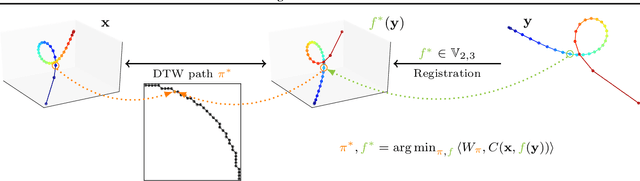

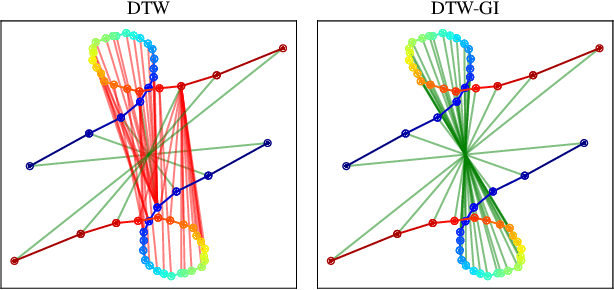
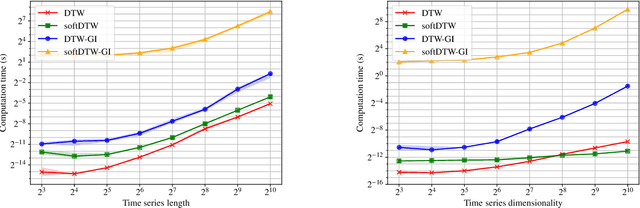
In this work we address the problem of comparing time series while taking into account both feature space transformation and temporal variability. The proposed framework combines a latent global transformation of the feature space with the widely used Dynamic Time Warping (DTW). The latent global transformation captures the feature invariance while the DTW (or its smooth counterpart soft-DTW) deals with the temporal shifts. We cast the problem as a joint optimization over the global transformation and the temporal alignments. The versatility of our framework allows for several variants depending on the invariance class at stake. Among our contributions we define a differentiable loss for time series and present two algorithms for the computation of time series barycenters under our new geometry. We illustrate the interest of our approach on both simulated and real world data.
CTCModel: a Keras Model for Connectionist Temporal Classification
Jan 23, 2019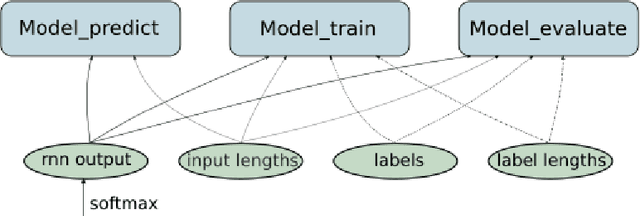
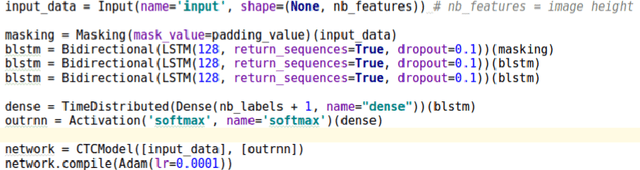
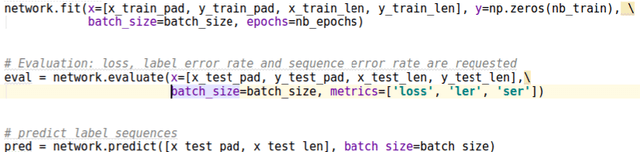
We report an extension of a Keras Model, called CTCModel, to perform the Connectionist Temporal Classification (CTC) in a transparent way. Combined with Recurrent Neural Networks, the Connectionist Temporal Classification is the reference method for dealing with unsegmented input sequences, i.e. with data that are a couple of observation and label sequences where each label is related to a subset of observation frames. CTCModel makes use of the CTC implementation in the Tensorflow backend for training and predicting sequences of labels using Keras. It consists of three branches made of Keras models: one for training, computing the CTC loss function; one for predicting, providing sequences of labels; and one for evaluating that returns standard metrics for analyzing sequences of predictions.
A Unified Multilingual Handwriting Recognition System using multigrams sub-lexical units
Aug 28, 2018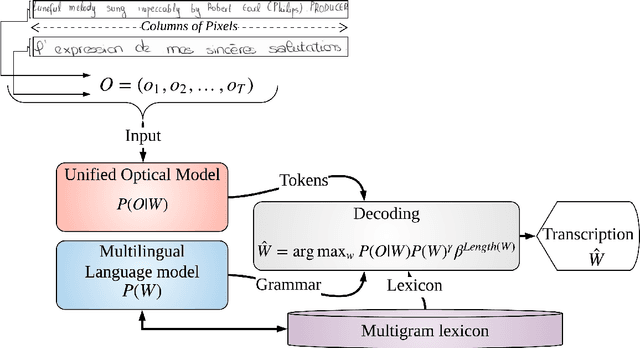

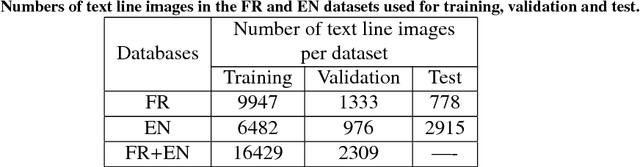
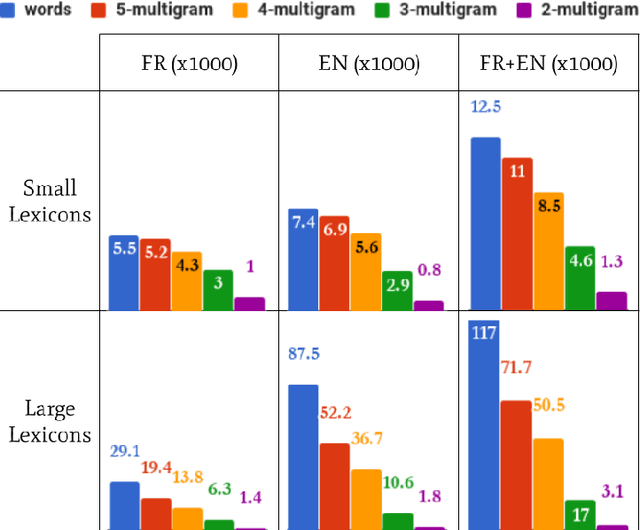
We address the design of a unified multilingual system for handwriting recognition. Most of multi- lingual systems rests on specialized models that are trained on a single language and one of them is selected at test time. While some recognition systems are based on a unified optical model, dealing with a unified language model remains a major issue, as traditional language models are generally trained on corpora composed of large word lexicons per language. Here, we bring a solution by con- sidering language models based on sub-lexical units, called multigrams. Dealing with multigrams strongly reduces the lexicon size and thus decreases the language model complexity. This makes pos- sible the design of an end-to-end unified multilingual recognition system where both a single optical model and a single language model are trained on all the languages. We discuss the impact of the language unification on each model and show that our system reaches state-of-the-art methods perfor- mance with a strong reduction of the complexity.
* preprint