 Add to Chrome
 Add to Firefox
 Add to Edge
Towards Spatio-Temporal World Scene Graph Generation from Monocular Videos
Mar 13, 2026
Spatio-temporal scene graphs provide a principled representation for modeling evolving object interactions, yet existing methods remain fundamentally frame-centric: they reason only about currently visible objects, discard entities upon occlusion, and operate in 2D. To address this, we first introduce ActionGenome4D, a dataset that upgrades Action Genome videos into 4D scenes via feed-forward 3D reconstruction, world-frame oriented bounding boxes for every object involved in actions, and dense relationship annotations including for objects that are temporarily unobserved due to occlusion or camera motion. Building on this data, we formalize World Scene Graph Generation (WSGG), the task of constructing a world scene graph at each timestamp that encompasses all interacting objects in the scene, both observed and unobserved. We then propose three complementary methods, each exploring a different inductive bias for reasoning about unobserved objects: PWG (Persistent World Graph), which implements object permanence via a zero-order feature buffer; MWAE (Masked World Auto-Encoder), which reframes unobserved-object reasoning as masked completion with cross-view associative retrieval; and 4DST (4D Scene Transformer), which replaces the static buffer with differentiable per-object temporal attention enriched by 3D motion and camera-pose features. We further design and evaluate the performance of strong open-source Vision-Language Models on the WSGG task via a suite of Graph RAG-based approaches, establishing baselines for unlocalized relationship prediction. WSGG thus advances video scene understanding toward world-centric, temporally persistent, and interpretable scene reasoning.

Chasing Ghosts: A Simulation-to-Real Olfactory Navigation Stack with Optional Vision Augmentation
Feb 23, 2026Autonomous odor source localization remains a challenging problem for aerial robots due to turbulent airflow, sparse and delayed sensory signals, and strict payload and compute constraints. While prior unmanned aerial vehicle (UAV)-based olfaction systems have demonstrated gas distribution mapping or reactive plume tracing, they rely on predefined coverage patterns, external infrastructure, or extensive sensing and coordination. In this work, we present a complete, open-source UAV system for online odor source localization using a minimal sensor suite. The system integrates custom olfaction hardware, onboard sensing, and a learning-based navigation policy trained in simulation and deployed on a real quadrotor. Through our minimal framework, the UAV is able to navigate directly toward an odor source without constructing an explicit gas distribution map or relying on external positioning systems. Vision is incorporated as an optional complementary modality to accelerate navigation under certain conditions. We validate the proposed system through real-world flight experiments in a large indoor environment using an ethanol source, demonstrating consistent source-finding behavior under realistic airflow conditions. The primary contribution of this work is a reproducible system and methodological framework for UAV-based olfactory navigation and source finding under minimal sensing assumptions. We elaborate on our hardware design and open source our UAV firmware, simulation code, olfaction-vision dataset, and circuit board to the community. Code, data, and designs will be made available at https://github.com/KordelFranceTech/ChasingGhosts.
Towards Unbiased and Robust Spatio-Temporal Scene Graph Generation and Anticipation
Nov 20, 2024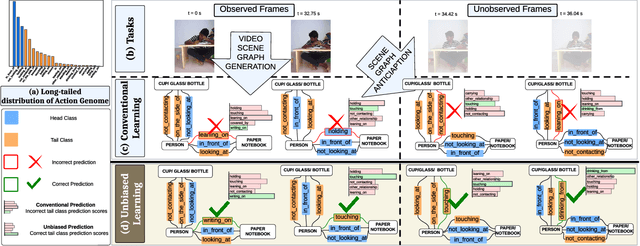
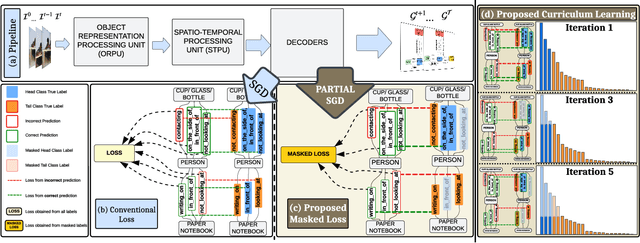
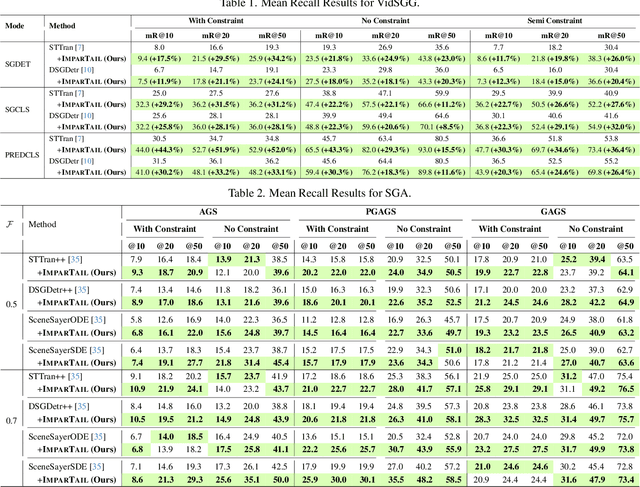

Spatio-Temporal Scene Graphs (STSGs) provide a concise and expressive representation of dynamic scenes by modelling objects and their evolving relationships over time. However, real-world visual relationships often exhibit a long-tailed distribution, causing existing methods for tasks like Video Scene Graph Generation (VidSGG) and Scene Graph Anticipation (SGA) to produce biased scene graphs. To this end, we propose ImparTail, a novel training framework that leverages curriculum learning and loss masking to mitigate bias in the generation and anticipation of spatio-temporal scene graphs. Our approach gradually decreases the dominance of the head relationship classes during training and focuses more on tail classes, leading to more balanced training. Furthermore, we introduce two new tasks, Robust Spatio-Temporal Scene Graph Generation and Robust Scene Graph Anticipation, designed to evaluate the robustness of STSG models against distribution shifts. Extensive experiments on the Action Genome dataset demonstrate that our framework significantly enhances the unbiased performance and robustness of STSG models compared to existing methods.
Grasping Trajectory Optimization with Point Clouds
Mar 08, 2024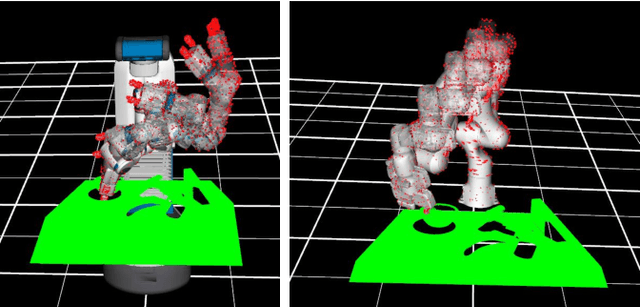
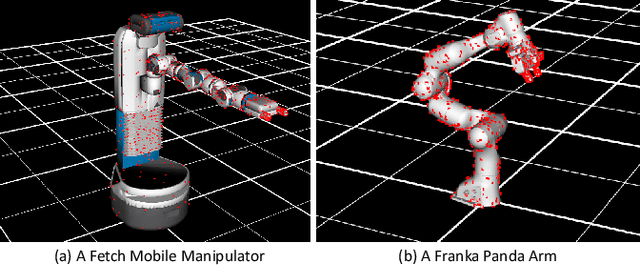
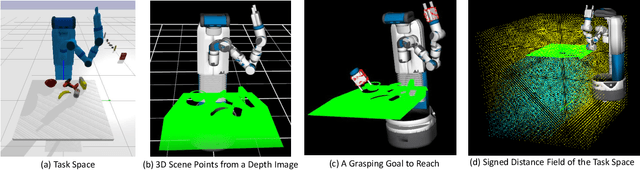
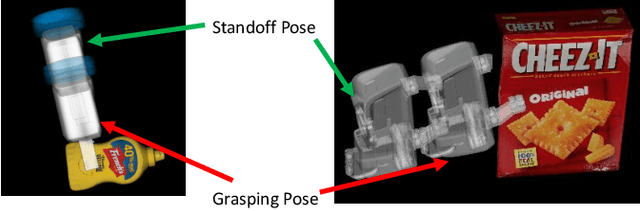
We introduce a new trajectory optimization method for robotic grasping based on a point-cloud representation of robots and task spaces. In our method, robots are represented by 3D points on their link surfaces. The task space of a robot is represented by a point cloud that can be obtained from depth sensors. Using the point-cloud representation, goal reaching in grasping can be formulated as point matching, while collision avoidance can be efficiently achieved by querying the signed distance values of the robot points in the signed distance field of the scene points. Consequently, a constrained non-linear optimization problem is formulated to solve the joint motion and grasp planning problem. The advantage of our method is that the point-cloud representation is general to be used with any robot in any environment. We demonstrate the effectiveness of our method by conducting experiments on a tabletop scene and a shelf scene for grasping with a Fetch mobile manipulator and a Franka Panda arm.
Towards Scene Graph Anticipation
Mar 07, 2024
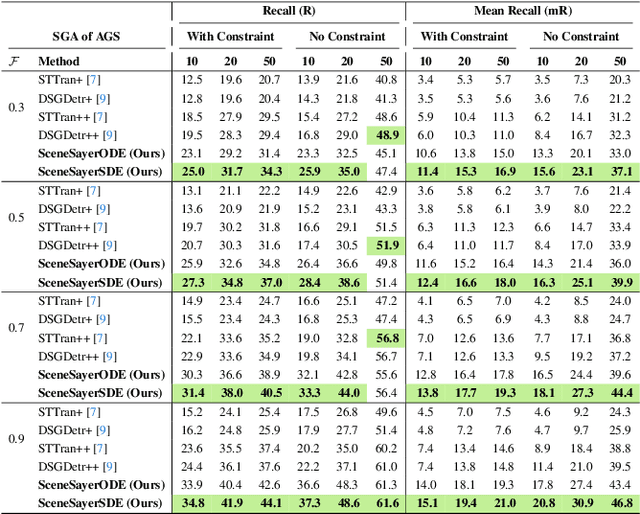

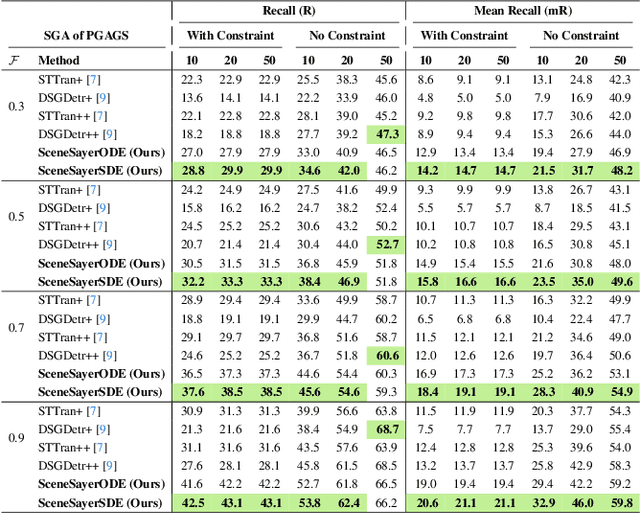
Spatio-temporal scene graphs represent interactions in a video by decomposing scenes into individual objects and their pair-wise temporal relationships. Long-term anticipation of the fine-grained pair-wise relationships between objects is a challenging problem. To this end, we introduce the task of Scene Graph Anticipation (SGA). We adapt state-of-the-art scene graph generation methods as baselines to anticipate future pair-wise relationships between objects and propose a novel approach SceneSayer. In SceneSayer, we leverage object-centric representations of relationships to reason about the observed video frames and model the evolution of relationships between objects. We take a continuous time perspective and model the latent dynamics of the evolution of object interactions using concepts of NeuralODE and NeuralSDE, respectively. We infer representations of future relationships by solving an Ordinary Differential Equation and a Stochastic Differential Equation, respectively. Extensive experimentation on the Action Genome dataset validates the efficacy of the proposed methods.
CaptainCook4D: A dataset for understanding errors in procedural activities
Dec 22, 2023


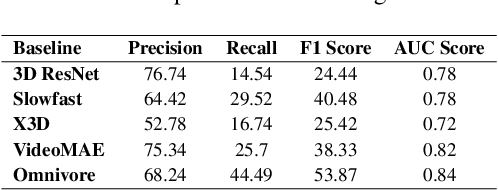
Following step-by-step procedures is an essential component of various activities carried out by individuals in their daily lives. These procedures serve as a guiding framework that helps to achieve goals efficiently, whether it is assembling furniture or preparing a recipe. However, the complexity and duration of procedural activities inherently increase the likelihood of making errors. Understanding such procedural activities from a sequence of frames is a challenging task that demands an accurate interpretation of visual information and the ability to reason about the structure of the activity. To this end, we collect a new egocentric 4D dataset, CaptainCook4D, comprising 384 recordings (94.5 hours) of people performing recipes in real kitchen environments. This dataset consists of two distinct types of activity: one in which participants adhere to the provided recipe instructions and another in which they deviate and induce errors. We provide 5.3K step annotations and 10K fine-grained action annotations and benchmark the dataset for the following tasks: supervised error recognition, multistep localization, and procedure learning