 Add to Chrome
 Add to Firefox
 Add to Edge
Towards Spatio-Temporal World Scene Graph Generation from Monocular Videos
Mar 13, 2026
Spatio-temporal scene graphs provide a principled representation for modeling evolving object interactions, yet existing methods remain fundamentally frame-centric: they reason only about currently visible objects, discard entities upon occlusion, and operate in 2D. To address this, we first introduce ActionGenome4D, a dataset that upgrades Action Genome videos into 4D scenes via feed-forward 3D reconstruction, world-frame oriented bounding boxes for every object involved in actions, and dense relationship annotations including for objects that are temporarily unobserved due to occlusion or camera motion. Building on this data, we formalize World Scene Graph Generation (WSGG), the task of constructing a world scene graph at each timestamp that encompasses all interacting objects in the scene, both observed and unobserved. We then propose three complementary methods, each exploring a different inductive bias for reasoning about unobserved objects: PWG (Persistent World Graph), which implements object permanence via a zero-order feature buffer; MWAE (Masked World Auto-Encoder), which reframes unobserved-object reasoning as masked completion with cross-view associative retrieval; and 4DST (4D Scene Transformer), which replaces the static buffer with differentiable per-object temporal attention enriched by 3D motion and camera-pose features. We further design and evaluate the performance of strong open-source Vision-Language Models on the WSGG task via a suite of Graph RAG-based approaches, establishing baselines for unlocalized relationship prediction. WSGG thus advances video scene understanding toward world-centric, temporally persistent, and interpretable scene reasoning.

CaptainCook4D: A dataset for understanding errors in procedural activities
Dec 22, 2023


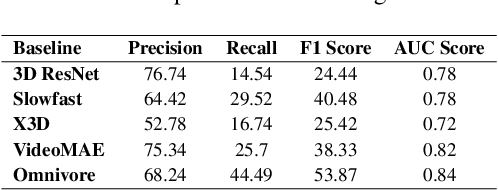
Following step-by-step procedures is an essential component of various activities carried out by individuals in their daily lives. These procedures serve as a guiding framework that helps to achieve goals efficiently, whether it is assembling furniture or preparing a recipe. However, the complexity and duration of procedural activities inherently increase the likelihood of making errors. Understanding such procedural activities from a sequence of frames is a challenging task that demands an accurate interpretation of visual information and the ability to reason about the structure of the activity. To this end, we collect a new egocentric 4D dataset, CaptainCook4D, comprising 384 recordings (94.5 hours) of people performing recipes in real kitchen environments. This dataset consists of two distinct types of activity: one in which participants adhere to the provided recipe instructions and another in which they deviate and induce errors. We provide 5.3K step annotations and 10K fine-grained action annotations and benchmark the dataset for the following tasks: supervised error recognition, multistep localization, and procedure learning