 Add to Chrome
 Add to Firefox
 Add to Edge
PhysVid: Physics Aware Local Conditioning for Generative Video Models
Mar 27, 2026
Generative video models achieve high visual fidelity but often violate basic physical principles, limiting reliability in real-world settings. Prior attempts to inject physics rely on conditioning: frame-level signals are domain-specific and short-horizon, while global text prompts are coarse and noisy, missing fine-grained dynamics. We present PhysVid, a physics-aware local conditioning scheme that operates over temporally contiguous chunks of frames. Each chunk is annotated with physics-grounded descriptions of states, interactions, and constraints, which are fused with the global prompt via chunk-aware cross-attention during training. At inference, we introduce negative physics prompts (descriptions of locally relevant law violations) to steer generation away from implausible trajectories. On VideoPhy, PhysVid improves physical commonsense scores by $\approx 33\%$ over baseline video generators, and by up to $\approx 8\%$ on VideoPhy2. These results show that local, physics-aware guidance substantially increases physical plausibility in generative video and marks a step toward physics-grounded video models.

Towards Spatio-Temporal World Scene Graph Generation from Monocular Videos
Mar 13, 2026Spatio-temporal scene graphs provide a principled representation for modeling evolving object interactions, yet existing methods remain fundamentally frame-centric: they reason only about currently visible objects, discard entities upon occlusion, and operate in 2D. To address this, we first introduce ActionGenome4D, a dataset that upgrades Action Genome videos into 4D scenes via feed-forward 3D reconstruction, world-frame oriented bounding boxes for every object involved in actions, and dense relationship annotations including for objects that are temporarily unobserved due to occlusion or camera motion. Building on this data, we formalize World Scene Graph Generation (WSGG), the task of constructing a world scene graph at each timestamp that encompasses all interacting objects in the scene, both observed and unobserved. We then propose three complementary methods, each exploring a different inductive bias for reasoning about unobserved objects: PWG (Persistent World Graph), which implements object permanence via a zero-order feature buffer; MWAE (Masked World Auto-Encoder), which reframes unobserved-object reasoning as masked completion with cross-view associative retrieval; and 4DST (4D Scene Transformer), which replaces the static buffer with differentiable per-object temporal attention enriched by 3D motion and camera-pose features. We further design and evaluate the performance of strong open-source Vision-Language Models on the WSGG task via a suite of Graph RAG-based approaches, establishing baselines for unlocalized relationship prediction. WSGG thus advances video scene understanding toward world-centric, temporally persistent, and interpretable scene reasoning.
Towards Unbiased and Robust Spatio-Temporal Scene Graph Generation and Anticipation
Nov 20, 2024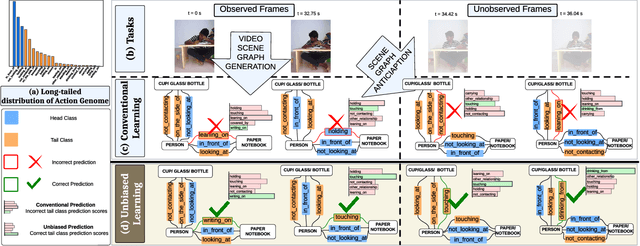
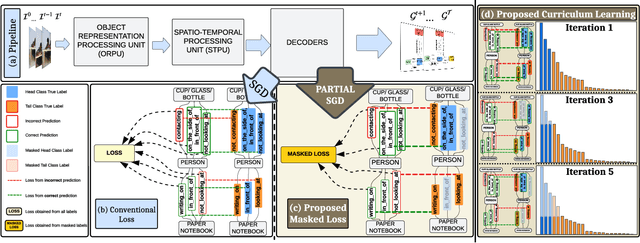
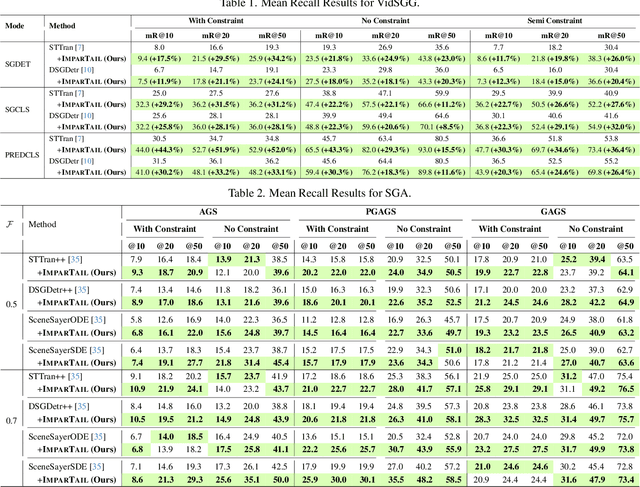

Spatio-Temporal Scene Graphs (STSGs) provide a concise and expressive representation of dynamic scenes by modelling objects and their evolving relationships over time. However, real-world visual relationships often exhibit a long-tailed distribution, causing existing methods for tasks like Video Scene Graph Generation (VidSGG) and Scene Graph Anticipation (SGA) to produce biased scene graphs. To this end, we propose ImparTail, a novel training framework that leverages curriculum learning and loss masking to mitigate bias in the generation and anticipation of spatio-temporal scene graphs. Our approach gradually decreases the dominance of the head relationship classes during training and focuses more on tail classes, leading to more balanced training. Furthermore, we introduce two new tasks, Robust Spatio-Temporal Scene Graph Generation and Robust Scene Graph Anticipation, designed to evaluate the robustness of STSG models against distribution shifts. Extensive experiments on the Action Genome dataset demonstrate that our framework significantly enhances the unbiased performance and robustness of STSG models compared to existing methods.
Towards Scene Graph Anticipation
Mar 07, 2024
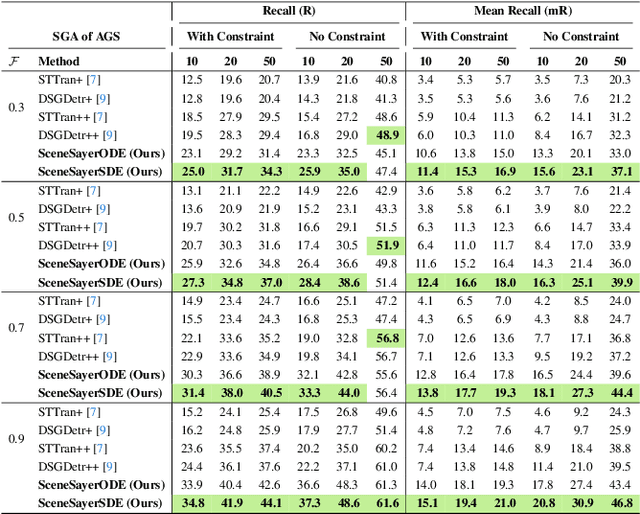

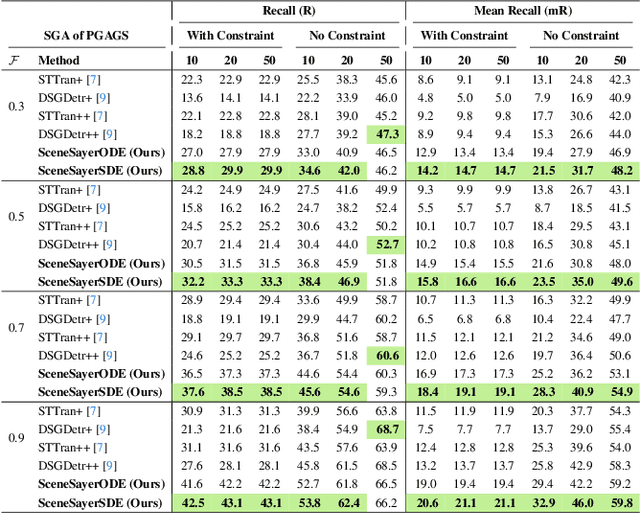
Spatio-temporal scene graphs represent interactions in a video by decomposing scenes into individual objects and their pair-wise temporal relationships. Long-term anticipation of the fine-grained pair-wise relationships between objects is a challenging problem. To this end, we introduce the task of Scene Graph Anticipation (SGA). We adapt state-of-the-art scene graph generation methods as baselines to anticipate future pair-wise relationships between objects and propose a novel approach SceneSayer. In SceneSayer, we leverage object-centric representations of relationships to reason about the observed video frames and model the evolution of relationships between objects. We take a continuous time perspective and model the latent dynamics of the evolution of object interactions using concepts of NeuralODE and NeuralSDE, respectively. We infer representations of future relationships by solving an Ordinary Differential Equation and a Stochastic Differential Equation, respectively. Extensive experimentation on the Action Genome dataset validates the efficacy of the proposed methods.