 Add to Chrome
 Add to Firefox
 Add to Edge
Enhancing User Throughput in Multi-panel mmWave Radio Access Networks for Beam-based MU-MIMO Using a DRL Method
Mar 03, 2026
Millimeter-wave (mmWave) communication systems, particularly those leveraging multi-user multiple-input and multiple-output (MU-MIMO) with hybrid beamforming, face challenges in optimizing user throughput and minimizing latency due to the high complexity of dynamic beam selection and management. This paper introduces a deep reinforcement learning (DRL) approach for enhancing user throughput in multi-panel mmWave radio access networks in a practical network setup. Our DRL-based formulation utilizes an adaptive beam management strategy that models the interaction between the communication agent and its environment as a Markov decision process (MDP), optimizing beam selection based on real-time observations. The proposed framework exploits spatial domain (SD) characteristics by incorporating the cross-correlation between the beams in different antenna panels, the measured reference signal received power (RSRP), and the beam usage statistics to dynamically adjust beamforming decisions. As a result, the spectral efficiency is improved and end-to-end latency is reduced. The numerical results demonstrate an increase in throughput of up to 16% and a reduction in latency by factors 3-7x compared to baseline (legacy beam management).

Towards Practical Deep Schedulers for Allocating Cellular Radio Resources
Nov 13, 2024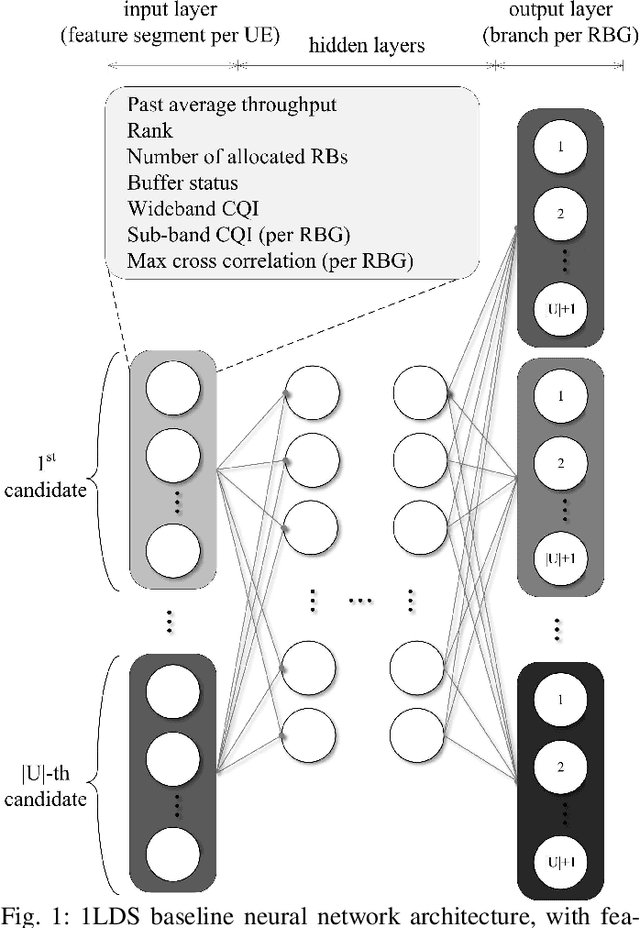
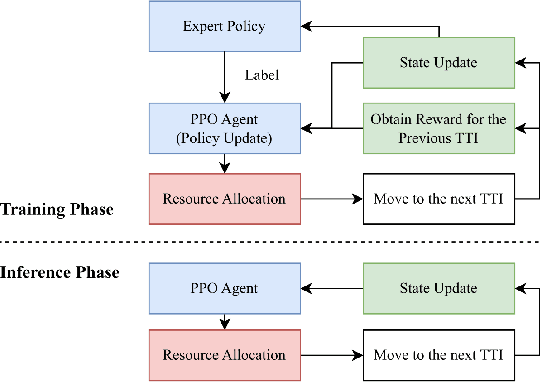
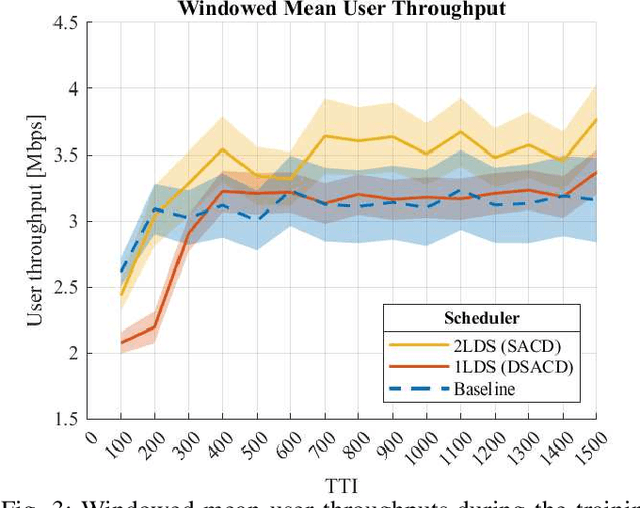
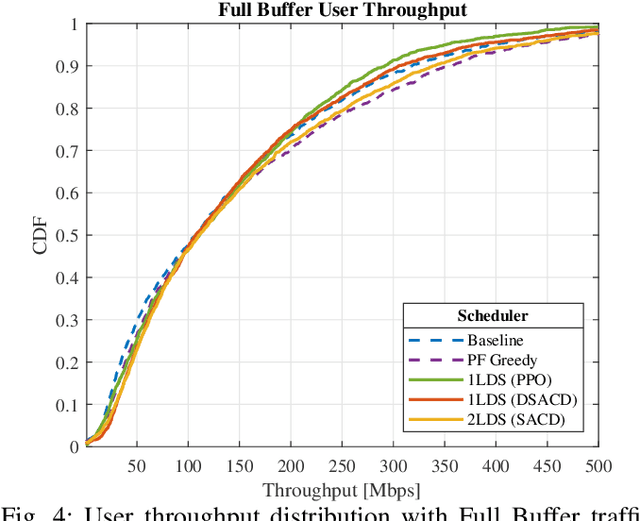
Machine learning methods are often suggested to address wireless network functions, such as radio packet scheduling. However, a feasible 3GPP-compliant scheduler capable of delivering fair throughput across users, while keeping a low computational complexity for 5G and beyond is still missing. To address this, we first take a critical look at previous deep scheduler efforts. Secondly, we enhance State-of-the-Art (SoTA) deep Reinforcement Learning (RL) algorithms and adapt them to train our deep scheduler. In particular, we propose novel training techniques for Proximal Policy Optimization (PPO) and a new Distributional Soft Actor-Critic Discrete (DSACD) algorithm, which outperformed other tested variants. These improvements were achieved while maintaining minimal actor network complexity, making them suitable for real-time computing environments. Additionally, the entropy learning in SACD was fine-tuned to accommodate resource allocation action spaces of varying sizes. Our proposed deep schedulers exhibited strong generalization across different bandwidths, number of MU-MIMO layers, and traffic models. Ultimately, we show that our pre-trained deep schedulers outperform their heuristic rivals in realistic and standard-compliant 5G system-level simulations.