 Add to Chrome
 Add to Firefox
 Add to Edge
What Do Biomedical NER and Entity Linking Benchmarks Measure? A Corpus-Centric Diagnostic Framework
May 19, 2026
Biomedical named entity recognition (NER) and entity linking (EL) strongly depend on annotated corpora, but the utility of these resources for benchmarking is often assumed rather than characterized. We present a corpus-centric framework for diagnosing benchmark-relevant properties directly from corpus annotations, concept links, train-test splits, document metadata, and terminology mappings. The framework organizes standardized statistics into five families: (1) scale, density and label distribution, (2) lexical and conceptual structure, (3) train-test overlap, (4) metadata composition, and (5) terminology coverage where applicable. Applying the framework to nine corpora spanning diseases, chemicals, and cell types, we find that corpus properties can differ substantially, even when they address the same apparent task. We find differences in the evaluation signal they provide, the generalization demands they impose, the degree of train-test reuse they permit, and the regions of biomedical literature and concept space they represent. These differences suggest that commonly reported corpus statistics can be insufficient to characterize what biomedical NER and EL benchmarks evaluate. We argue that corpus-centric diagnostics provide a practical framework for analyzing corpora beyond surface descriptors such as corpus size and entity type, for identifying potential transfer risks, and for interpreting the scope of benchmarking conclusions. We release the framework as open-source code with an interactive dashboard to support reproducing our analyses and characterizing additional corpora.

MedHopQA: A Disease-Centered Multi-Hop Reasoning Benchmark and Evaluation Framework for LLM-Based Biomedical Question Answering
May 12, 2026Evaluating large language models (LLMs) in the biomedical domain requires benchmarks that can distinguish reasoning from pattern matching and remain discriminative as model capabilities improve. Existing biomedical question answering (QA) benchmarks are limited in this respect. Multiple-choice formats can allow models to succeed through answer elimination rather than inference, while widely circulated exam-style datasets are increasingly vulnerable to performance saturation and training data contamination. Multi-hop reasoning, defined as the ability to integrate information across multiple sources to derive an answer, is central to clinically meaningful tasks such as diagnostic support, literature-based discovery, and hypothesis generation, yet remains underrepresented in current biomedical QA benchmarks. MedHopQA is a disease-centered multi-hop reasoning benchmark consisting of 1,000 expert-curated question-answer pairs introduced as a shared task at BioCreative IX. Each question requires synthesis of information across two distinct Wikipedia articles, and answers are provided in an open-ended free-text format. Gold annotations are augmented with ontology-grounded synonym sets from MONDO, NCBI Gene, and NCBI Taxonomy to support both lexical and concept-level evaluation. MedHopQA was constructed through a structured process combining human annotation, triage, iterative verification, and LLM-as-a-judge validation. To reduce leaderboard gaming and contamination risk, the 1,000 scored questions are embedded within a publicly downloadable set of 10,000 questions, with answers withheld, on a CodaBench leaderboard. MedHopQA provides both a benchmark and a reusable framework for constructing future biomedical QA datasets that prioritize compositional reasoning, saturation resistance, and contamination resistance as core design constraints.
Overview of the MedHopQA track at BioCreative IX: track description, participation and evaluation of systems for multi-hop medical question answering
May 12, 2026Multi-hop question answering (QA) remains a significant challenge in the biomedical domain, requiring systems to integrate information across multiple sources to answer complex questions. To address this problem, the BioCreative IX MedHopQA shared task was designed to benchmark in multi-hop reasoning for large language models (LLMs). We developed a novel dataset of 1,000 challenging QA pairs spanning diseases, genes, and chemicals, with particular emphasis on rare diseases. Each question was constructed to require two-hop reasoning through the integration of information from two distinct Wikipedia pages. The challenge attracted 48 submissions from 13 teams. Systems were evaluated using both surface string comparison and conceptual accuracy (MedCPT score). The results showed a substantial performance gap between baseline LLMs and enhanced systems. The top-ranked submission achieved an 89.30% F1 score on the MedCPT metric and an 87.30% exact match (EM) score, compared with 67.40% and 60.20%, respectively, for the zero-shot baseline. A central finding of the challenge was that retrieval-augmented generation (RAG) and related retrieval-based strategies were critical for strong performance. In addition, concept-level evaluation improved answer assessment when correct responses differed in surface form. The MedHopQA dataset is publicly available to support continued progress in this important area. Challenge materials: https://www.ncbi.nlm.nih.gov/research/bionlp/medhopqa and benchmark https://www.codabench.org/competitions/7609/
Opportunities and Challenges for ChatGPT and Large Language Models in Biomedicine and Health
Jun 15, 2023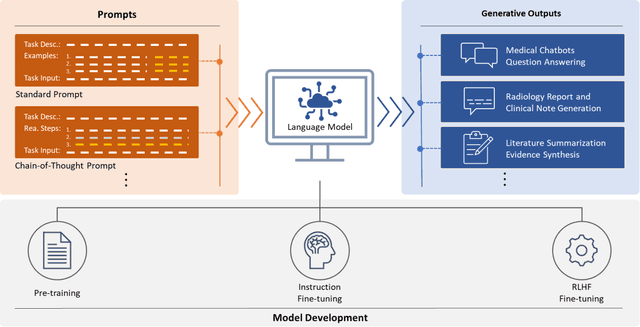
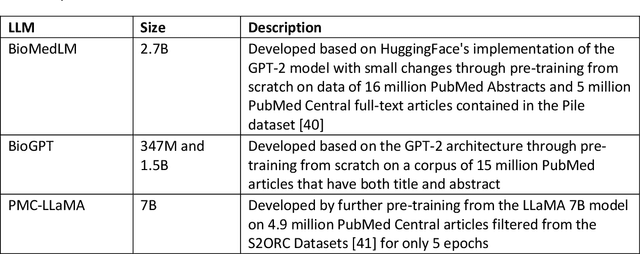

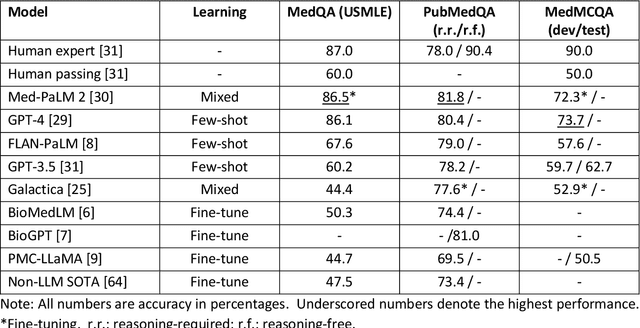
ChatGPT has drawn considerable attention from both the general public and domain experts with its remarkable text generation capabilities. This has subsequently led to the emergence of diverse applications in the field of biomedicine and health. In this work, we examine the diverse applications of large language models (LLMs), such as ChatGPT, in biomedicine and health. Specifically we explore the areas of biomedical information retrieval, question answering, medical text summarization, information extraction, and medical education, and investigate whether LLMs possess the transformative power to revolutionize these tasks or whether the distinct complexities of biomedical domain presents unique challenges. Following an extensive literature survey, we find that significant advances have been made in the field of text generation tasks, surpassing the previous state-of-the-art methods. For other applications, the advances have been modest. Overall, LLMs have not yet revolutionized the biomedicine, but recent rapid progress indicates that such methods hold great potential to provide valuable means for accelerating discovery and improving health. We also find that the use of LLMs, like ChatGPT, in the fields of biomedicine and health entails various risks and challenges, including fabricated information in its generated responses, as well as legal and privacy concerns associated with sensitive patient data. We believe this first-of-its-kind survey can provide a comprehensive overview to biomedical researchers and healthcare practitioners on the opportunities and challenges associated with using ChatGPT and other LLMs for transforming biomedicine and health.
Comprehensive identification of Long Covid articles with human-in-the-loop machine learning
Sep 16, 2022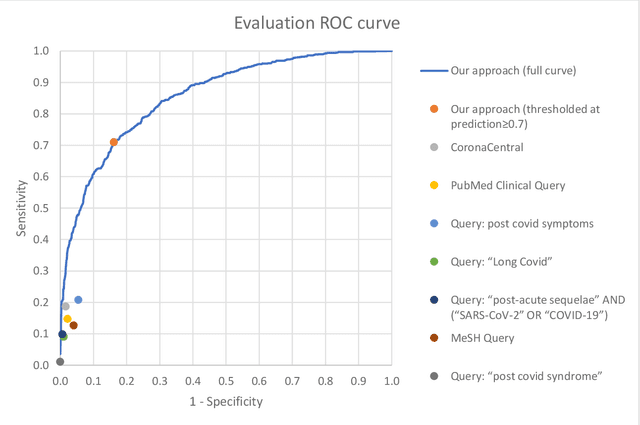
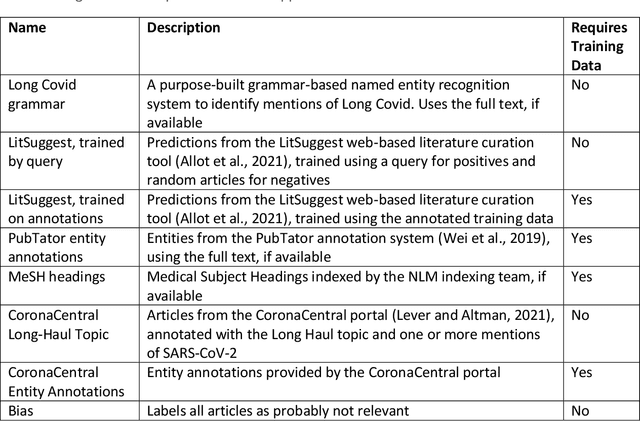
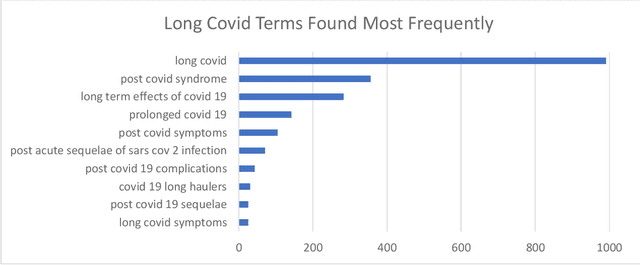
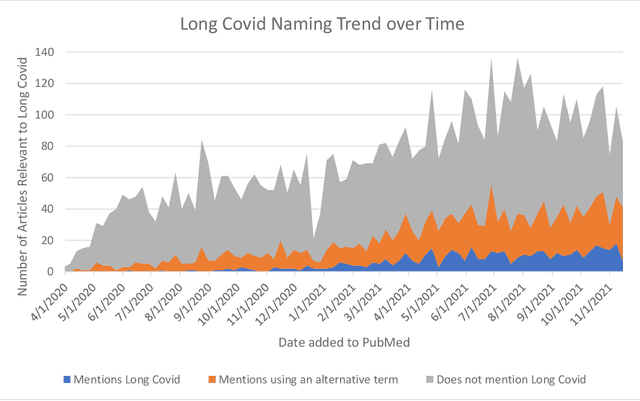
A significant percentage of COVID-19 survivors experience ongoing multisystemic symptoms that often affect daily living, a condition known as Long Covid or post-acute-sequelae of SARS-CoV-2 infection. However, identifying Long Covid articles is challenging since articles refer to the condition using a variety of less common terms or refrain from naming it at all. We developed an iterative human-in-the-loop machine learning framework designed to effectively leverage the data available and make the most efficient use of human labels. Specifically, our approach combines data programming with active learning into a robust ensemble model. Evaluating our model on a holdout set demonstrates over three times the sensitivity of other methods. We apply our model to PubMed to create the Long Covid collection, and demonstrate that (1) most Long Covid articles do not refer to Long Covid by any name (2) when the condition is named, the name used most frequently in the biomedical literature is Long Covid, and (3) Long Covid is associated with disorders in a wide variety of body systems. The Long Covid collection is updated weekly and is searchable online at the LitCovid portal: https://www.ncbi.nlm.nih.gov/research/coronavirus/docsum?filters=e_condition.LongCovid
Navigating the landscape of COVID-19 research through literature analysis: A bird's eye view
Sep 11, 2020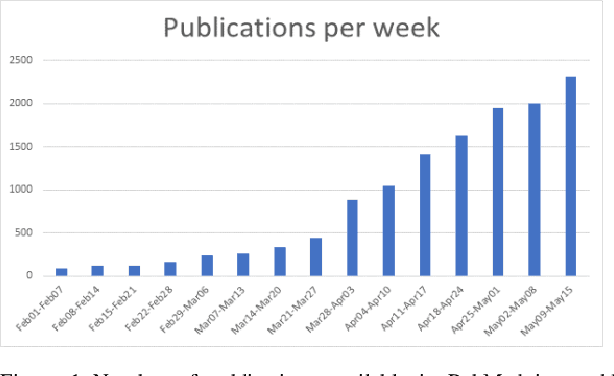
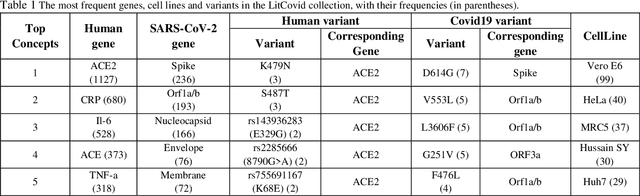
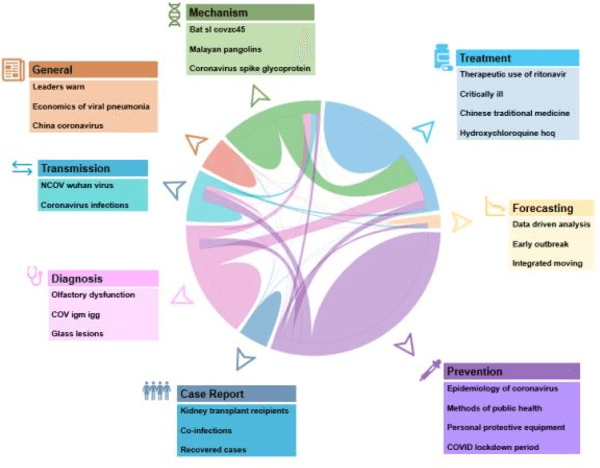
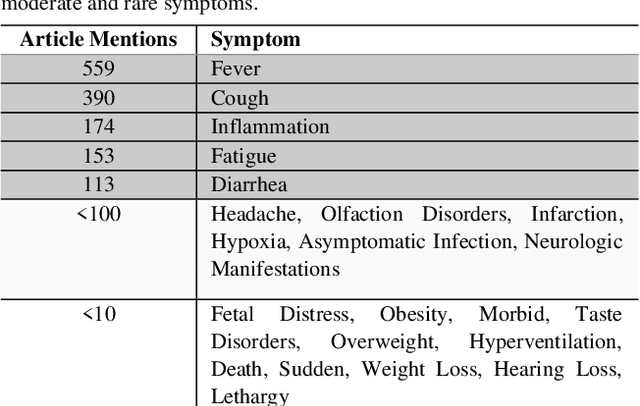
Timely access to accurate scientific literature in the battle with the ongoing COVID-19 pandemic is critical. This unprecedented public health risk has motivated research towards understanding the disease in general, identifying drugs to treat the disease, developing potential vaccines, etc. This has given rise to a rapidly growing body of literature that doubles in number of publications every 20 days as of May 2020. Providing medical professionals with means to quickly analyze the literature and discover growing areas of knowledge is necessary for addressing their question and information needs. In this study we analyze the LitCovid collection, 13,369 COVID-19 related articles found in PubMed as of May 15th, 2020 with the purpose of examining the landscape of literature and presenting it in a format that facilitates information navigation and understanding. We do that by applying state-of-the-art named entity recognition, classification, clustering and other NLP techniques. By applying NER tools, we capture relevant bioentities (such as diseases, internal body organs, etc.) and assess the strength of their relationship with COVID-19 by the extent they are discussed in the corpus. We also collect a variety of symptoms and co-morbidities discussed in reference to COVID-19. Our clustering algorithm identifies topics represented by groups of related terms, and computes clusters corresponding to documents associated with the topic terms. Among the topics we observe several that persist through the duration of multiple weeks and have numerous associated documents, as well several that appear as emerging topics with fewer documents. All the tools and data are publicly available, and this framework can be applied to any literature collection. Taken together, these analyses produce a comprehensive, synthesized view of COVID-19 research to facilitate knowledge discovery from literature.
* 10 pages, 8 Figures, Submitted to KDD 2020 Health Day
PDC -- a probabilistic distributional clustering algorithm: a case study on suicide articles in PubMed
Dec 04, 2019
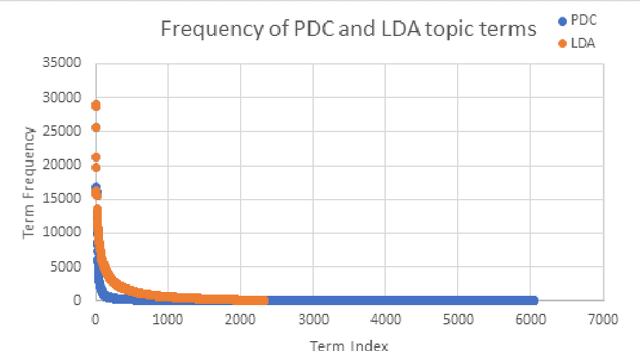
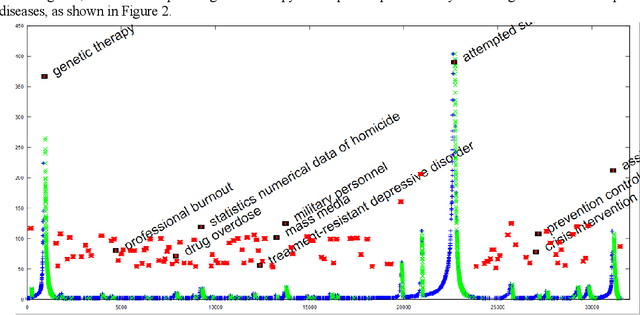
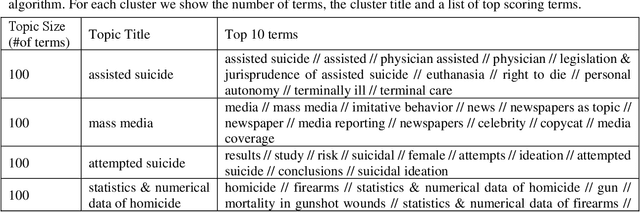
The need to organize a large collection in a manner that facilitates human comprehension is crucial given the ever-increasing volumes of information. In this work, we present PDC (probabilistic distributional clustering), a novel algorithm that, given a document collection, computes disjoint term sets representing topics in the collection. The algorithm relies on probabilities of word co-occurrences to partition the set of terms appearing in the collection of documents into disjoint groups of related terms. In this work, we also present an environment to visualize the computed topics in the term space and retrieve the most related PubMed articles for each group of terms. We illustrate the algorithm by applying it to PubMed documents on the topic of suicide. Suicide is a major public health problem identified as the tenth leading cause of death in the US. In this application, our goal is to provide a global view of the mental health literature pertaining to the subject of suicide, and through this, to help create a rich environment of multifaceted data to guide health care researchers in their endeavor to better understand the breadth, depth and scope of the problem. We demonstrate the usefulness of the proposed algorithm by providing a web portal that allows mental health researchers to peruse the suicide-related literature in PubMed.