 Add to Chrome
 Add to Firefox
 Add to Edge
Med-V1: Small Language Models for Zero-shot and Scalable Biomedical Evidence Attribution
Mar 05, 2026
Assessing whether an article supports an assertion is essential for hallucination detection and claim verification. While large language models (LLMs) have the potential to automate this task, achieving strong performance requires frontier models such as GPT-5 that are prohibitively expensive to deploy at scale. To efficiently perform biomedical evidence attribution, we present Med-V1, a family of small language models with only three billion parameters. Trained on high-quality synthetic data newly developed in this study, Med-V1 substantially outperforms (+27.0% to +71.3%) its base models on five biomedical benchmarks unified into a verification format. Despite its smaller size, Med-V1 performs comparably to frontier LLMs such as GPT-5, along with high-quality explanations for its predictions. We use Med-V1 to conduct a first-of-its-kind use case study that quantifies hallucinations in LLM-generated answers under different citation instructions. Results show that the format instruction strongly affects citation validity and hallucination, with GPT-5 generating more claims but exhibiting hallucination rates similar to GPT-4o. Additionally, we present a second use case showing that Med-V1 can automatically identify high-stakes evidence misattributions in clinical practice guidelines, revealing potentially negative public health impacts that are otherwise challenging to identify at scale. Overall, Med-V1 provides an efficient and accurate lightweight alternative to frontier LLMs for practical and real-world applications in biomedical evidence attribution and verification tasks. Med-V1 is available at https://github.com/ncbi-nlp/Med-V1.

Exploring Anti-Aging Literature via ConvexTopics and Large Language Models
Feb 23, 2026The rapid expansion of biomedical publications creates challenges for organizing knowledge and detecting emerging trends, underscoring the need for scalable and interpretable methods. Common clustering and topic modeling approaches such as K-means or LDA remain sensitive to initialization and prone to local optima, limiting reproducibility and evaluation. We propose a reformulation of a convex optimization based clustering algorithm that produces stable, fine-grained topics by selecting exemplars from the data and guaranteeing a global optimum. Applied to about 12,000 PubMed articles on aging and longevity, our method uncovers topics validated by medical experts. It yields interpretable topics spanning from molecular mechanisms to dietary supplements, physical activity, and gut microbiota. The method performs favorably, and most importantly, its reproducibility and interpretability distinguish it from common clustering approaches, including K-means, LDA, and BERTopic. This work provides a basis for developing scalable, web-accessible tools for knowledge discovery.
BioCPT: Contrastive Pre-trained Transformers with Large-scale PubMed Search Logs for Zero-shot Biomedical Information Retrieval
Jul 02, 2023Information retrieval (IR) is essential in biomedical knowledge acquisition and clinical decision support. While recent progress has shown that language model encoders perform better semantic retrieval, training such models requires abundant query-article annotations that are difficult to obtain in biomedicine. As a result, most biomedical IR systems only conduct lexical matching. In response, we introduce BioCPT, a first-of-its-kind Contrastively Pre-trained Transformer model for zero-shot biomedical IR. To train BioCPT, we collected an unprecedented scale of 255 million user click logs from PubMed. With such data, we use contrastive learning to train a pair of closely-integrated retriever and re-ranker. Experimental results show that BioCPT sets new state-of-the-art performance on five biomedical IR tasks, outperforming various baselines including much larger models such as GPT-3-sized cpt-text-XL. In addition, BioCPT also generates better biomedical article and sentence representations for semantic evaluations. As such, BioCPT can be readily applied to various real-world biomedical IR tasks. BioCPT API and code are publicly available at https://github.com/ncbi/BioCPT.
Opportunities and Challenges for ChatGPT and Large Language Models in Biomedicine and Health
Jun 15, 2023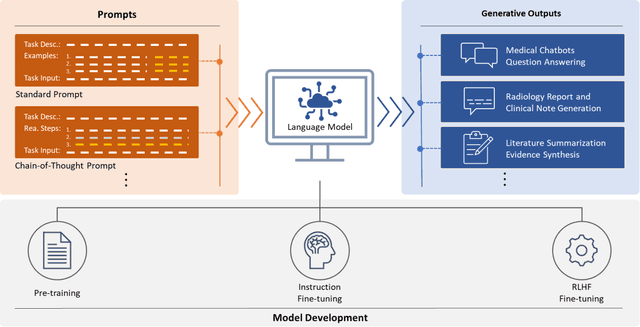
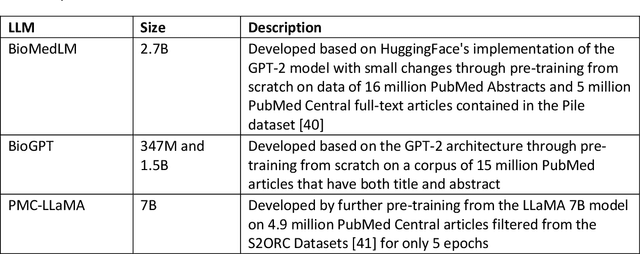

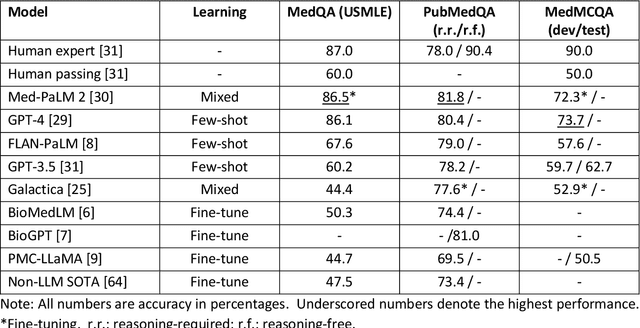
ChatGPT has drawn considerable attention from both the general public and domain experts with its remarkable text generation capabilities. This has subsequently led to the emergence of diverse applications in the field of biomedicine and health. In this work, we examine the diverse applications of large language models (LLMs), such as ChatGPT, in biomedicine and health. Specifically we explore the areas of biomedical information retrieval, question answering, medical text summarization, information extraction, and medical education, and investigate whether LLMs possess the transformative power to revolutionize these tasks or whether the distinct complexities of biomedical domain presents unique challenges. Following an extensive literature survey, we find that significant advances have been made in the field of text generation tasks, surpassing the previous state-of-the-art methods. For other applications, the advances have been modest. Overall, LLMs have not yet revolutionized the biomedicine, but recent rapid progress indicates that such methods hold great potential to provide valuable means for accelerating discovery and improving health. We also find that the use of LLMs, like ChatGPT, in the fields of biomedicine and health entails various risks and challenges, including fabricated information in its generated responses, as well as legal and privacy concerns associated with sensitive patient data. We believe this first-of-its-kind survey can provide a comprehensive overview to biomedical researchers and healthcare practitioners on the opportunities and challenges associated with using ChatGPT and other LLMs for transforming biomedicine and health.
Navigating the landscape of COVID-19 research through literature analysis: A bird's eye view
Sep 11, 2020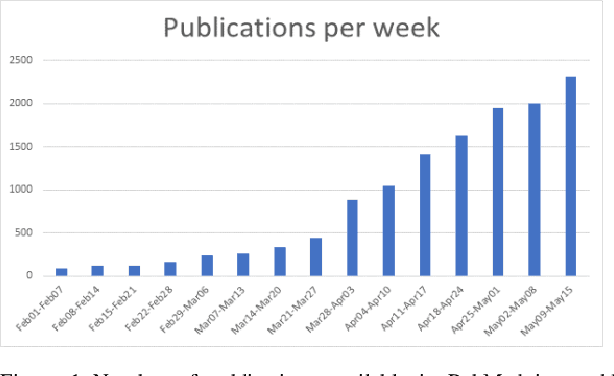
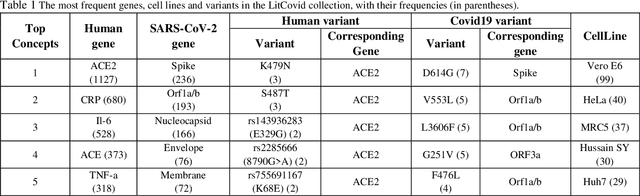
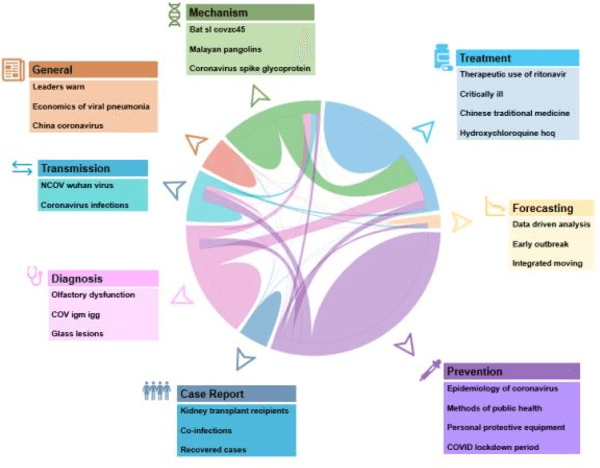
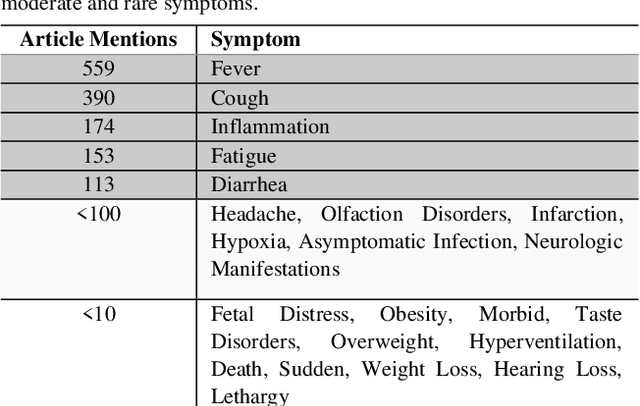
Timely access to accurate scientific literature in the battle with the ongoing COVID-19 pandemic is critical. This unprecedented public health risk has motivated research towards understanding the disease in general, identifying drugs to treat the disease, developing potential vaccines, etc. This has given rise to a rapidly growing body of literature that doubles in number of publications every 20 days as of May 2020. Providing medical professionals with means to quickly analyze the literature and discover growing areas of knowledge is necessary for addressing their question and information needs. In this study we analyze the LitCovid collection, 13,369 COVID-19 related articles found in PubMed as of May 15th, 2020 with the purpose of examining the landscape of literature and presenting it in a format that facilitates information navigation and understanding. We do that by applying state-of-the-art named entity recognition, classification, clustering and other NLP techniques. By applying NER tools, we capture relevant bioentities (such as diseases, internal body organs, etc.) and assess the strength of their relationship with COVID-19 by the extent they are discussed in the corpus. We also collect a variety of symptoms and co-morbidities discussed in reference to COVID-19. Our clustering algorithm identifies topics represented by groups of related terms, and computes clusters corresponding to documents associated with the topic terms. Among the topics we observe several that persist through the duration of multiple weeks and have numerous associated documents, as well several that appear as emerging topics with fewer documents. All the tools and data are publicly available, and this framework can be applied to any literature collection. Taken together, these analyses produce a comprehensive, synthesized view of COVID-19 research to facilitate knowledge discovery from literature.
* 10 pages, 8 Figures, Submitted to KDD 2020 Health Day