 Add to Chrome
 Add to Firefox
 Add to Edge
Scalable Training of Mixture-of-Experts Models with Megatron Core
Mar 10, 2026
Scaling Mixture-of-Experts (MoE) training introduces systems challenges absent in dense models. Because each token activates only a subset of experts, this sparsity allows total parameters to grow much faster than per-token computation, creating coupled constraints across memory, communication, and computation. Optimizing one dimension often shifts pressure to another, demanding co-design across the full system stack. We address these challenges for MoE training through integrated optimizations spanning memory (fine-grained recomputation, offloading, etc.), communication (optimized dispatchers, overlapping, etc.), and computation (Grouped GEMM, fusions, CUDA Graphs, etc.). The framework also provides Parallel Folding for flexible multi-dimensional parallelism, low-precision training support for FP8 and NVFP4, and efficient long-context training. On NVIDIA GB300 and GB200, it achieves 1,233/1,048 TFLOPS/GPU for DeepSeek-V3-685B and 974/919 TFLOPS/GPU for Qwen3-235B. As a performant, scalable, and production-ready open-source solution, it has been used across academia and industry for training MoE models ranging from billions to trillions of parameters on clusters scaling up to thousands of GPUs. This report explains how these techniques work, their trade-offs, and their interactions at the systems level, providing practical guidance for scaling MoE models with Megatron Core.

CAGRA: Highly Parallel Graph Construction and Approximate Nearest Neighbor Search for GPUs
Aug 29, 2023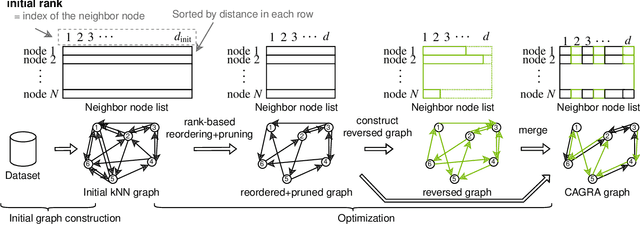
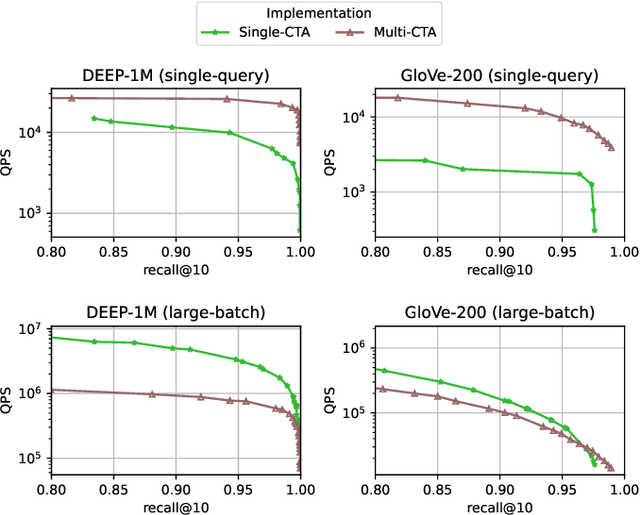
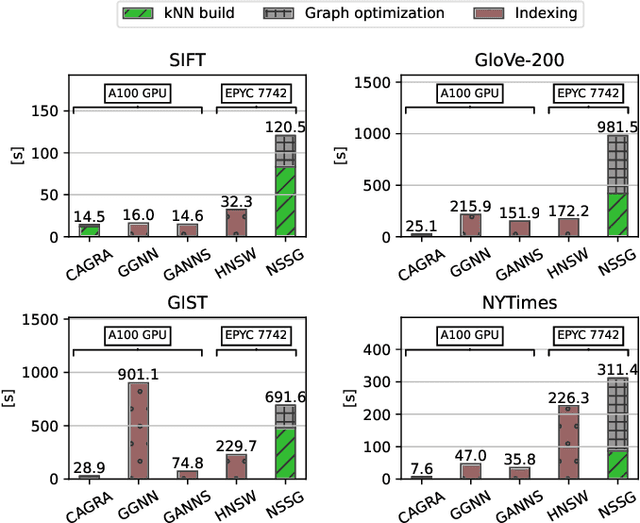

Approximate Nearest Neighbor Search (ANNS) plays a critical role in various disciplines spanning data mining and artificial intelligence, from information retrieval and computer vision to natural language processing and recommender systems. Data volumes have soared in recent years and the computational cost of an exhaustive exact nearest neighbor search is often prohibitive, necessitating the adoption of approximate techniques. The balanced performance and recall of graph-based approaches have more recently garnered significant attention in ANNS algorithms, however, only a few studies have explored harnessing the power of GPUs and multi-core processors despite the widespread use of massively parallel and general-purpose computing. To bridge this gap, we introduce a novel parallel computing hardware-based proximity graph and search algorithm. By leveraging the high-performance capabilities of modern hardware, our approach achieves remarkable efficiency gains. In particular, our method surpasses existing CPU and GPU-based methods in constructing the proximity graph, demonstrating higher throughput in both large- and small-batch searches while maintaining compatible accuracy. In graph construction time, our method, CAGRA, is 2.2~27x faster than HNSW, which is one of the CPU SOTA implementations. In large-batch query throughput in the 90% to 95% recall range, our method is 33~77x faster than HNSW, and is 3.8~8.8x faster than the SOTA implementations for GPU. For a single query, our method is 3.4~53x faster than HNSW at 95% recall.