 Add to Chrome
 Add to Firefox
 Add to Edge
LLM-Based Automated Diagnosis Of Integration Test Failures At Google
Apr 13, 2026
Integration testing is critical for the quality and reliability of complex software systems. However, diagnosing their failures presents significant challenges due to the massive volume, unstructured nature, and heterogeneity of logs they generate. These result in a high cognitive load, low signal-to-noise ratio, and make diagnosis difficult and time-consuming. Developers complain about these difficulties consistently and report spending substantially more time diagnosing integration test failures compared to unit test failures. To address these shortcomings, we introduce Auto-Diagnose, a novel diagnosis tool that leverages LLMs to help developers efficiently determine the root cause of integration test failures. Auto-Diagnose analyzes failure logs, produces concise summaries with the most relevant log lines, and is integrated into Critique, Google's internal code review system, providing contextual and in-time assistance. Based on our case studies, Auto-Diagnose is highly effective. A manual evaluation conducted on 71 real-world failures demonstrated 90.14% accuracy in diagnosing the root cause. Following its Google-wide deployment, Auto-Diagnose was used across 52, 635 distinct failing tests. User feedback indicated that the tool was deemed "Not helpful" in only 5.8% of cases, and it was ranked #14 in helpfulness among 370 tools that post findings in Critique. Finally, user interviews confirmed the perceived usefulness of Auto-Diagnose and positive reception of integrating automatic diagnostic assistance into existing workflows. We conclude that LLMs are highly successful in diagnosing integration test failures due to their capacity to process and summarize complex textual data. Integrating such AI-powered tooling automatically into developers' daily workflows is perceived positively, with the tool's accuracy remaining a critical factor in shaping developer perception and adoption.

Bimanual Dexterity for Complex Tasks
Nov 20, 2024
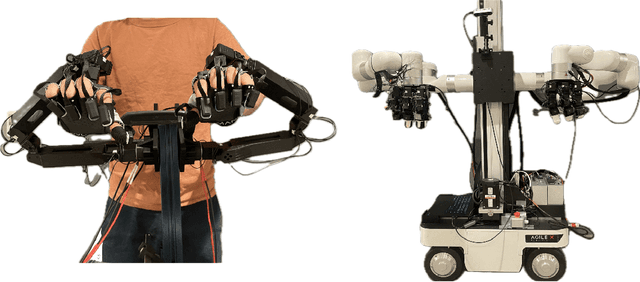

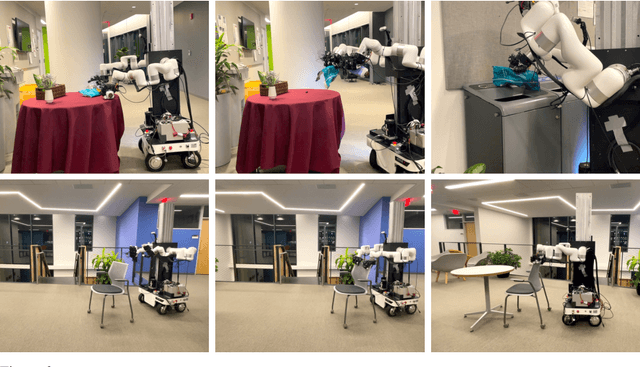
To train generalist robot policies, machine learning methods often require a substantial amount of expert human teleoperation data. An ideal robot for humans collecting data is one that closely mimics them: bimanual arms and dexterous hands. However, creating such a bimanual teleoperation system with over 50 DoF is a significant challenge. To address this, we introduce Bidex, an extremely dexterous, low-cost, low-latency and portable bimanual dexterous teleoperation system which relies on motion capture gloves and teacher arms. We compare Bidex to a Vision Pro teleoperation system and a SteamVR system and find Bidex to produce better quality data for more complex tasks at a faster rate. Additionally, we show Bidex operating a mobile bimanual robot for in the wild tasks. The robot hands (5k USD) and teleoperation system (7k USD) is readily reproducible and can be used on many robot arms including two xArms (16k USD). Website at https://bidex-teleop.github.io/
Structural modeling using overlapped group penalties for discovering predictive biomarkers for subgroup analysis
Apr 26, 2019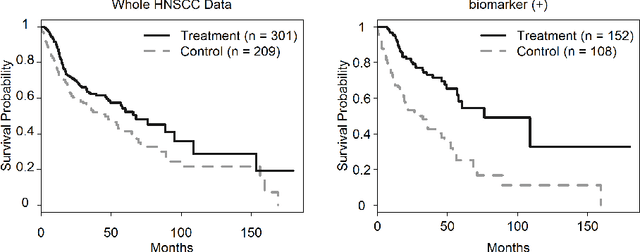
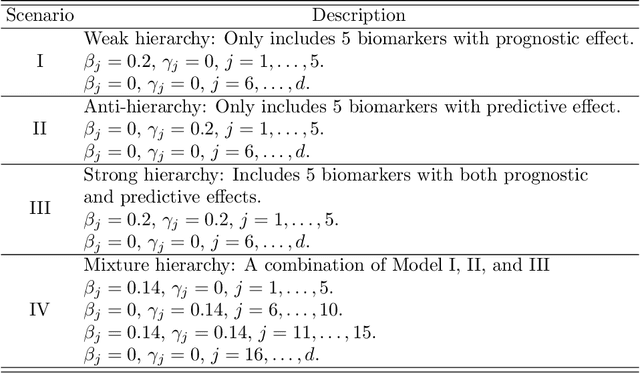
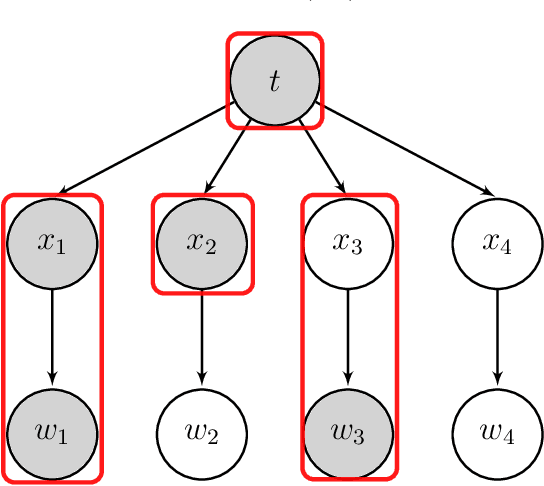
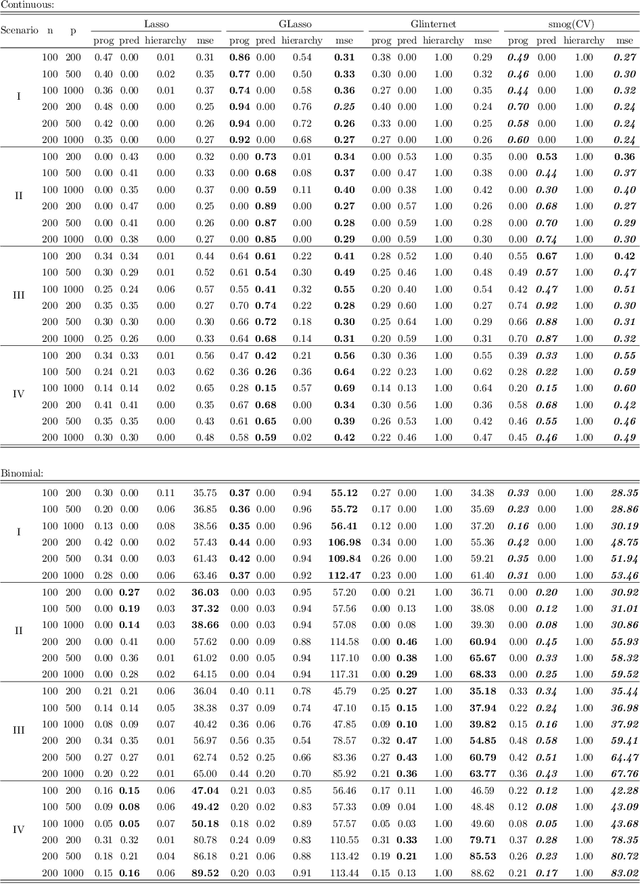
The identification of predictive biomarkers from a large scale of covariates for subgroup analysis has attracted fundamental attention in medical research. In this article, we propose a generalized penalized regression method with a novel penalty function, for enforcing the hierarchy structure between the prognostic and predictive effects, such that a nonzero predictive effect must induce its ancestor prognostic effects being nonzero in the model. Our method is able to select useful predictive biomarkers by yielding a sparse, interpretable, and predictable model for subgroup analysis, and can deal with different types of response variable such as continuous, categorical, and time-to-event data. We show that our method is asymptotically consistent under some regularized conditions. To minimize the generalized penalized regression model, we propose a novel integrative optimization algorithm by integrating the majorization-minimization and the alternating direction method of multipliers, which is named after \texttt{smog}. The enriched simulation study and real case study demonstrate that our method is very powerful for discovering the true predictive biomarkers and identifying subgroups of patients.