 Add to Chrome
 Add to Firefox
 Add to Edge
Deep Multitask Learning for Mixed-Type Outcomes with Shared Sparsity
Jul 01, 2026
Most existing multitask learning approaches are limited by their reliance on task-specific loss functions tailored to the scale and type of each outcome. When outcomes differ across tasks, these losses are generally not directly comparable, which makes it difficult to formulate a unified objective and may limit information sharing across tasks. We propose a multitask transformation framework in which task-specific responses may differ through unknown monotone transformations. Motivated by high-dimensional biological applications in which the predictor dimension may diverge with the sample size while only a common subset of predictors is informative, we consider shared sparsity across tasks. Under this framework, we estimate the target functions and identify important predictors by optimizing a smoothed rank-based criterion with a group-Lasso penalty, implemented through a multitask deep neural network with a shared first layer. We establish the nonasymptotic excess-risk bounds, and variable-selection consistency for the proposed estimator. Simulation studies show that the proposed method achieves competitive prediction and variable-selection performance compared with competing approaches. Analyses of gene-expression studies with continuous, binary, and mixed outcomes further illustrate that the proposed method improves prediction and identifies biologically meaningful shared predictors.

Sparse Bayesian Deep Functional Learning with Structured Region Selection
Feb 24, 2026In modern applications such as ECG monitoring, neuroimaging, wearable sensing, and industrial equipment diagnostics, complex and continuously structured data are ubiquitous, presenting both challenges and opportunities for functional data analysis. However, existing methods face a critical trade-off: conventional functional models are limited by linearity, whereas deep learning approaches lack interpretable region selection for sparse effects. To bridge these gaps, we propose a sparse Bayesian functional deep neural network (sBayFDNN). It learns adaptive functional embeddings through a deep Bayesian architecture to capture complex nonlinear relationships, while a structured prior enables interpretable, region-wise selection of influential domains with quantified uncertainty. Theoretically, we establish rigorous approximation error bounds, posterior consistency, and region selection consistency. These results provide the first theoretical guarantees for a Bayesian deep functional model, ensuring its reliability and statistical rigor. Empirically, comprehensive simulations and real-world studies confirm the effectiveness and superiority of sBayFDNN. Crucially, sBayFDNN excels in recognizing intricate dependencies for accurate predictions and more precisely identifies functionally meaningful regions, capabilities fundamentally beyond existing approaches.
Penalized Generative Variable Selection
Feb 26, 2024Deep networks are increasingly applied to a wide variety of data, including data with high-dimensional predictors. In such analysis, variable selection can be needed along with estimation/model building. Many of the existing deep network studies that incorporate variable selection have been limited to methodological and numerical developments. In this study, we consider modeling/estimation using the conditional Wasserstein Generative Adversarial networks. Group Lasso penalization is applied for variable selection, which may improve model estimation/prediction, interpretability, stability, etc. Significantly advancing from the existing literature, the analysis of censored survival data is also considered. We establish the convergence rate for variable selection while considering the approximation error, and obtain a more efficient distribution estimation. Simulations and the analysis of real experimental data demonstrate satisfactory practical utility of the proposed analysis.
Structural modeling using overlapped group penalties for discovering predictive biomarkers for subgroup analysis
Apr 26, 2019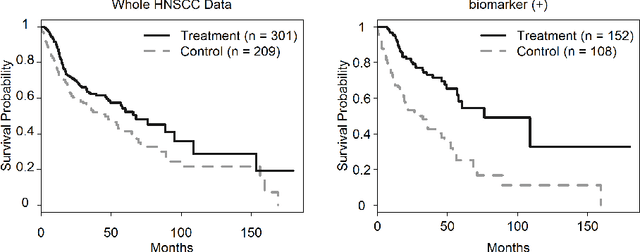
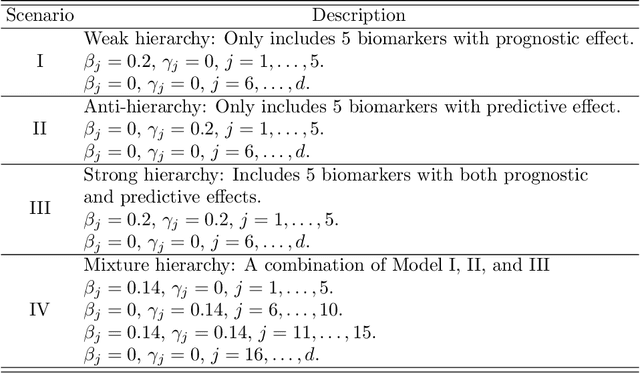
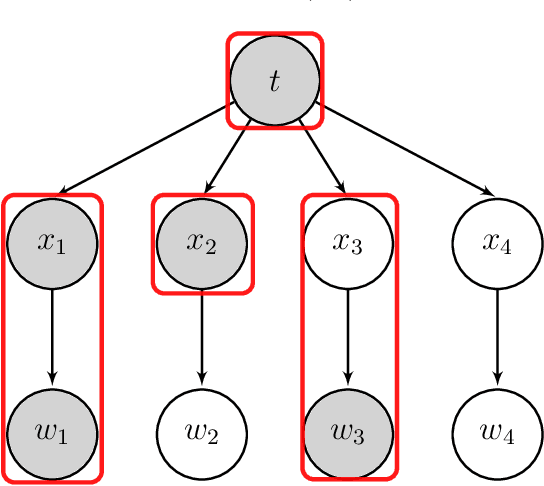
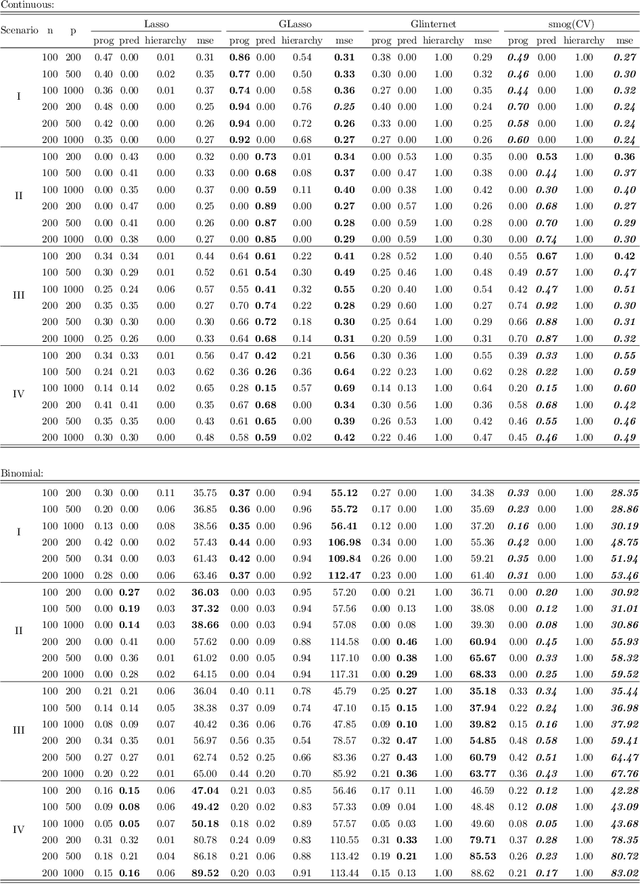
The identification of predictive biomarkers from a large scale of covariates for subgroup analysis has attracted fundamental attention in medical research. In this article, we propose a generalized penalized regression method with a novel penalty function, for enforcing the hierarchy structure between the prognostic and predictive effects, such that a nonzero predictive effect must induce its ancestor prognostic effects being nonzero in the model. Our method is able to select useful predictive biomarkers by yielding a sparse, interpretable, and predictable model for subgroup analysis, and can deal with different types of response variable such as continuous, categorical, and time-to-event data. We show that our method is asymptotically consistent under some regularized conditions. To minimize the generalized penalized regression model, we propose a novel integrative optimization algorithm by integrating the majorization-minimization and the alternating direction method of multipliers, which is named after \texttt{smog}. The enriched simulation study and real case study demonstrate that our method is very powerful for discovering the true predictive biomarkers and identifying subgroups of patients.