 Add to Chrome
 Add to Firefox
 Add to Edge
Speech Enhancement Based on Drifting Models
Apr 27, 2026
We propose Speech Enhancement based on Drifting Models (DriftSE), a novel generative framework that formulates denoising as an equilibrium problem. Rather than relying on iterative sampling, DriftSE natively achieves one-step inference by evolving the pushforward distribution of a mapping function to directly match the clean speech distribution. This evolution is driven by a Drifting Field, a learned correction vector that guides samples toward the high-density regions of the clean distribution, which naturally facilitates training on unpaired data by matching distributions rather than paired samples. We investigate the framework under two formulations: a direct mapping from the noisy observation, and a stochastic conditional generative model from a Gaussian prior. Experiments on the VoiceBank-DEMAND benchmark demonstrate that DriftSE achieves high-fidelity enhancement in a single step, outperforming multi-step diffusion baselines and establishing a new paradigm for speech enhancement.

Bandwidth-Scalable Fully Mask-Based Deep FCRN Acoustic Echo Cancellation and Postfiltering
May 09, 2022
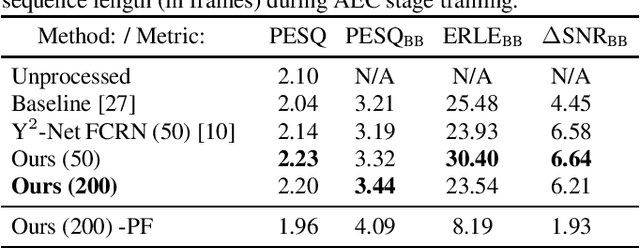
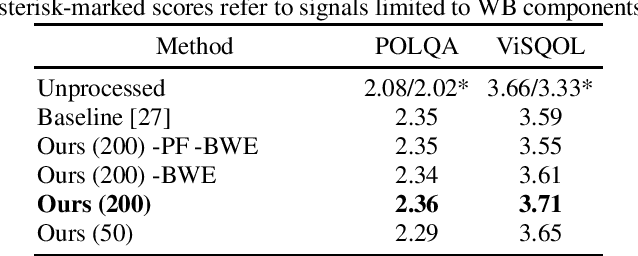
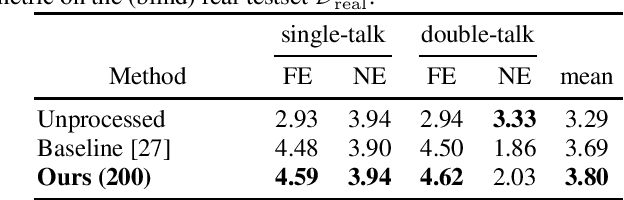
Although today's speech communication systems support various bandwidths from narrowband to super-wideband and beyond, state-of-the art DNN methods for acoustic echo cancellation (AEC) are lacking modularity and bandwidth scalability. Our proposed DNN model builds upon a fully convolutional recurrent network (FCRN) and introduces scalability over various bandwidths up to a fullband (FB) system (48 kHz sampling rate). This modular approach allows joint wideband (WB) pre-training of mask-based AEC and postfilter stages with dedicated losses, followed by a separate training of them on FB data. A third lightweight blind bandwidth extension stage is separately trained on FB data, flexibly allowing to extend the WB postfilter output towards higher bandwidths until reaching FB. Thereby, higher frequency noise and echo are reliably suppressed. On the ICASSP 2022 Acoustic Echo Cancellation Challenge blind test set we report a competitive performance, showing robustness even under highly delayed echo and dynamic echo path changes.