 Add to Chrome
 Add to Firefox
 Add to Edge
GroupAffect-4: A Multimodal Dataset of Four-Person Collaborative Interaction
May 19, 2026
Existing affective-computing, social-signal-processing, and meeting corpora capture important parts of human interaction, but they rarely support analysis of affect in co-located groups as a coupled individual, interpersonal, and group-level process. The required signals (per-participant physiology, eye movement, audio, self-report, task outcomes, and personality) are usually fragmented across separate dataset traditions. We introduce GroupAffect-4, a multimodal corpus of 40 participants in 10 four-person groups, each completing four ecologically varied collaborative tasks spanning information pooling, negotiation, idea generation, and a public-goods game. Each participant is instrumented with a wrist-worn physiology sensor, eye-tracking glasses, and a close-talk microphone; sessions include continuous affect self-reports, post-task questionnaires, task outcomes, and Big-Five personality scores, all time-aligned to a shared clock. The dataset covers over 91% of expected physiology windows and 98% of eye-tracking windows, with strong task validity confirmed by a clear affective manipulation check across the negotiation block. We define fifteen benchmarkable targets spanning three analysis levels -- within-person state, between-person traits, and group dynamics -- and report leave-one-group-out feasibility baselines establishing the dataset's evaluative scope. GroupAffect-4 is released with a BIDS-inspired structure, Croissant metadata, a datasheet, per-session quality reports, and open processing scripts. Code and processing scripts are available at https://github.com/meisamjam/GroupAffect-4; the dataset is publicly archived at https://zenodo.org/records/20037847.

Bandwidth-Scalable Fully Mask-Based Deep FCRN Acoustic Echo Cancellation and Postfiltering
May 09, 2022
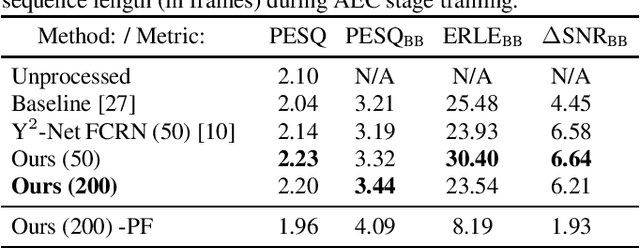
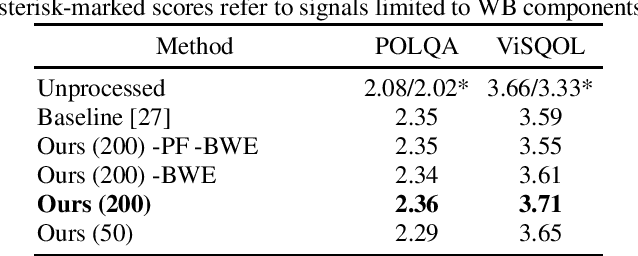
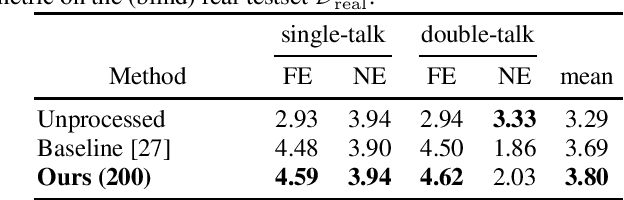
Although today's speech communication systems support various bandwidths from narrowband to super-wideband and beyond, state-of-the art DNN methods for acoustic echo cancellation (AEC) are lacking modularity and bandwidth scalability. Our proposed DNN model builds upon a fully convolutional recurrent network (FCRN) and introduces scalability over various bandwidths up to a fullband (FB) system (48 kHz sampling rate). This modular approach allows joint wideband (WB) pre-training of mask-based AEC and postfilter stages with dedicated losses, followed by a separate training of them on FB data. A third lightweight blind bandwidth extension stage is separately trained on FB data, flexibly allowing to extend the WB postfilter output towards higher bandwidths until reaching FB. Thereby, higher frequency noise and echo are reliably suppressed. On the ICASSP 2022 Acoustic Echo Cancellation Challenge blind test set we report a competitive performance, showing robustness even under highly delayed echo and dynamic echo path changes.