 Add to Chrome
 Add to Firefox
 Add to Edge
Speech Enhancement Based on Drifting Models
Apr 27, 2026
We propose Speech Enhancement based on Drifting Models (DriftSE), a novel generative framework that formulates denoising as an equilibrium problem. Rather than relying on iterative sampling, DriftSE natively achieves one-step inference by evolving the pushforward distribution of a mapping function to directly match the clean speech distribution. This evolution is driven by a Drifting Field, a learned correction vector that guides samples toward the high-density regions of the clean distribution, which naturally facilitates training on unpaired data by matching distributions rather than paired samples. We investigate the framework under two formulations: a direct mapping from the noisy observation, and a stochastic conditional generative model from a Gaussian prior. Experiments on the VoiceBank-DEMAND benchmark demonstrate that DriftSE achieves high-fidelity enhancement in a single step, outperforming multi-step diffusion baselines and establishing a new paradigm for speech enhancement.

Room impulse response reconstruction with physics-informed deep learning
Jan 02, 2024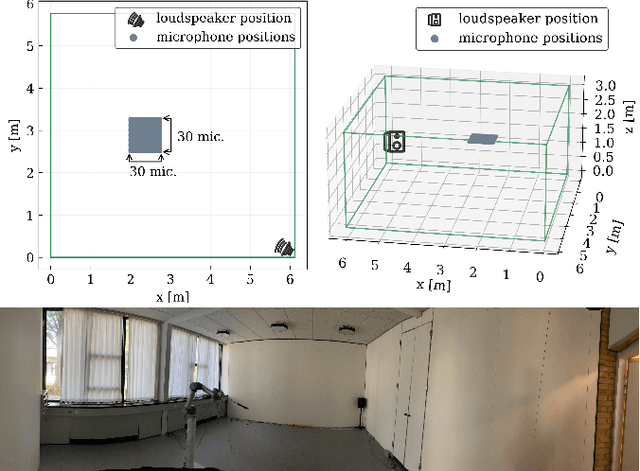
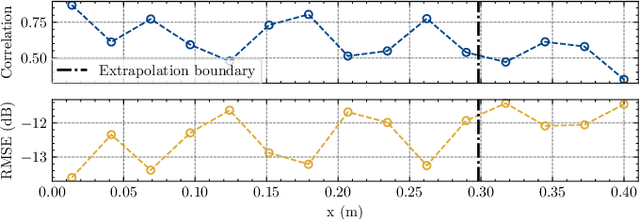
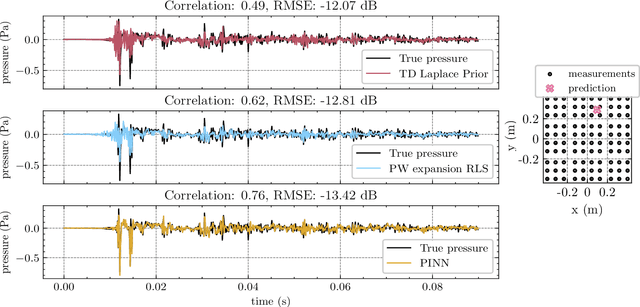
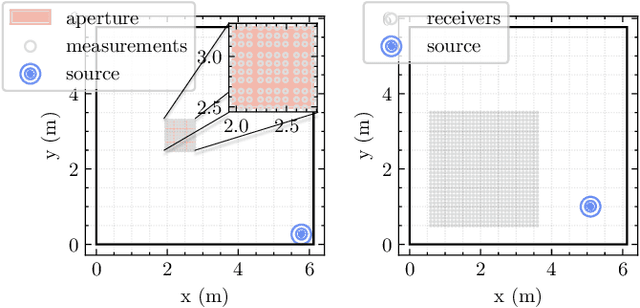
A method is presented for estimating and reconstructing the sound field within a room using physics-informed neural networks. By incorporating a limited set of experimental room impulse responses as training data, this approach combines neural network processing capabilities with the underlying physics of sound propagation, as articulated by the wave equation. The network's ability to estimate particle velocity and intensity, in addition to sound pressure, demonstrates its capacity to represent the flow of acoustic energy and completely characterise the sound field with only a few measurements. Additionally, an investigation into the potential of this network as a tool for improving acoustic simulations is conducted. This is due to its profficiency in offering grid-free sound field mappings with minimal inference time. Furthermore, a study is carried out which encompasses comparative analyses against current approaches for sound field reconstruction. Specifically, the proposed approach is evaluated against both data-driven techniques and elementary wave-based regression methods. The results demonstrate that the physics-informed neural network stands out when reconstructing the early part of the room impulse response, while simultaneously allowing for complete sound field characterisation in the time domain.