 Add to Chrome
 Add to Firefox
 Add to Edge
Speech Enhancement Based on Drifting Models
Apr 27, 2026
We propose Speech Enhancement based on Drifting Models (DriftSE), a novel generative framework that formulates denoising as an equilibrium problem. Rather than relying on iterative sampling, DriftSE natively achieves one-step inference by evolving the pushforward distribution of a mapping function to directly match the clean speech distribution. This evolution is driven by a Drifting Field, a learned correction vector that guides samples toward the high-density regions of the clean distribution, which naturally facilitates training on unpaired data by matching distributions rather than paired samples. We investigate the framework under two formulations: a direct mapping from the noisy observation, and a stochastic conditional generative model from a Gaussian prior. Experiments on the VoiceBank-DEMAND benchmark demonstrate that DriftSE achieves high-fidelity enhancement in a single step, outperforming multi-step diffusion baselines and establishing a new paradigm for speech enhancement.

Zero-Shot Mono-to-Binaural Speech Synthesis
Dec 11, 2024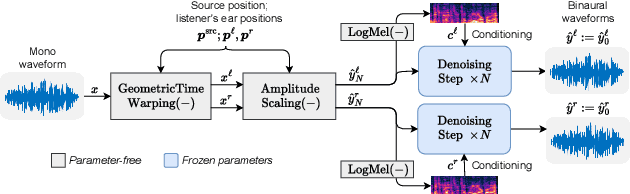
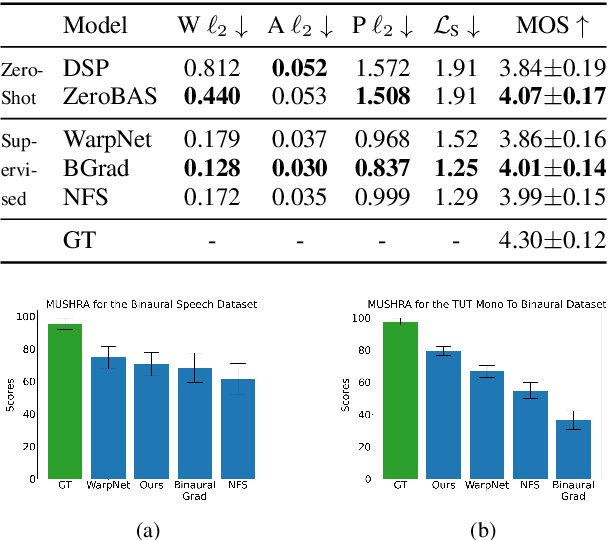
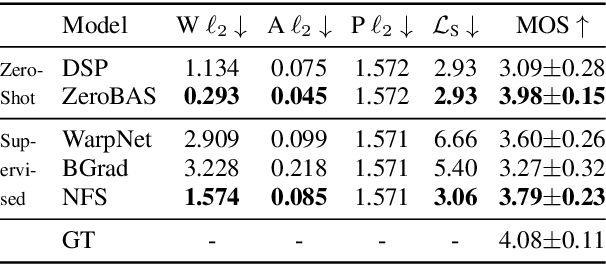

We present ZeroBAS, a neural method to synthesize binaural audio from monaural audio recordings and positional information without training on any binaural data. To our knowledge, this is the first published zero-shot neural approach to mono-to-binaural audio synthesis. Specifically, we show that a parameter-free geometric time warping and amplitude scaling based on source location suffices to get an initial binaural synthesis that can be refined by iteratively applying a pretrained denoising vocoder. Furthermore, we find this leads to generalization across room conditions, which we measure by introducing a new dataset, TUT Mono-to-Binaural, to evaluate state-of-the-art monaural-to-binaural synthesis methods on unseen conditions. Our zero-shot method is perceptually on-par with the performance of supervised methods on the standard mono-to-binaural dataset, and even surpasses them on our out-of-distribution TUT Mono-to-Binaural dataset. Our results highlight the potential of pretrained generative audio models and zero-shot learning to unlock robust binaural audio synthesis.